
Last letters from the living dead man
David Patterson (Spirit) Hatch
THE CLASSIC COLLECTION · 1916
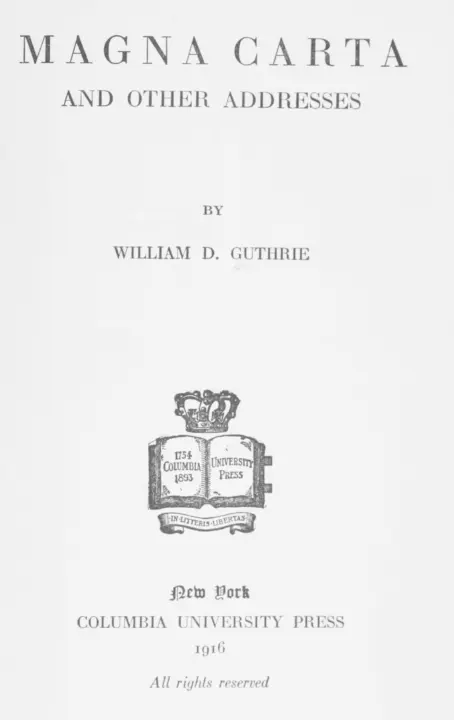
"Magna Carta and Other Addresses" by William D. Guthrie is a collection of historical and legal addresses written in the early 20th century. The work primarily focuses on foundational documents of American democracy, such as the Magna Carta and the Mayflower Compact, examining their influences on civil liberties and constitutional principles in the United States. The addresses reflect on the significance of these historic milestones in the context of contemporary governance and law. The opening of the book begins with an address commemorating the 700th anniversary of the Magna Carta, delivered at a New York Constitutional Convention. Guthrie highlights the Great Charter's profound legacy in safeguarding individual liberties and establishing the rule of law against tyranny. He discusses how the Magna Carta provided essential principles regarding governance and justice which resonate through subsequent American constitutional developments. The address emphasizes the importance of these historical documents in nurturing a commitment to civil rights, alongside a cautionary note on the need for vigilance in preserving these hard-won freedoms in the face of contemporary legal challenges.
Introduction adapted from the source catalogue; source summaries may be automatically generated.
Free to read · English · 71,269 words · No account needed
MAKE TIME FOR A GOOD BOOK
On by default. Untick to stop anonymous reading totals. Each page counts after 10 seconds in view. How this works.
Anonymous counting is on unless you have switched it off.
Elections, primary elections a menace, 39, 142, 227-228, 231-236,
238, 245-246;
presidential, 178 sqq.;
nomination of candidates, 207, 219-246;
vote on constitutional amendments, 208-209;
effect of the short ballot, 222-224;
secret ballot objectionable, 228;
some New York statistics, 231-233;
origin of primaries, 239-240;
to judicial office, 243-245.
See Conventions.
Electorate, responsible for political evils, 205-206, 245; voting a duty, 206, 238, 245; indifference and negligence of, 207, 208, 209, 230-232, 237, 240; remedy for corruption, 237-238.
Eleventh amendment, main treatment, 87-129;
text, 91;
possibly qualified, 97, 110.
Employers' Liability cases, 61-64, 67-68, 121.
English church, its part in Magna Carta, 3, 4, 11, 12; freed from the crown by Magna Carta, 11, 12.
England, political thought in the 13th and 14th centuries, 6-9, 18-19;
taxation, 9, 16-18;
courts, 10, 17, 76, 77, 103-107;
class legislation, 11;
acts of Supremacy and Uniformity, 32, 36-37;
debt to Puritanism, 34-35;
in the World War, 35, 261, 267-270;
labor legislation, 79;
protective tariff, 196;
cost of living, 199, 200;
board of trade, 200;
union of legislative and executive powers, 227-228;
state aid to parochial schools, 256.
See English church and Parliament.
Entick vs. Carrington, 104.
Equality before the law, 31, 35, 152, 161.
Europe, political ideas in the 13th century, 6;
in 1620, 35;
the great war, 35, 41, 267 sqq.;
source of legislative schemes, 76;
industrial competition with the United States, 196-197;
high cost of living, 200.
Executive, and legislative power in England, 17; power limited by Magna Carta, 24-25; increase in power threatens despotism, 44, 223-224; shifting responsibility to the courts, 47; duty to uphold the Constitution, 171-172; sentiment against a third term, 186-188; now most powerful branch of the government, 220; should not exercise the lawmaking power, 227; control of foreign relations, 269.
Feather vs. The Queen, 104.
Federalist, quoted on judicial power, 71-72, 109.
Fifteenth amendment, 83, 110.
Fifth amendment, 19, 68.
Fitts vs. McGhee, 118.
Fitzwater vs. Warren, 138.
Five Knights case, 15.
Fourteenth amendment, 24, 36, 68, 110, 111, 169.
France, early charters of liberties, 5;
les lois fondamentales, 7;
legislative and executive powers, 76, 77, 227-228;
forced loans, 164;
French Revolution, 164;
cost of living, 200;
friendly relations with America, 261-266;
in the World War, 261, 262-266;
aid to American revolutionists, 262-264;
treaty of alliance with America of 1778, 265.
France-America Committee, 261.
Fuller, Chief Justice, 46, 173.
Fundamental laws, idea revived by Magna Carta, 6-7;
in Greece and Rome, 6;
in France, 7;
a controlling principle of American constitutions, 8, 73;
idea abandoned in England, 9;
theory may yet be applied by English courts, 11.
See Constitutions.
Gaynor, William J., 54, 55, 57.
Georgia, 89, 90, 95.
Glen Cove parochial school, 247, 259.
Government, origin and importance of separation of powers, 4, 13, 16, 17, 18, 227; depends more upon men than upon laws, 28, 206, 221; governmental powers derived from the consent of the governed, 30; government by the legislature preferable to government by the judiciary, 45, 46; the form may survive the substance, 46; constant extension of governmental functions, 74, 80, 120, 220; the American government different from others, 76, 161, 227; trend toward centralization in America, 176; local self-government essential, 177; need of trained experts, 220-221. See Congress, Constitutional government, Democracy, Executive, Judiciary, Legislature, Minorities, Majorities, Representative government, and State governments.
Your reading position is saved on this browser. Take it to another device with a library code. Reading pages adapt to text, rather than matching a printed edition.
BEHIND THE BOOK
This eBook is for the use of anyone anywhere in the United States and most other parts of the world at no cost and with almost no restrictions whatsoever. You may copy it, give it away or re-use it under the terms of the Project Gutenberg License included with this eBook or online at www.gutenberg.org. If you are not located in the United States, you will have to check the laws of the country where you are located before using this eBook. Read the source licence.
The original source file, including credits and licence, is retained by this library. Request an original-format copy at no charge. Please include the book title and Project Gutenberg identifier #64197.
KEEP YOUR CURIOSITY GOING
David Patterson (Spirit) Hatch

David Patterson (Spirit) Hatch

David Patterson (Spirit) Hatch
Cécile Tormay

Moritz Busch
John L. Ransom