
Last letters from the living dead man
David Patterson (Spirit) Hatch
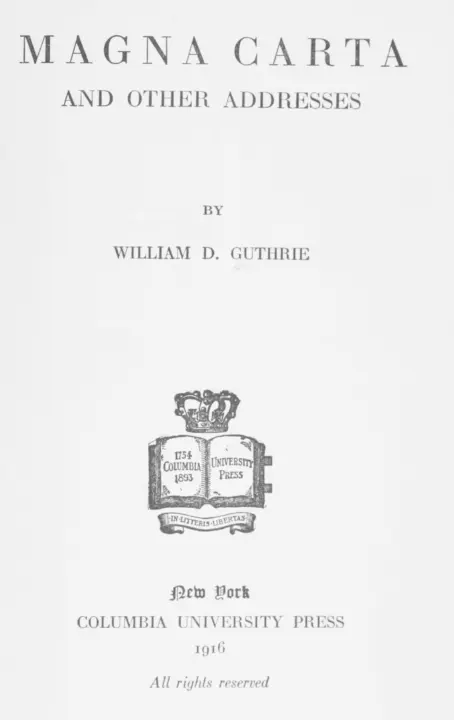
THE CLASSIC COLLECTION · 1916
"Magna Carta and Other Addresses" by William D. Guthrie is a collection of historical and legal addresses written in the early 20th century. The work primarily focuses on foundational documents of American democracy, such as the Magna Carta and the Mayflower Compact, examining their influences on civil liberties and constitutional principles in the United States. The addresses reflect on the significance of these historic milestones in the context of contemporary governance and law. The opening of the book begins with an address commemorating the 700th anniversary of the Magna Carta, delivered at a New York Constitutional Convention. Guthrie highlights the Great Charter's profound legacy in safeguarding individual liberties and establishing the rule of law against tyranny. He discusses how the Magna Carta provided essential principles regarding governance and justice which resonate through subsequent American constitutional developments. The address emphasizes the importance of these historical documents in nurturing a commitment to civil rights, alongside a cautionary note on the need for vigilance in preserving these hard-won freedoms in the face of contemporary legal challenges.
Introduction adapted from the source catalogue; source summaries may be automatically generated.
Free to read · English · 71,269 words · No account needed
MAKE TIME FOR A GOOD BOOK
On by default. Untick to stop anonymous reading totals. Each page counts after 10 seconds in view. How this works.
Anonymous counting is on unless you have switched it off.
Constitutional limitations, idea in Magna Carta, 6-7;
recognized in statute of 42 Edward III., 7, 8;
common to every American constitution, 8, 73;
not imposed upon parliament, 9-11, 76-77, 107;
their enforcement left to the courts, 25, 45, 47, 70 sqq., 87, 109,
113, 127;
growing impatience with, 42, 43, 48, 124, 202;
could be nullified if judges followed the prevailing
morality, 45, 46;
enforcement by the courts necessary, 70 sqq.;
binding upon Congress, 74-75, 171-172;
Elihu Root on, 75;
make possible constitutional morality, 86;
to be observed by the President, 171-172.
See Constitutions, Due process of law, Constitutional morality,
Judiciary, and Fundamental laws.
Constitutional morality, a condition of permanent free
government, 26, 42;
discussed generally, 42-86;
growing tendency to disregard, 42;
its disregard caused the overthrow of Grecian democracy, 42;
its essence is self-imposed restraint, 42;
its necessity should be taught, 48, 85-86.
Conventions, Constitutional, their duty to secure the privileges
of Magna Carta, 2;
the first American, 29-30, 37;
Ohio convention of 1912, 61, 64;
the federal convention of 1787, 89, 256;
in New York, 154, 186, 235, 257.
Conventions, Nominating, discussed generally, 219-246;
right to, should be guaranteed by the Constitution, 220, 225;
their origin, 229;
abuses of, 229, 237;
movement to abolish, 230, 239-240;
their merits and advantages, 236-237, 242-246.
Cotting vs. Kansas City Stock Yards Co., 123.
Courts, see Judiciary.
Coxey's Army, 181, 199.
Criminal Procedure, delays in, 126, 143-146.
Cromwell, Oliver, 34-35.
Crown, power limited by Magna Carta, 11, 12, 24-25; former exercise of legislative power, 17; maxim that "the king can do no wrong," 98, 102, 105, 108, 114; sued under the Petition of Right, 99-102; not suable in tort, 102.
Cullen, Chief Judge, 80, 139, 210.
Davis vs. Gray, 115.
Day in court, 13, 121, 150.
Debs case, 148-151, 212, 215-216.
Declaration of Independence, proclaimed the inalienable rights of the
individual, 4, 81;
relation to the Mayflower Compact, 30;
its spirit perpetuated, 76;
marked human progress towards liberty, 203;
its truths eternal, 203.
Demagogue, his plea that the people are infallible, 43;
his well-known arts, 192.
Democracy, the fallacies of absolute, 39-40, 43, 165;
in Plymouth colony, 39;
historical failures, 42, 75, 205.
Democratic party, principles and recent campaigns, 178 sqq.;
tariff legislation, 195-198;
on use of injunctions, 213-214.
Despotism, equal laws a feature of, 36; will result from increasing power of the executive, 44.
Dicey, A.V., 15, 103.
Dies parentales, 27.
Due course of law, in New York bill of rights of 1787, 23.
Due process of law, universal application in the United States, 18; equivalent of "law of the land" (q.v.), 18; substance of expression in Magna Carta, 18; history of expression in America, 18-19, 23-24; meaning, 19, 22-24; earliest use, 22-23; term meaningless to man in the street, 48; principle applied in the Tenement House case, 54; in the Ives case and Employers' Liability cases, 65, 68.
Education, Catholic parochial schools, 247-260;
primary and elementary, 253;
the Catholic university, 255;
public grants to private schools, 256, 257.
Edward I., 100.
Edward III., 7, 8, 11, 22, 23.
Edward the Confessor, 7.
Egyptians, 27, 168.
Election Law (New York), 209, 219.
Your reading position is saved on this browser. Take it to another device with a library code. Reading pages adapt to text, rather than matching a printed edition.
BEHIND THE BOOK
This eBook is for the use of anyone anywhere in the United States and most other parts of the world at no cost and with almost no restrictions whatsoever. You may copy it, give it away or re-use it under the terms of the Project Gutenberg License included with this eBook or online at www.gutenberg.org. If you are not located in the United States, you will have to check the laws of the country where you are located before using this eBook. Read the source licence.
The original source file, including credits and licence, is retained by this library. Request an original-format copy at no charge. Please include the book title and Project Gutenberg identifier #64197.
KEEP YOUR CURIOSITY GOING
David Patterson (Spirit) Hatch

David Patterson (Spirit) Hatch

David Patterson (Spirit) Hatch
Cécile Tormay

Moritz Busch
John L. Ransom