
Last letters from the living dead man
David Patterson (Spirit) Hatch
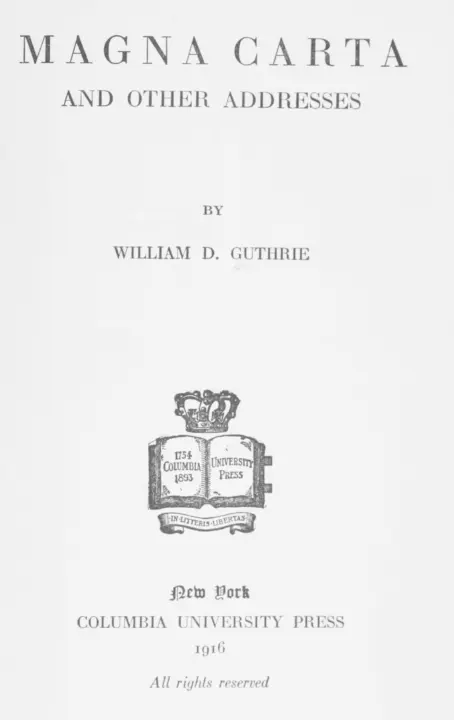
THE CLASSIC COLLECTION · 1916
"Magna Carta and Other Addresses" by William D. Guthrie is a collection of historical and legal addresses written in the early 20th century. The work primarily focuses on foundational documents of American democracy, such as the Magna Carta and the Mayflower Compact, examining their influences on civil liberties and constitutional principles in the United States. The addresses reflect on the significance of these historic milestones in the context of contemporary governance and law. The opening of the book begins with an address commemorating the 700th anniversary of the Magna Carta, delivered at a New York Constitutional Convention. Guthrie highlights the Great Charter's profound legacy in safeguarding individual liberties and establishing the rule of law against tyranny. He discusses how the Magna Carta provided essential principles regarding governance and justice which resonate through subsequent American constitutional developments. The address emphasizes the importance of these historical documents in nurturing a commitment to civil rights, alongside a cautionary note on the need for vigilance in preserving these hard-won freedoms in the face of contemporary legal challenges.
Introduction adapted from the source catalogue; source summaries may be automatically generated.
Free to read · English · 71,269 words · No account needed
MAKE TIME FOR A GOOD BOOK
On by default. Untick to stop anonymous reading totals. Each page counts after 10 seconds in view. How this works.
Anonymous counting is on unless you have switched it off.
Bar, should defend the courts against criticism, 70, 127, 147, 158; duty to defend constitutional guaranties, 85, 86; efforts to secure proper judicial nominations, 139-141; professional responsibility, 142-143.
Barons, Articles of the, 5.
Bate's case, 17.
Belgium, 261, 262, 267, 270.
Bill of Rights, New York statute of 1787, 19, 23; permanent nature, 20, 21, 203; the federal bill of rights, 74, 83; must be enforced by the courts, 77-78; ineffective where legislative power is supreme, 77-78. See Constitutions and Constitutional limitations.
Blackstone, Sir William, 99, 168.
Bonham's case, 10.
Bosses, Political, their power increased by direct primaries, 142,
236, 238;
efforts to overthrow them, 230-231, 245;
Woodrow Wilson on, 242.
Bracton, Henry de, 102.
Bradford, William, 30n, 38-39.
Bryan, William J., 180-182, 213-215.
Bryce, Viscount, 69, 251.
Carlisle vs. United States, 101.
Charter, see Constitutions and Magna Carta.
Chisholm vs. Georgia, 89, 95.
Church and State, Separation of, germ of idea in Magna Carta, 11, 12;
an American political principle, 12;
opposed by Puritans, 32, 33;
accomplished by the Pilgrims, 32, 34.
Clark vs. Barnard, 96.
Class legislation, may lead England to restrain temporary
majorities, 11;
masking as social reform, 43;
dangers of, 74, 79, 85, 124;
New York tenement law of 1884, 85;
involved in graduated taxation, 165, 166.
Cleveland, Grover, 149, 151, 216.
Cohens vs. Virginia, 93.
Coke, Sir Edward, 23, 105.
Common law, silent as to the equal protection of the laws, 36; may be changed by the legislature, 68-69, 134-138, 155; the birthright of Americans, 98; soundness of common-law rules, 132-134.
Commune consilium, antecedent of parliament, 16;
power to impose taxes, 16.
Communism, a conceit of Plato's, 38;
failure of the experiment in Plymouth colony, 37-39;
in the colony of Virginia, 38.
Congress, decay through increase of executive power, 44; power to regulate interstate commerce, 61; cannot regulate internal affairs of the several states, 61; acts of, 61, 62, 68, 100, 121, 126; limitations upon, 74, 78, 81, 169-171; proposes amendments to the Constitution, 74, 89; attempts to curtail the federal courts, 88, 125; duty to enforce constitutional amendments, 110; duty to uphold the Constitution, 171-172; protection of American industries and wages, 193-197; dissatisfaction with, 205-206.
Consolidated Gas Co. case, 122.
Cooley, Thomas M., 90, 161-162.
Constitutions, principles rooted in Magna Carta, 1; intended to endure forever, 20, 21, 203; unwise to create political body to enforce, 25; may be deprived of practical force by failure to observe constitutional restraints, 46, 75; explanation would dispel prejudice against the courts, 48; nature and purpose to declare general principles, 52; a rule of interpretation, 154-155; antiquated in the view of modern iconoclasts, 202; small vote on amendments, 208-209; should deal only with fundamentals, 224, 225. See Magna Carta and Mayflower Compact.
Constitution, Federal, sources of, 1, 31, 98;
enforced by the courts, 25, 42 sqq., 70 sqq., 87 sqq., 109 sqq.;
supremacy of, 71 sqq., 87, 111, 113;
considered and ratified, 74, 88, 89;
easily amended, 82-85, 89, 91-92, 175, 176, 208;
necessity for deliberation in amending, 84-85, 176-177;
rule for construing, 97-98;
oath to support, 171-172;
attempts to circumvent, 175;
embodies eternal truths, 203.
See Constitutional limitations.
Constitutional government, depends upon constitutional morality, 26; its debt to the Pilgrims, 29, 32, 35; characterized by equality before the law, 35.
Your reading position is saved on this browser. Take it to another device with a library code. Reading pages adapt to text, rather than matching a printed edition.
BEHIND THE BOOK
This eBook is for the use of anyone anywhere in the United States and most other parts of the world at no cost and with almost no restrictions whatsoever. You may copy it, give it away or re-use it under the terms of the Project Gutenberg License included with this eBook or online at www.gutenberg.org. If you are not located in the United States, you will have to check the laws of the country where you are located before using this eBook. Read the source licence.
The original source file, including credits and licence, is retained by this library. Request an original-format copy at no charge. Please include the book title and Project Gutenberg identifier #64197.
KEEP YOUR CURIOSITY GOING
David Patterson (Spirit) Hatch

David Patterson (Spirit) Hatch

David Patterson (Spirit) Hatch
Cécile Tormay

Moritz Busch
John L. Ransom