THE CLASSIC COLLECTION✦An outlaw’s diary: the CommuneCLASSIC FREE BOOKS
An outlaw’s diary: the Commune
Cécile Tormay
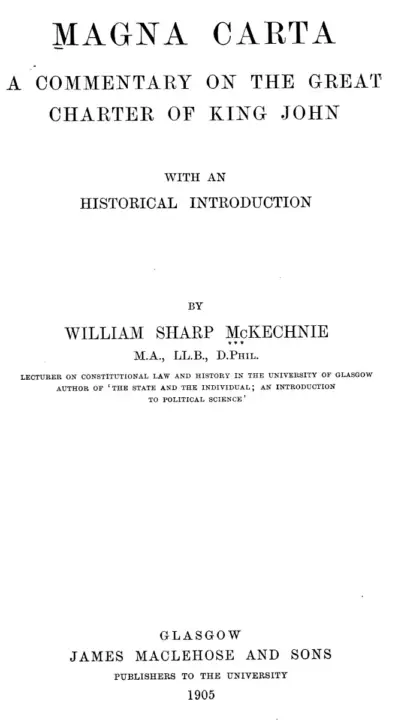
THE CLASSIC COLLECTION · 1905
"Magna Carta: A Commentary on the Great Charter of King John" by William Sharp McKechnie is a historical account written in the early 20th century. This work delves into the significance and implications of the Magna Carta, focusing on its historical context and its role in the development of constitutional freedoms in England. The book aims to provide a fresh commentary on this pivotal document, critiquing earlier interpretations and emphasizing its relevance to the struggles for liberty. The opening of the commentary highlights that no significant modern analysis of Magna Carta has been published until now, despite the profound impact of the Great Charter on English constitutional history. McKechnie discusses the motivations behind his work, emphasizing the necessity of examining the various grievances that led to its creation and outlining the events that unfolded in the lead-up to its signing. He argues that the Magna Carta is deserving of detailed study due to its complexities and the wealth of knowledge in contemporary scholarship, setting the stage for a thorough exploration of its chapters and clauses in the remaining text.
Introduction adapted from the source catalogue; source summaries may be automatically generated.
Free to read · English · 212,300 words · No account needed
MAKE TIME FOR A GOOD BOOK
On by default. Untick to stop anonymous reading totals. Each page counts after 10 seconds in view. How this works.
Anonymous counting is on unless you have switched it off.
Magna Carta. (See Charter.)
Maitland, Prof. F. W., 95 n., 98 n., 128 n, 144 n., 153 n., 207, 362
n., 456.
Manors, 10, 71, 141, 342, 352 n., 393;
on royal demesne, 372, 376.
Manorial courts, 10, 93, 96, 106.
(See also Courts and Jurisdictions.)
Marriage, feudal incident of, 66, 68, 69, 77-8, 250-3, 260-1.
Maritagium, 254-7, 531.
Marshal (William, earl Marshal), 39, 44, 215, 216, 507, 559; a mediator between King and barons, 39, 40, 43, 559; acts as Regent, 164, 165, 170, 171, 180, 184, 201, 299.
Matilda (daughter of Henry I.), 12-13, 118, 162.
Mayor of London, 288, 289, 290, 551.
Medley (Prof. D. J.), 295 n., 296, 327 n., 564 n.
Mercenaries, 15, 30, 39, 165, 166, 261, 391, 522-3.
Merchants, 61, 63, 140, 145, 334, 340-1, 402, 415, 416, 440, 463-73,
474.
Ministerial responsibility, 25, 150, 188, 192, 298, 505.
Minorities (Rights of), 299-300.
Mirror of Justices, 207, 357 n., 431 n., 434.
Monarchy, two types of, 5.
Monarchy (English), 60, 409;
growth of, 4, 6, 12, 13, 15, 18, 20;
strength of, 7, 12, 15, 16, 24, 59;
weakness of, under Anglo-Saxons, 16, 20;
functions of, 94, 97.
Monopolies, 140, 156, 445-6, 469, 470-5.
Montfort (Simon de), 188, 189.
Moore, Stuart A. and H. S., 358, 403 n.
Mort d’ancestor, 317, 324, 333 n., 426.
Municipalities. (See Boroughs.)
Nationality (conception of), 149, 156.
National unity in England, growth of, 6, 149;
forces opposed to, 7.
Neilson, George, 321 n., 527 n., 528 n.
Nicholas (Papal legate), 36, 227, 365.
Norgate, Miss Kate, 36, 49 n., 50 n., 58 n., 90 n., 92 n., 212, 288,
374 n., 559.
Norman Conquest, 5, 9, 20, 71, 105, 115, 158, 321, 366, 484.
Norman period and rule, characteristics of 5, 7.
Novel disseisin. (See Disseisin.)
Oligarchic elements in England, 5.
Ordeal, 74, 102, 103, 104, 161, 399, 415, 430-3, 528-9.
Original writs. (See Writs.)
Outlaws, 74, 446, 473-4.
Parliament, 150, 173, 185-6, 188, 190, 294, 557;
rights of, 81;
functions of, 174, 190-1, 298;
composition of, 190.
Parliamentary taxation. (See Taxation.)
Parliamentary Representation. (See Representation.)
Palatine earldoms. (See Earls.)
Pandulf (Papal legate), 31, 54, 561.
Papal Bull, annulling Charter, 55.
Papal Curia, 28.
Papal interference in England, 21, 28, 32, 54, 56, 182, 227.
Papal legates. (See Gualo, Nicholas, Pandulf.)
Paris, Matthew, 32, 53, 58, 181, 293 n., 300-1, 453, 543 n., 550, 559,
561 n.
Parks, 247, 492.
Peasantry. (See Villeins.)
Peers, 103, 152, 216 n., 346-9.
Peers (Judgment of), 158 n., 346, 436, 438-40, 449-50 n. , 452-6, 523.
Peter des Roches (Bishop of Winchester), 36-7, 51, 54, 58, 180, 183,
215, 300, 452, 503.
Peter of Wakefield, 30.
Petition of Barons (1258), 232 n., 252, 333 n., 430, 481, 507.
Petty Assize. (See Assize.)
Petty Jury. (See Jury.)
Petty Serjeanty. (See Serjeanty.)
Philip (King of France), 31, 33, 37, 56, 470.
Pike, L. O., 152 n., 295 n., 313, 347, 348 n., 442 n., 444 n., 449-50
n., 456, 457 n.
Pipe Rolls, 11.
Pleas. (See Common pleas.)
Pleas of the Crown, 107, 109, 111, 112, 310, 314-5, 359-363, 370-1,
398;
in Scots law, 360.
Pleas of the forest, 368.
Pollock, Sir Frederic, 310.
Pope, 61, 79 n., 164, 167 n., 227.
(See Papal, also Honorius and Innocent.)
Presentment (darrein), 176-7, 225, 317, 325, 326, 333.
Primer seisin, 78-9, 248, 254.
Privy Council, 191.
Procedure (legal), 14, 99-112;
Henry II.’s reforms, 14, 106-112.
Proof (in medieval law), 102-3;
(See also Trial.)
Protests by the prelates in John’s favour, 52, 560-1;
text of, 579.
Prothero, G. W., 85 n., 117 n., 125 n., 131-2, 139-140, 149 n., 154 n., 175 n., 203, 212 n., 228 n., 448.
Provisions of Oxford (1258), 187, 504.
Purprestures, 495.
Purveyance, 142, 369, 386-90, 392-4.
Quarantine (Widow’s), 258.
Queen’s gold, 232.
Ramsay, Sir James, 92 n., 212, 225 n., 243 n., 375 n., 394 n.
Recognitio (principle of), 34, 105-6, 159, 160, 162, 323, 325, 512.
Reeves, John, 209-210, 257, 340 n., 447 n., 450.
Regarders, 484, 490, 491.
Regency, 164, 169.
Relief (feudal incident of), 68, 69, 73, 117, 179, 239-241, 249, 276
n.;
not due from bishop-elect, 117, 238-9;
not due after wardship, 239;
definition of sums due, 230-3.
Representation, principle of, 25, 34, 36, 160, 190, 192, 297-8;
parliamentary, 292, 297-8.
Responsibility. (See Ministerial.)
Restoration (The), 66, 67, 248, 387, 502.
Richard I., 24-6, 63, 81, 89, 148, 231, 286, 539;
lessons of his reign, 25-6.
Richard II., 473.
Roches (Peter des). (See Peter.)
Roger, bishop of Salisbury, 11, 119.
Roger of Hoveden. (See Hoveden.)
Roger of Wendover. (See Wendover.)
Rolls. (See Pipe Rolls.)
Your reading position is saved on this browser. Take it to another device with a library code. Reading pages adapt to text, rather than matching a printed edition.
BEHIND THE BOOK
This eBook is for the use of anyone anywhere in the United States and most other parts of the world at no cost and with almost no restrictions whatsoever. You may copy it, give it away or re-use it under the terms of the Project Gutenberg License included with this eBook or online at www.gutenberg.org. If you are not located in the United States, you will have to check the laws of the country where you are located before using this eBook. Read the source licence.
The original source file, including credits and licence, is retained by this library. Request an original-format copy at no charge. Please include the book title and Project Gutenberg identifier #65363.
KEEP YOUR CURIOSITY GOING
Cécile Tormay

Moritz Busch
John L. Ransom
Frances Wright
Cécile Tormay

Mabel Potter Daggett