THE CLASSIC COLLECTION✦An outlaw’s diary: the CommuneCLASSIC FREE BOOKS
An outlaw’s diary: the Commune
Cécile Tormay
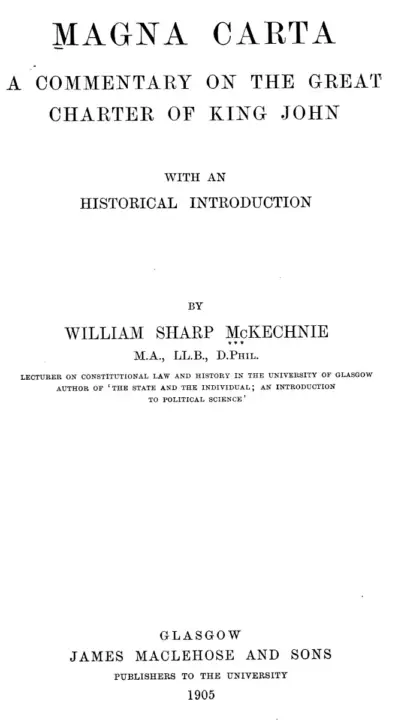
THE CLASSIC COLLECTION · 1905
"Magna Carta: A Commentary on the Great Charter of King John" by William Sharp McKechnie is a historical account written in the early 20th century. This work delves into the significance and implications of the Magna Carta, focusing on its historical context and its role in the development of constitutional freedoms in England. The book aims to provide a fresh commentary on this pivotal document, critiquing earlier interpretations and emphasizing its relevance to the struggles for liberty. The opening of the commentary highlights that no significant modern analysis of Magna Carta has been published until now, despite the profound impact of the Great Charter on English constitutional history. McKechnie discusses the motivations behind his work, emphasizing the necessity of examining the various grievances that led to its creation and outlining the events that unfolded in the lead-up to its signing. He argues that the Magna Carta is deserving of detailed study due to its complexities and the wealth of knowledge in contemporary scholarship, setting the stage for a thorough exploration of its chapters and clauses in the remaining text.
Introduction adapted from the source catalogue; source summaries may be automatically generated.
Free to read · English · 212,300 words · No account needed
MAKE TIME FOR A GOOD BOOK
On by default. Untick to stop anonymous reading totals. Each page counts after 10 seconds in view. How this works.
Anonymous counting is on unless you have switched it off.
Charter, Henry III.’s second reissue (1217), 142, 151, 388, 391, 392,
410 n., 514, 545;
its omissions, 151, 175, 382 n.;
its additions, 142, 172-179, 355-6, 391, 432-3, 444, 448, 480, 506,
545;
its reactionary side, 173-4, 177;
on widows’ rights, 255, 258, 382 n.;
on scutages, 172-3, 276, 283-4, 300;
on petty assizes, 326, 327, 327-8, 333;
on villeins, 343, 448, 449 n.;
on clergy, 351;
text of, 580.
Charter, Henry III.’s third reissue (1225), 168 n., 181, 183, 184, 228,
364, 410 n., 506 n., 508, 509;
its additions, 181-2, 228-9, 382 n.;
marks final form of Magna Carta, 183, 206;
its price, 182, 228-9.
Charter of Liberties of Henry I., 35, 58, 115-8, 219, 230, 239, 242-3,
336 n., 337, 385 n., 494, 544;
the model of Magna Carta, 35, 39, 58, 113, 123;
its tenor, 117-8, 242-3, 494;
on marriage, 253, 261;
on wardships, 242-3, 249, 250;
text of, 565.
Charter of Henry II., 121-2;
text of, 568.
Charter of Stephen, 77 n., 119, 120, 219, 385 n., 494 n.;
text of, 567.
Charter of Liberties (the so-called “unknown charter”). (See Schedule
of Grievances.)
Chase, 492.
Chatham, Lord, 133.
Chattels, 262-4, 271, 377, 385, 444 n.;
of felons’, 371, 384 n., 395-9;
of intestates, 166, 383-4, 385 n.
Church, (English), Henry II.’s struggle with, 15;
relations to State, 20, 23, 27, 226, 379;
relations to Rome, 20, 21, 27, 167 n., 227, 228 n., 474;
freedom of, 22-23, 50, 117, 120, 138, 166, 217, 222-5, 564-5;
national character of, 21, 224 n.;
question of investitures, 21-2;
canonical election (see Bishops);
influence of church on Charter, 50, 145, 223, 382-4, 474;
relations to Crown, 116, 220, 227, 474;
relations to John, 61, 62, 139;
relations to barons, 62;
relations to lower classes, 61-2;
its wealth, 178-9, 379.
(See also Clergy.)
Clergy, 167 n., 349-51, 417, 474;
Benefit of, 23, 121, 122, 138, 139, 224, 253 n., 515 n.
Cnut, 7, 17, 18, 484.
Coinage, private, 10.
Coke, Sir Edward (Chief Justice), 66, 70 n., 79 n., 133, 141, 156, 157, 183, 208, 211, 221, 236, 241 n., 246 n., 252 n., 256, 259, 329 n. 338 n., 345, 364 n., 370 n., 371 n., 396, 401, 406 n., 410 n., 442, 445, 447, 448, 463, 476, 530, 544; his unhistorical method, 208, 447.
Combat. (See Trial by combat.)
Comitatus, 238 n., 317 n.
(See Shire, Shire Court, and also Earldom.)
Commissions of Justices, 329-331.
Committee of Executors. (See Executors.)
Common Law, 433 n.;
growth of, 15.
Common Pleas, 109, 111, 308-17;
Court of, 14, 109, 177, 311-5.
Commons (House of), 156 n., 191, 554.
Commune Concilium, 81, 82, 110, 124, 150, 166, 167, 173, 188, 190,
274-284, 291-301, 348, 450 n., 453, 557;
functions of, 151-2, 174, 192, 298-300, 557;
composition of, 293-8.
Commune, 138, 286-9, 553-4.
Commune of London. (See London.)
Compurgation, 103, 104, 432.
Confirmatio Cartarum, 85, 185, 281.
Constables, 269, 270, 358, 368-70, 387-8, 390-1, 456 n., 486 n., 502-5.
Constitutional development in England, 3, 60, 143-4, 173, 188, 192,
556.
Constitutions of Clarendon, 23, 225, 238 n., 248, 350 n., 474.
Contenement, 334, 339, 345-6, 347.
Conviction, 391-401, 415.
Coronation, 119, 218, 220;
oath, 114, 115, 116, 122, 131.
Coroner, 20, 358, 362, 370-2, 415 n.
Copyhold, 65.
Cotton, Sir Robert, 195, 196-7.
Council of St. Alban’s (1213), 34, 123, 365, 503.
Council of Oxford (1213), 36.
Councils, Lateran. (See Lateran.)
County, 18, 366, 368, 372-5, 431.
(See also Firma Comitatus.)
County Court, 13, 94, 99, 103, 177, 261, 319, 331-2; to appoint twelve Knights to reform abuses, 51, 511, 513; to appoint Knights for assizes, 327-8.
Courts, three rival systems of, 94-112.
Courts, Christian, 121, 379, 384-5.
Courts, local, 94, 99, 106.
(See also County and Hundred.)
Courts, private, 60, 64, 95-7.
Courts, royal, 14, 93-112, 308-9, 319.
(See Curia Regis, Chancery, Common Pleas, Exchequer, King’s
Bench.)
Creasy, Sir Edward, 133-4, 212, 437 n., 446 n.
Creditors, 262-6, 271, 273-4, 316-7.
(See also Jews.)
Criminal Law, 107-8, 334-7, 360, 361-3, 398-401, 420-7, 446, 453-5. (See also Pleas of the Crown.)
Crown: relation to feudatories, 10;
title to, 9, 113, 217, 219.
(See also Pleas of the Crown.)
Crusaders, 523-6, 535.
Curia Regis, 13, 14, 63, 71, 97, 106, 109, 115, 190, 191, 219, 220,
294, 309, 311, 451.
Customs, 445, 465, 468-9, 512, 543.
Cygony, Engelard de, 486 n., 503, 518-21.
Darrein presentment. (See Presentment.)
David I., King of Scots, 538.
Debtors, 262-6, 269, 271, 273-4, 316-7, 376-8.
Your reading position is saved on this browser. Take it to another device with a library code. Reading pages adapt to text, rather than matching a printed edition.
BEHIND THE BOOK
This eBook is for the use of anyone anywhere in the United States and most other parts of the world at no cost and with almost no restrictions whatsoever. You may copy it, give it away or re-use it under the terms of the Project Gutenberg License included with this eBook or online at www.gutenberg.org. If you are not located in the United States, you will have to check the laws of the country where you are located before using this eBook. Read the source licence.
The original source file, including credits and licence, is retained by this library. Request an original-format copy at no charge. Please include the book title and Project Gutenberg identifier #65363.
KEEP YOUR CURIOSITY GOING
Cécile Tormay

Moritz Busch
John L. Ransom
Frances Wright
Cécile Tormay

Mabel Potter Daggett