THE CLASSIC COLLECTION✦An outlaw’s diary: the CommuneCLASSIC FREE BOOKS
An outlaw’s diary: the Commune
Cécile Tormay
THE CLASSIC COLLECTION · 1905
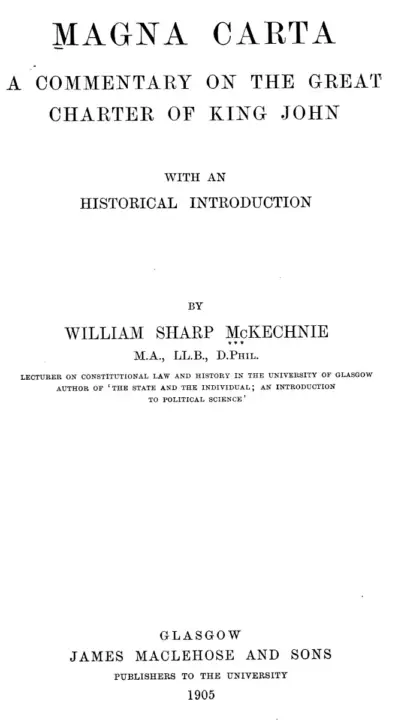
"Magna Carta: A Commentary on the Great Charter of King John" by William Sharp McKechnie is a historical account written in the early 20th century. This work delves into the significance and implications of the Magna Carta, focusing on its historical context and its role in the development of constitutional freedoms in England. The book aims to provide a fresh commentary on this pivotal document, critiquing earlier interpretations and emphasizing its relevance to the struggles for liberty. The opening of the commentary highlights that no significant modern analysis of Magna Carta has been published until now, despite the profound impact of the Great Charter on English constitutional history. McKechnie discusses the motivations behind his work, emphasizing the necessity of examining the various grievances that led to its creation and outlining the events that unfolded in the lead-up to its signing. He argues that the Magna Carta is deserving of detailed study due to its complexities and the wealth of knowledge in contemporary scholarship, setting the stage for a thorough exploration of its chapters and clauses in the remaining text.
Introduction adapted from the source catalogue; source summaries may be automatically generated.
Free to read · English · 212,300 words · No account needed
MAKE TIME FOR A GOOD BOOK
On by default. Untick to stop anonymous reading totals. Each page counts after 10 seconds in view. How this works.
Anonymous counting is on unless you have switched it off.
History of Great Britain, VI. 74. (6th edition, 1823). See also S. Henshall, History of South Britain, cited by Thomson, Magna Charta, 268-9.
The substance of this chapter appears in the reissues of 1217 and 1225; but its force is there greatly impaired by the addition of a new clause inconsistent with its spirit, reserving to archbishops, bishops, abbots, priors, templars, hospitallers, earls, barons, and all other persons as well ecclesiastical as secular, all the franchises and free customs they previously had.[1068] The chief object of this was presumably to make it clear that Magna Carta, while conferring benefits, took nothing away; but it would naturally be interpreted as a saving clause in favour of aristocrats in their relations with their dependants (“erga suos”) as well as with the Crown, thus modifying the clause which immediately preceded it.
Footnote 1068:
See c. 46 of 1217.
Footnote 1069:
The words “in perpetuum” are written at the foot of one of the Cottonian versions. See supra, 195, n.
Cum autem pro Deo, et ad emendacionem regni nostri, et ad melius sopiendam discordiam inter nos et barones nostros ortam, hec omnia predicta concesserimus, volentes ea integra et firma stabilitate in perpetuum[1069] gaudere, facimus et concedimus eis securitatem subscriptam; videlicet quod barones eligant viginti quinque barones de regno quos voluerint, qui debeant pro totis viribus suis observare, tenere, et facere observari, pacem et libertates quas eis concessimus, et hac presenti carta nostra confirmavimus, ita scilicet quod, si nos, vel justiciarius noster, vel ballivi nostri, vel aliquis de ministris nostris, in aliquo erga aliquem deliquerimus, vel aliquem articulorum pacis aut securitatis transgressi fuerimus, et delictum ostensum fuerit quatuor baronibus de predictis viginti quinque baronibus, illi quatuor barones accedant ad nos vel ad justiciarum nostrum, si fuerimus extra regnum, proponentes nobis excessum, petent ut excessum illum sine dilacione faciamus emendari. Et si nos excessum non emendaverimus, vel, si fuerimus extra regnum justiciarius noster non emendaverit, infra tempus quadraginta dierum computandum a tempore quo monstratum fuerit nobis vel justiciario nostro si extra regnum fuerimus, predicti quatuor barones referant causam illam ad residuos de viginti quinque baronibus, et illi viginti quinque barones cum communa tocius terre distringent et gravabunt nos modis omnibus quibus poterunt, scilicet per capcionem castrorum, terrarum, possessionum, et aliis modis quibus poterunt, donec fuerit emendatum secundum arbitrium eorum, salva persona nostra et regine nostre et liberorum nostrorum; et cum fuerit emendatum intendent nobis sicut prius fecerunt. Et quicumque voluerit de terra juret quod ad predicta omnia exequenda parebit mandatis predictorum viginti quinque baronum, et quod gravabit nos pro posse suo cum ipsis, et nos publice et libere damus licenciam jurandi cuilibet qui jurare voluerit, et nulli umquam jurare prohibebimus. Omnes autem illos de terra qui per se et sponte sua noluerint jurare viginti quinque baronibus, de distringendo et gravando nos cum eis, faciemus jurare eosdem de mandato nostro, sicut predictum est. Et si aliquis de viginti quinque baronibus decesserit, vel a terra recesserit, vel aliquo alio modo impeditus fuerit, quominus ista predicta possent exequi, qui residui fuerint de predictis viginti quinque baronibus eligant alium loco ipsius, pro arbitrio suo, qui simili modo erit juratus quo et ceteri. In omnibus autem que istis viginti quinque baronibus committuntur exequenda, si forte ipsi viginti quinque presentes fuerint, et inter se super re aliqua discordaverint, vel aliqui ex eis summoniti nolint vel nequeant interesse, ratum habeatur et firmum quod major pars eorum qui presentes fuerint providerit, vel preceperit, ac si omnes viginti quinque in hoc consensissent; et predicti viginti quinque jurent quod omnia antedicta fideliter observabunt, et pro toto posse suo facient observari. Et nos nichil impetrabimus ab aliquo, per nos nec per alium, per quod aliqua istarum concessionum et libertatum revocetur vel minuatur; et, si aliquid tale impetratum fuerit, irritum sit et inane et numquam eo utemur per nos nec per alium.
Your reading position is saved on this browser. Take it to another device with a library code. Reading pages adapt to text, rather than matching a printed edition.
BEHIND THE BOOK
This eBook is for the use of anyone anywhere in the United States and most other parts of the world at no cost and with almost no restrictions whatsoever. You may copy it, give it away or re-use it under the terms of the Project Gutenberg License included with this eBook or online at www.gutenberg.org. If you are not located in the United States, you will have to check the laws of the country where you are located before using this eBook. Read the source licence.
The original source file, including credits and licence, is retained by this library. Request an original-format copy at no charge. Please include the book title and Project Gutenberg identifier #65363.
KEEP YOUR CURIOSITY GOING
Cécile Tormay

Moritz Busch
John L. Ransom
Frances Wright
Cécile Tormay

Mabel Potter Daggett