THE CLASSIC COLLECTION✦An outlaw’s diary: the CommuneCLASSIC FREE BOOKS
An outlaw’s diary: the Commune
Cécile Tormay
THE CLASSIC COLLECTION · 1905
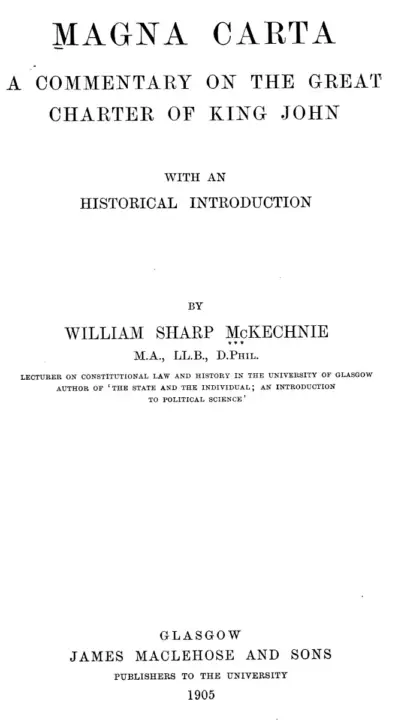
"Magna Carta: A Commentary on the Great Charter of King John" by William Sharp McKechnie is a historical account written in the early 20th century. This work delves into the significance and implications of the Magna Carta, focusing on its historical context and its role in the development of constitutional freedoms in England. The book aims to provide a fresh commentary on this pivotal document, critiquing earlier interpretations and emphasizing its relevance to the struggles for liberty. The opening of the commentary highlights that no significant modern analysis of Magna Carta has been published until now, despite the profound impact of the Great Charter on English constitutional history. McKechnie discusses the motivations behind his work, emphasizing the necessity of examining the various grievances that led to its creation and outlining the events that unfolded in the lead-up to its signing. He argues that the Magna Carta is deserving of detailed study due to its complexities and the wealth of knowledge in contemporary scholarship, setting the stage for a thorough exploration of its chapters and clauses in the remaining text.
Introduction adapted from the source catalogue; source summaries may be automatically generated.
Free to read · English · 212,300 words · No account needed
MAKE TIME FOR A GOOD BOOK
On by default. Untick to stop anonymous reading totals. Each page counts after 10 seconds in view. How this works.
Anonymous counting is on unless you have switched it off.
Common Pleas. I. The Curia Regis as a Court of Law. II. 308 Common Pleas and Royal Pleas. III. Effects of Magna Carta on the Genesis of the three Courts of Common Law. IV. Evolution of the Court of Common Pleas. V. Erroneous Views,
Petty Assizes. I. The Curia Regis and the Travelling 317 Justices. II. The Nature and Origin of the three Petty Assizes. III. The Assizes in 1215. IV. An Erroneous View. V. Later History of the Justices of Assize,
Procedure at Petty Assizes, 331
Amercement. I. Three Stages of Criminal Law: (1) The 334 blood-feud; (2) Fixed money-payments; (3) Amercements. II. Magna Carta and Amercements: (1) Of the Freeholder; (2) Of the Merchant; (3) Of the Villein; (4) Fines and Amercements; (5) Contenement,
Amercement of Earls and Barons, 346
Amercement of the Clergy, 349
I. Origin of the Obligation to make Bridges. II. The 352
King’s Rights of Falconry. III. Erroneous
Interpretations,
I. Pleas of the Crown. II. Keeping and Trying Criminal 358 Pleas. III. The Intention of Magna Carta. IV. An Erroneous View. V. Local Magistrates under John: (1) The Sheriff; (2) The Constable; (3) The Coroner; (4) The Bailiff,
Farms of Counties and Hundreds, 372
Crown Debtors. I. Nature of the Grievance. II. The Right 376
to Bequeath,
Intestate Succession, 382
I. Purveyance in General. II. Branches of it restricted 385 by Magna Carta. III. Its other Branches,
Castle-Guard, 390
Purveyance of Horses and Carts, 392
Purveyance of Timber, 393
I. The Crown’s Claim to Felons’ Property: (1) Lands; (2) 394 Chattels. II. Indictment, Conviction, and Attainder,
Obstructions to be removed from Rivers, 402
The Writ “Praecipe.” I. Royal Writs and the Feudal 405 Jurisdictions. II. Influence of this provision on later legal Development,
Standards of Weights and Measures, 414
Writ de Odio et Atia. I. Trial by Combat prior to 417 John’s Reign. II. The Writ of Life and Limbs. III. Its Subsidiary Uses. IV. Later History of Appeal and Battle,
Prerogative Wardship, 427
No Bailiff to put anyone to his “law” without Witnesses. 430 I. Probable Object of this Chapter. II. Medieval Interpretations. III. Modern Interpretations,
I. Its Main Object: (1) Judgment must precede Execution; 436 (2) Per judicium parium; (3) Per legem terrae; (4) Meaning of "vel." II. The scope of the Protection afforded. III. What classes of men enjoyed it. IV. Reactionary Aspects. V. The Genesis of this Chapter. VI. Later History of "Judgment of Peers." VII. Erroneous Interpretations,
Justice not to be Sold, Refused, or Delayed, 459
Freedom of Trade. I. Magna Carta favours Alien 463 Merchants. II. Customs and Tolls. III. The Motives prompting this Chapter. IV. English Boroughs and Merchant Strangers,
Your reading position is saved on this browser. Take it to another device with a library code. Reading pages adapt to text, rather than matching a printed edition.
BEHIND THE BOOK
This eBook is for the use of anyone anywhere in the United States and most other parts of the world at no cost and with almost no restrictions whatsoever. You may copy it, give it away or re-use it under the terms of the Project Gutenberg License included with this eBook or online at www.gutenberg.org. If you are not located in the United States, you will have to check the laws of the country where you are located before using this eBook. Read the source licence.
The original source file, including credits and licence, is retained by this library. Request an original-format copy at no charge. Please include the book title and Project Gutenberg identifier #65363.
KEEP YOUR CURIOSITY GOING
Cécile Tormay

Moritz Busch
John L. Ransom
Frances Wright
Cécile Tormay

Mabel Potter Daggett