THE CLASSIC COLLECTION✦Goldsmith English Men of Letters SeriesCLASSIC FREE BOOKS
Goldsmith English Men of Letters Series
William Black
THE CLASSIC COLLECTION · 1879
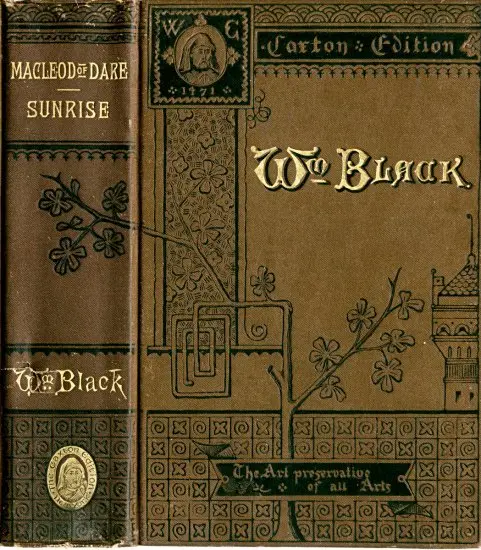
"Macleod of Dare" by William Black is a novel written in the late 19th century. The story centralizes around Sir Keith Macleod, the last surviving son of Lady Macleod, as he prepares to leave his home at Castle Dare for London. The narrative explores themes of family, duty, and the contrast between the wildness of the Scottish Highlands and the sophistication of urban society. The opening of the novel introduces us to Castle Dare, illuminating the emotional weight that Lady Macleod carries as she bids farewell to her only remaining son, Keith. Surrounded by memories of her other sons who have fallen in battle, she is proud yet sorrowful as Keith embraces his youthful spirit, ready for adventure. The poignant moment is heightened by their cousin Janet's efforts to maintain a sense of cheerfulness despite the family's grief. As the scene progresses, Keith’s spirited nature becomes evident through his dialogue and interactions with the people around him, including the piper and his dear cousin Janet, who worry about his departure. The contrasting emotions set the stage for his journey away from the familiar rugged beauty of Mull into the bustling life of London, suggesting the intertwining of their fates as they navigate matters of heart and heritage.
Introduction adapted from the source catalogue; source summaries may be automatically generated.
Free to read · English · 165,752 words · No account needed
MAKE TIME FOR A GOOD BOOK
On by default. Untick to stop anonymous reading totals. Each page counts after 10 seconds in view. How this works.
Anonymous counting is on unless you have switched it off.
But neither Lieutenant Ogilvie's pert common-sense, nor his apt and accurate quotation, nor the proffered brandy, seemed to alter much the mood of this haggard-faced man. He rose.
"I think I am going now," said he, in a low voice. "You won't take it unkindly, Ogilvie, that I don't stop to talk with you: it is a strange story you have told me--I want time to think over it. Good-by!"
"The fact is, Macleod," Ogilvie stammered, as he regarded his friend's face, "I don't like to leave you. Won't you stay and dine with our fellows? or shall I see if I can run up to London with you?"
"No, thank you, Ogilvie," said he. "And have you any message for the
mother and Janet?"
"Oh, I hope you will remember me most kindly to them. At least, I will go to the station with you, Macleod."
"Thank you, Ogilvie; but I would rather go alone. Good-by, now."
He shook hands with his friend, in an absent sort of way, and left. But while yet his hand was on the door, he turned and said,--
"Oh, do you remember my gun that has the shot barrel and the rifle
barrel?"
"Yes, certainly."
"And would you like to have that, Ogilvie?--we sometimes had it when we
were out together."
"Do you think I would take your gun from you, Macleod?" said the other. "And you will soon have plenty of use for it now."
"Good-by, then, Ogilvie," said he, and he left, and went out into the world of rain, and lowering skies, and darkening moors.
And when he went back to Dare it was a wet day also; but he was very cheerful; and he had a friendly word for all whom he met; and he told the mother and Janet that he had got home at last, and meant to go no more a-roving. But that evening, after dinner, when Donald began to play the Lament for the memory of the five sons of Dare, Macleod gave a sort of stifled cry, and there were tears running down his cheeks--which was a strange thing for a man; and he rose and left the hall, just as a woman would have done. And his mother sat there, cold, and pale, and trembling; but the gentle cousin Janet called out, with a piteous trouble in her eyes,--
"Oh, auntie, have you seen the look on our Keith's face, ever since he
came ashore to-day?"
"I know it, Janet," said she. "I have seen it. That woman has broken his heart; and he is the last of my six brave lads!"
Your reading position is saved on this browser. Take it to another device with a library code. Reading pages adapt to text, rather than matching a printed edition.
William Black
William Black
William Black

William Black
BEHIND THE BOOK
This eBook is for the use of anyone anywhere in the United States and most other parts of the world at no cost and with almost no restrictions whatsoever. You may copy it, give it away or re-use it under the terms of the Project Gutenberg License included with this eBook or online at www.gutenberg.org. If you are not located in the United States, you will have to check the laws of the country where you are located before using this eBook. Read the source licence.
The original source file, including credits and licence, is retained by this library. Request an original-format copy at no charge. Please include the book title and Project Gutenberg identifier #15587.
KEEP YOUR CURIOSITY GOING
Coulson Kernahan

Maurice Baring
Frances Wright
Cécile Tormay

Frederic Jesup Stimson

W. H. P. (William Henry Pope) Jarvis