THE CLASSIC COLLECTION✦Goldsmith English Men of Letters SeriesCLASSIC FREE BOOKS
Goldsmith English Men of Letters Series
William Black
THE CLASSIC COLLECTION · 1879
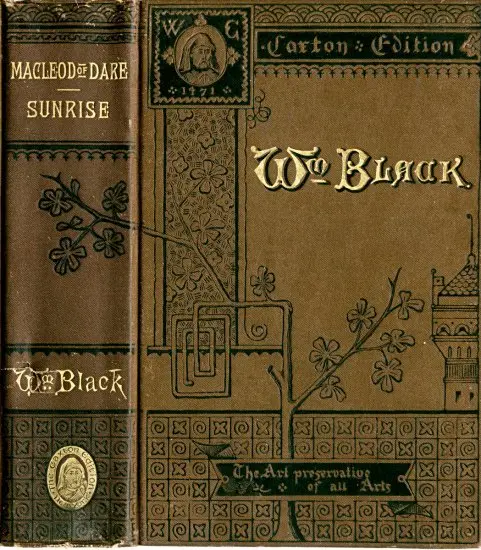
"Macleod of Dare" by William Black is a novel written in the late 19th century. The story centralizes around Sir Keith Macleod, the last surviving son of Lady Macleod, as he prepares to leave his home at Castle Dare for London. The narrative explores themes of family, duty, and the contrast between the wildness of the Scottish Highlands and the sophistication of urban society. The opening of the novel introduces us to Castle Dare, illuminating the emotional weight that Lady Macleod carries as she bids farewell to her only remaining son, Keith. Surrounded by memories of her other sons who have fallen in battle, she is proud yet sorrowful as Keith embraces his youthful spirit, ready for adventure. The poignant moment is heightened by their cousin Janet's efforts to maintain a sense of cheerfulness despite the family's grief. As the scene progresses, Keith’s spirited nature becomes evident through his dialogue and interactions with the people around him, including the piper and his dear cousin Janet, who worry about his departure. The contrasting emotions set the stage for his journey away from the familiar rugged beauty of Mull into the bustling life of London, suggesting the intertwining of their fates as they navigate matters of heart and heritage.
Introduction adapted from the source catalogue; source summaries may be automatically generated.
Free to read · English · 165,752 words · No account needed
MAKE TIME FOR A GOOD BOOK
On by default. Untick to stop anonymous reading totals. Each page counts after 10 seconds in view. How this works.
Anonymous counting is on unless you have switched it off.
"AH, pappy," said Miss Gertrude White to her father and she pretended to sigh as she spoke--"this is a change indeed!"
They were driving up to the gate of the small cottage in South Bank. It was the end of October. In the gardens they passed the trees were almost bare; though such leaves as hung sparsely on the branches of the chestnuts and maples were ablaze with russet and gold in the misty sunshine.
"In another week," she continued, "there will not be a leaf left. I dare say there is not a single geranium in the garden. All hands on deck to pipe a farewell:
'Ihr Matten, lebt wohl,
Ihr sonnigen Weiden
Der Senne muss scheiden,
Der Sommer ist hin.'
Farewell to the blue mountains of Newcastle, and the sunlit valleys of Liverpool, and the silver waterfalls of Leeds; the summer is indeed over; and a very nice and pleasant summer we have had of it."
The flavor of sarcasm running through this affected sadness vexed Mr. White, and he answered, sharply,
"I think you have little reason to grumble over a tour which has so distinctly added to your reputation."
"I was not aware," said she, with a certain careless sauciness of manner, "that an actress was allowed to have a reputation; at least, there are always plenty of people anxious enough to take it away."
"Gertrude," said he, sternly, "what do you mean by this constant carping? Do you wish to cease to be an actress? Or what in all the world do you want?"
"To cease to be an actress?" she said, with a mild wonder, and with the sweetest of smiles, as she prepared to get out of the open door of the cab. "Why, don't you know; pappy, that a leopard cannot change his spots, or an Etheopian his skin? Take care of the step, pappy! That's right. Come here, Marie, and give the cabman a hand with this portmanteau."
Miss White was not grumbling at all--but, on the contrary, was quite pleasant and cheerful--when she entered the small house and found herself once more at home.
"Oh, Carry," she said, when her sister followed her into her room; "you don't know what it is to get back home, after having been bandied from one hotel to another hotel, and from one lodging-house to another lodging-house, for goodness knows how long."
"Oh, indeed!" said Miss Carry, with such marked coldness that her sister
turned to her.
"What is the matter with you?"
"What is the matter with you?" the younger sister retorted, with sudden fire. "Do you know that your letters to me have been quite disgraceful?"
Your reading position is saved on this browser. Take it to another device with a library code. Reading pages adapt to text, rather than matching a printed edition.
William Black
William Black
William Black

William Black
BEHIND THE BOOK
This eBook is for the use of anyone anywhere in the United States and most other parts of the world at no cost and with almost no restrictions whatsoever. You may copy it, give it away or re-use it under the terms of the Project Gutenberg License included with this eBook or online at www.gutenberg.org. If you are not located in the United States, you will have to check the laws of the country where you are located before using this eBook. Read the source licence.
The original source file, including credits and licence, is retained by this library. Request an original-format copy at no charge. Please include the book title and Project Gutenberg identifier #15587.
KEEP YOUR CURIOSITY GOING
Coulson Kernahan

Maurice Baring
Frances Wright
Cécile Tormay

Frederic Jesup Stimson

W. H. P. (William Henry Pope) Jarvis