THE CLASSIC COLLECTION✦Goldsmith English Men of Letters SeriesCLASSIC FREE BOOKS
Goldsmith English Men of Letters Series
William Black
THE CLASSIC COLLECTION · 1879
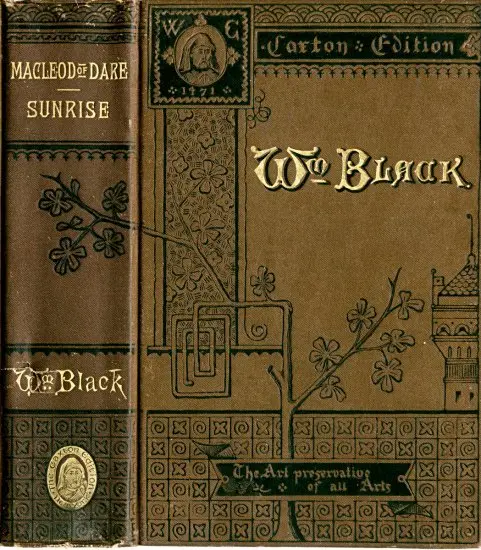
"Macleod of Dare" by William Black is a novel written in the late 19th century. The story centralizes around Sir Keith Macleod, the last surviving son of Lady Macleod, as he prepares to leave his home at Castle Dare for London. The narrative explores themes of family, duty, and the contrast between the wildness of the Scottish Highlands and the sophistication of urban society. The opening of the novel introduces us to Castle Dare, illuminating the emotional weight that Lady Macleod carries as she bids farewell to her only remaining son, Keith. Surrounded by memories of her other sons who have fallen in battle, she is proud yet sorrowful as Keith embraces his youthful spirit, ready for adventure. The poignant moment is heightened by their cousin Janet's efforts to maintain a sense of cheerfulness despite the family's grief. As the scene progresses, Keith’s spirited nature becomes evident through his dialogue and interactions with the people around him, including the piper and his dear cousin Janet, who worry about his departure. The contrasting emotions set the stage for his journey away from the familiar rugged beauty of Mull into the bustling life of London, suggesting the intertwining of their fates as they navigate matters of heart and heritage.
Introduction adapted from the source catalogue; source summaries may be automatically generated.
Free to read · English · 165,752 words · No account needed
MAKE TIME FOR A GOOD BOOK
On by default. Untick to stop anonymous reading totals. Each page counts after 10 seconds in view. How this works.
Anonymous counting is on unless you have switched it off.
"No," said he, slowly, "she has not told me all about it. Well, she did tell me about a poor creature--a woman-man--a thing of affectation, with his paint-box and his velvet coat, and his furniture. Ogilvie, have you got any brandy?"
Ogilvie rang, and got some brandy, some water, a tumbler, and a wineglass placed on the table. Macleod, with a hand that trembled violently, filled the tumbler half full of brandy.
"And she could not deny the story to Mrs. Ross?" said he, with a strange and hard smile on his face. "It was her modesty. Ah, you don't know, Ogilvie, what an exalted soul she has. She is full of idealisms. She could not explain all that to Mrs. Ross. I know. And when she found herself too weak to carry out her aspirations, she sought help. Is that it? She would gain assurance and courage from the woman-man?"
He pushed the tumbler away; his hand was still trembling violently.
"I will not touch that Ogilvie," said he, "for I have not much mastery over myself. I am going away now--I am going back now to the Highlands--oh! you do not know what I have become since I met that woman--a coward and a liar! They wouldn't have you sit down at the mess-table, Ogilvie, if you were that, would they? I dare not stay in London now. I must run away now--like a hare that is hunted. It would not be good for her or for me that I should stay any longer in London."
He rose and held out his hand; there was a curious glazed look on his eyes. Ogilvie pressed him back into the chair again.
"You are not going out in this condition, Macleod?--you don't know what you are doing! Come now, let us be reasonable; let us talk over the thing like men. And I must say, first of all, that I am heartily glad of it, for your sake. It will be a hard twist at first; but, bless you! lots of fellows have had to fight through the same thing, and they come up smiling after it, and you would scarcely know the difference. Don't imagine I am surprised--oh no. I never did believe in that young woman; I thought she was a deuced sight too clever; and when she used to go about humbugging this one and the other with her innocent airs, I said to myself, 'Oh, it's all very well: but you know what you are about.' Of course there was no use talking to you. I believe at one time Mrs. Ross was considering the point whether she ought not to give you a hint--seeing that you had met Miss White first at her house--that the young lady was rather clever at flirtation, and that you ought to keep a sharp lookout. But then you would only have blazed up in anger. It was no use talking to you. And then, after all, I said that if you were so bent on marrying her, the chances were that you would have no difficulty, for I thought the bribe of her being called Lady Macleod would be enough for any actress. As for this man Lemuel, no doubt he is a very great man, as people say; but I don't know much about these things myself; and--and--I think it is very plucky of Mrs. Ross to cut off two of her lions at one stroke. It shows she must have taken an uncommon liking for you. So you must cheer up, Macleod. If woman take a fancy to you like that, you'll easily get a better wife than Miss White would have made. Mind you, I don't go back from anything I ever said of her. She is a handsome woman, and no mistake; and I will say that she is the best waltzer that I ever met with in the whole course of my life--without exception. But she's the sort of woman who, if I married her, would want some looking after--I mean, that is my impression. The fact is, Macleod, away there in Mull you have been brought up too much on books and your own imagination. You were ready to believe any pretty woman, with soft English ways, an angel. Well, you have had a twister; but you'll come through it; and you will get to believe, after all, that women are very good creatures just as men are very good creatures, when you get the right sort. Come now, Macleod, pull yourself together; Perhaps I have just as hard an opinion of her conduct towards you as you have yourself. But you know what Tommy Moore, or some fellow like that says--'Though she be not fair to me, what the devil care I how fair she be?' And if I were you, I would have a drop of brandy--but not half a tumblerful."
Your reading position is saved on this browser. Take it to another device with a library code. Reading pages adapt to text, rather than matching a printed edition.
William Black
William Black
William Black

William Black
BEHIND THE BOOK
This eBook is for the use of anyone anywhere in the United States and most other parts of the world at no cost and with almost no restrictions whatsoever. You may copy it, give it away or re-use it under the terms of the Project Gutenberg License included with this eBook or online at www.gutenberg.org. If you are not located in the United States, you will have to check the laws of the country where you are located before using this eBook. Read the source licence.
The original source file, including credits and licence, is retained by this library. Request an original-format copy at no charge. Please include the book title and Project Gutenberg identifier #15587.
KEEP YOUR CURIOSITY GOING
Coulson Kernahan

Maurice Baring
Frances Wright
Cécile Tormay

Frederic Jesup Stimson

W. H. P. (William Henry Pope) Jarvis