THE CLASSIC COLLECTION✦South Australia and Western AustraliaCLASSIC FREE BOOKS
South Australia and Western Australia
Anthony Trollope
THE CLASSIC COLLECTION · 1882
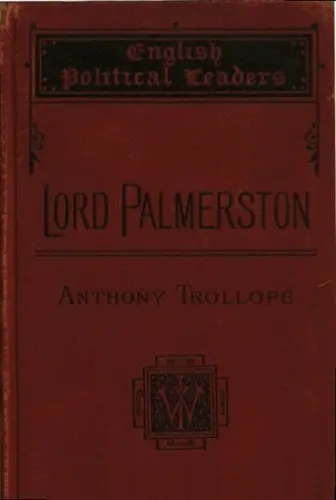
"Lord Palmerston" by Anthony Trollope is a historical account written in the late 19th century. The book provides a detailed examination of the life and political career of Henry John Temple, the 3rd Viscount Palmerston, who served as a prominent British statesman and Prime Minister during the 19th century. It covers his extensive impact on foreign and domestic policy, focusing particularly on his perception as a foreign minister and his clashes with other political figures, including the Prince Consort. The opening of "Lord Palmerston" introduces readers to the author's approach in compiling the memoir, citing various sources, including speeches and biographies. Trollope expresses his intention to navigate the complicated political landscape of Palmerston's life, emphasizing the controversies surrounding his dismissal as Foreign Minister and how he skillfully maneuvered through the political arena to regain power. The author hints at Palmerston's character, noting his determination and resilience, while also foreshadowing the key events in Palmerston’s career that would define his legacy in British politics. The initial narrative sets up a contextual framework for understanding Palmerston's role in significant historical events and debates, laying the groundwork for a deeper exploration of his life throughout the rest of the text.
Introduction adapted from the source catalogue; source summaries may be automatically generated.
Free to read · English · 65,828 words · No account needed
MAKE TIME FOR A GOOD BOOK
On by default. Untick to stop anonymous reading totals. Each page counts after 10 seconds in view. How this works.
Anonymous counting is on unless you have switched it off.
As I am now quoting what was said of him shortly after his death, I will give an extract from an article which appeared in August, 1868, in the Saint Paul’s Magazine, and was from the hand of Mr. Peter Bayne;--
“When we were at war with Russia, and when the nation, after trying statesman after statesman, continued in the distressing consciousness that the administration lacked vigour, the man who, for a quarter of a century, had been checkmating the policy of Russia was naturally called for. In no spirit of confidence or enthusiasm,--feeling clearly that others had failed, but by no means certain that the right man was yet discovered,--England said, ‘Try Palmerston.’ It was on the 8th of February, 1855, that the Earl of Derby withdrew, and that he took the helm. On the 16th he explained his position to the House. Already all the machinery of an energetic administration was at work, and as the new Prime Minister glanced at department after department, detailing what had been done and what was planned, members felt that a new spirit of energy was already penetrating the framework of Government. The country looked on in hope, beginning to breathe more freely. Month after month went by; month after month the public watched. Troubles came at first in threatening battalions upon the Ministry; but the practical instinct of the nation gradually decided that Palmerston was the man to whom the business of the war could be committed, and in whose hands the name of England was safe. It was astonishing with what ease he held the reins at that noisy time, and with what lightness and self-possession he encountered the obstacles in his path. In May the Opposition made a determined attempt to unseat him, and a long and stormy debate took place. Mr. Disraeli, anxious to avail himself of the uneasy and disconted feeling which still widely prevailed, and to make the most of the inarticulate shouting of a number of ill-informed people who called themselves Administrative Reformers, moved a resolution to the effect that the language of Her Majesty’s Government was ‘ambiguous and uncertain.’ The Opposition maintained the attack with spirit and animosity, and the men below the gangway on the Liberal side, in whose eyes Lord Palmerston never found favour, kept up a raking fire of argument, taunt and invective. Mr. Disraeli closed the attack in one of his most impassioned philippics. One can still see him with the mind’s eye as his sentences rang through the House, his right arm coming down with fierce emphasis at each rhetorical close, while he asked, in impetuous torrent of interrogatives, whether the Prime Minister had not done this, that, and the other evil thing? It was beautiful to observe Lord Palmerston sitting in fixed and placid attention, cool as an old admiral cut out of oak, the figure-head of a seventy-four gun ship in a Biscay squall. At last, as the hours of morning stole on, he placed his hat quietly on the table, and, amid the intense excitement of the House, sprang to his feet. Not a shade of agitation or anxiety could you trace on that brave, clear, splendidly intelligent face. The forehead, broad and expansive, the eye frank, fearless, and sparkling, the whole countenance radiant with energy, courage, good temper, spoke assurance to his party and defiance to the Opposition. He had got into the heart of his subject,--eleven and a half columns of Hansard had been spoken,--when the cry of ‘Black Rod’ echoed through the House, and the usher who rejoices in that mysterious title summoned the Commons to the bar of the Lords, to receive her Majesty’s assent by commission to certain Bills. Lord Palmerston was interrupted; the Speaker left the chair, and, with as many of the members as chose to accompany him, proceeded to the Upper House. After a while the Speaker returned, and Lord Palmerston resumed. ‘I think,’--these were his first words,--‘I have some reason to complain of the impatience of the other House in not waiting for the censure which the right honourable gentleman opposite is desirous of inflicting, but in prematurely administering the rod.’ The Opposition, joining in the titter which ran along every bench, learned that the tempest they had so passionately raised had agitated the mind of Lord Palmerston to no greater extent than was consistent with its wafting towards them a jest so feather-light as this. The next second he was grappling with the arguments of his opponents, and in one or two minutes all recollection of the interruption had passed from the memory of the House. His speech may be pronounced one of the noblest ever uttered in Parliament. Simple, manly, luminous, convincing, high in tone and unanswerable in reasoning, it told upon the intellect not only of Parliament, not only of England, but of the civilized world. Some of its sentences deserve to be remembered. ‘I feel that, in whatever hands the Government is placed, the will of the country must and will be obeyed. I know that will is that England, having engaged in a war necessary and just, in concert with our great ally and neighbour, France, must and shall succeed.’ From the moment he was Prime Minister, Lord Palmerston felt that he held a trust higher than the interests of party, and not in the utmost fervour of debate, not in the most unguarded moment of social converse, could an expression pass his lips which, in discrediting his adversaries, cast a slur upon the name of England. In a still loftier tone, one seldom assumed by Lord Palmerston, and never except in a spirit of deep reverence and sincerity, is the following: ‘The fate of battle is in the hands of a Higher Power. It is not in our power to command success, but it is enough for us to do all in our power to obtain it. That we have done. In a cause which we consider to be just, necessary, and honourable, we confidently place our trust in a Higher Power.’ Mr. Disraeli was beaten by a majority of one hundred, and the Government confirmed in the hands of Lord Palmerston.
Your reading position is saved on this browser. Take it to another device with a library code. Reading pages adapt to text, rather than matching a printed edition.
Anthony Trollope

Anthony Trollope

Anthony Trollope

Anthony Trollope
BEHIND THE BOOK
This eBook is for the use of anyone anywhere in the United States and most other parts of the world at no cost and with almost no restrictions whatsoever. You may copy it, give it away or re-use it under the terms of the Project Gutenberg License included with this eBook or online at www.gutenberg.org. If you are not located in the United States, you will have to check the laws of the country where you are located before using this eBook. Read the source licence.
The original source file, including credits and licence, is retained by this library. Request an original-format copy at no charge. Please include the book title and Project Gutenberg identifier #55648.
KEEP YOUR CURIOSITY GOING
Cécile Tormay

Moritz Busch
John L. Ransom
Frances Wright
Cécile Tormay

Mabel Potter Daggett