
What the White Race May Learn from the Indian
George Wharton James
THE CLASSIC COLLECTION · 1916
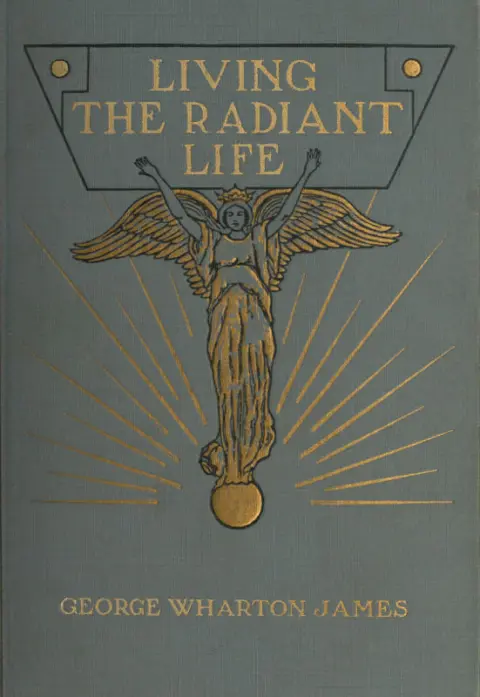
"Living the Radiant Life: A Personal Narrative" by George Wharton James is a personal narrative written in the early 20th century. This work explores themes of personal growth, spirituality, and the importance of actively radiating positivity and goodness in life. Through individual reflections, James seeks to inspire readers to embrace a more vibrant and generous approach to living. The opening of the book introduces the concept of radiance, both in nature and within individuals, suggesting that everything possesses a unique aura that reflects its essence. James discusses how natural elements—like the sun, flowers, and landscapes—radiate qualities that are perceptible to the sensitive observer. He emphasizes the need for individuals to recognize their own radiancies and consciously decide what they wish to project into the world, aiming to inspire readers to engage in a life characterized by kindness, creativity, and spiritual awareness. The tone is reflective and encouraging, aiming to awaken deeper thoughts and aspirations in those who seek to live more meaningfully.
Introduction adapted from the source catalogue; source summaries may be automatically generated.
Free to read · English · 69,010 words · No account needed
MAKE TIME FOR A GOOD BOOK
On by default. Untick to stop anonymous reading totals. Each page counts after 10 seconds in view. How this works.
Anonymous counting is on unless you have switched it off.
Swedenborg, who was one of the most eminent of scientists and engineers, as well as the founder of the religious system that bears his name, asserted that various "aura" surrounded all living beings, and that the mental or spiritual state radiates, just as light and heat radiate from the sun, and cold from the snow. When one was angry, he said, he gave out the aura of anger which enveloped him as a cloud. Hatred had its aura, as well as love, sympathy, purity, impurity, kindliness, charity, jealousy, courage, justice, and the like.
He also asserted that, to those who were simple, natural, and unspoiled by false reasoning--those who were spiritually inclined--these varied aura were clearly perceptible, and were as certainly felt or seen as were heat, cold, whiteness, blackness by the senses.
Rudyard Kipling bases his story, "They," which appeared some years ago in Scribner's Magazine, upon this statement of Swedenborg's, and in this light it becomes an extra fascinating story to read.
A great modern French scientist has made many exhaustive studies of these aura, and claims to have photographed them.
In the Panama-Pacific Exposition, one of the exhibits contained a series of interesting pictures, or diagrams, which purported to be exact representations of the various aura of people under different mental conditions. In an article on this subject, written by a well-known authority, we are told that:
It is not around the human body alone that an aura is to be seen; a similar cloud of light surrounds or emanates from animals, trees, and even minerals, though in all these cases it is less extended and less complex than that of man.
The occultists assert that the aura is extremely complex in its character, in other words, that there are several aura superposed one upon the other. The first appearance is of a luminous cloud, extending some eighteen inches or two feet from the body, assuming a somewhat oval shape. Careful study, however, reveals that this first appearance is resolvable into several component parts, or separate aura, of different degrees of tenuity, and, apparently, superposed. Five of these have been defined. The first, or most material, is that pertaining to the physical body. In a state of health this is composed of separate, orderly, and nearly parallel lines, which radiate from the body in every direction.
When one suffers from disease the lines in the neighborhood of the part affected become erratic, and radiate less actively but in the wildest confusion, or, if the whole body be affected, all the lines are consequently erratic.
Your reading position is saved on this browser. Take it to another device with a library code. Reading pages adapt to text, rather than matching a printed edition.
George Wharton James
George Wharton James
George Wharton James
George Wharton James
BEHIND THE BOOK
This eBook is for the use of anyone anywhere in the United States and most other parts of the world at no cost and with almost no restrictions whatsoever. You may copy it, give it away or re-use it under the terms of the Project Gutenberg License included with this eBook or online at www.gutenberg.org. If you are not located in the United States, you will have to check the laws of the country where you are located before using this eBook. Read the source licence.
The original source file, including credits and licence, is retained by this library. Request an original-format copy at no charge. Please include the book title and Project Gutenberg identifier #56306.
KEEP YOUR CURIOSITY GOING

David Patterson (Spirit) Hatch

David Patterson (Spirit) Hatch

David Patterson (Spirit) Hatch

Edwin Abbott Abbott

Richard Watson
T. G. (Theophilus Gould) Steward