Lives of Fair and Gallant Ladies. Vol 1
Pierre de Bourdeille Brantôme
THE CLASSIC COLLECTION · 1922
"Lives of Fair and Gallant Ladies. Vol 2." by Pierre de Bourdeille Brantôme is a historical account likely written during the late 16th century. This work presents a compilation of anecdotes and discourses describing the interactions between noblewomen and men of valor, exploring themes of love, honor, and chivalry. The text reflects the moral and social dynamics of the French court, particularly focusing on prominent figures from the Valois era. The opening of the book introduces the theme of love among noble individuals, highlighting how women of status are often enchanted by the bravery and courage of men, despite their own more delicate inclinations. Brantôme discusses notable historical and mythical examples, including Venus's infatuation with Mars and the tale of the Amazonian Queen Penthesilea's admiration for Hector of Troy. He illustrates the reciprocal nature of valor and love, suggesting that acts of bravery in war are intertwined with romantic pursuits, thereby setting the tone for a broader exploration of love's complexities throughout the text.
Introduction adapted from the source catalogue; source summaries may be automatically generated.
Free to read · English · 118,777 words · No account needed
MAKE TIME FOR A GOOD BOOK
On by default. Untick to stop anonymous reading totals. Each page counts after 10 seconds in view. How this works.
Anonymous counting is on unless you have switched it off.
◆Sancerre, a small town on the left bank of the Loire, modern Department of the Cher, 27 miles from Bourges. The Huguenots of Sancerre endured two terrible sieges in 1569 and 1573.
◆Vitré, a town of Brittany, modern Department Ille-et-Vilaine, of about 10,000 inhabitants. Retains its medieval aspect and town walls to the present day.
◆Collenuccio, Bk. V.
◆Boccaccio has arranged this story in his De claries mulieribus, cap. CI. Vopiscus, Aurelius, XXVI–XXX, relates this fact more coolly.
◆Zenobia, the famous Queen of Palmyra, widow of Odena—thus, who had been allowed by the weak Emperor Gallienus to participate in the title of Augustus, and had extended his empire over a great part of Asia Minor, Syria and Egypt. She was eventually defeated by Aurelian in a great battle on the Orontes not far from Antioch. Palmyra was destroyed, and its inhabitants massacred; and Zenobia brought in chains to Rome.
◆The Emperor Aurelian was born about 212 A. D., and was of very humble origin. He served as a soldier in almost every part of the Roman Empire, and rose at last to the purple by dint of his prowess and address in arms, succeeding Claudius in 270 A. D. Almost the whole of his short reign of four years and a half was occupied in constant fighting. Killed in a conspiracy 275 A. D.
◆Perseus, the last King of Macedon, son of Philip V., came to the throne 179 B. C. His struggle with the Roman power lasted from 171 to 165, when he was finally defeated at the battle of Pydna by the consul L. Aemilius Paulus. He was carried to Rome and adorned the triumph of his conqueror in 167 B. C., and afterwards thrown into a dungeon. He was subsequently released, however, on the intercession of Aemilius Paulus, and died in honourable captivity at Alba.
◆Maria of Austria, sister of Charles V., widow of Louis II. of Hungary, and ruler over the Netherlands; she died in 1558. It was against her rule that John of Leyden struggled.
◆Brantôme has in mind Aurelia Victorina, mother of Victorinus, according to Trebillius Pollio, Thirty Tyrants, XXX.
◆In Froissart, liv. I, chap. 174.
◆Henri I., Prince de Condé, died in 1588 (January 5), poisoned, says the Journal de Henri, by his wife Catherine Charlotte de la Trémolle.
◆Isabella of Austria, daughter of Philip II.
◆Jeanne de Flandres.
◆Jacquette de Montberon, Brantôme’s sister-in-law.
◆Machiavelli, Dell’arte della guerre, Bk. V., ii.
◆Paule de Penthièvre, the second wife of Jean II. de Bourgogne, Count
de Nevers.
◆Richilde, Countess de Hainaut, who died in 1091.
◆Hugues Spencer, or le Dépensier.
◆Jean de Hainaut, brother of Count de Hainaut.
◆Cassel and Broqueron.
Your reading position is saved on this browser. Take it to another device with a library code. Reading pages adapt to text, rather than matching a printed edition.
Pierre de Bourdeille Brantôme
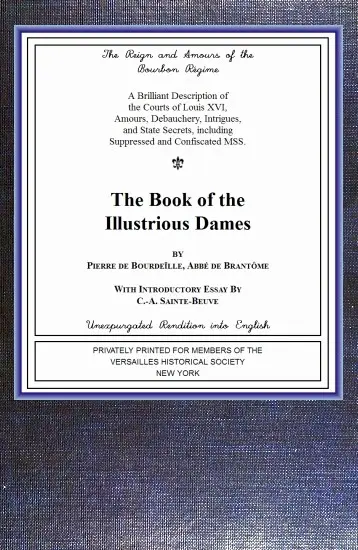
Pierre de Bourdeille Brantôme
BEHIND THE BOOK
This eBook is for the use of anyone anywhere in the United States and most other parts of the world at no cost and with almost no restrictions whatsoever. You may copy it, give it away or re-use it under the terms of the Project Gutenberg License included with this eBook or online at www.gutenberg.org. If you are not located in the United States, you will have to check the laws of the country where you are located before using this eBook. Read the source licence.
The original source file, including credits and licence, is retained by this library. Request an original-format copy at no charge. Please include the book title and Project Gutenberg identifier #67026.
KEEP YOUR CURIOSITY GOING
Cécile Tormay

Moritz Busch
John L. Ransom
Frances Wright
Cécile Tormay

Mabel Potter Daggett