Lives of Fair and Gallant Ladies. Vol 1
Pierre de Bourdeille Brantôme
THE CLASSIC COLLECTION · 1922
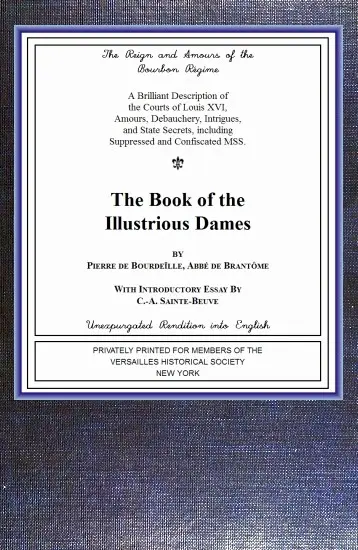
"Lives of Fair and Gallant Ladies. Vol 2." by Pierre de Bourdeille Brantôme is a historical account likely written during the late 16th century. This work presents a compilation of anecdotes and discourses describing the interactions between noblewomen and men of valor, exploring themes of love, honor, and chivalry. The text reflects the moral and social dynamics of the French court, particularly focusing on prominent figures from the Valois era. The opening of the book introduces the theme of love among noble individuals, highlighting how women of status are often enchanted by the bravery and courage of men, despite their own more delicate inclinations. Brantôme discusses notable historical and mythical examples, including Venus's infatuation with Mars and the tale of the Amazonian Queen Penthesilea's admiration for Hector of Troy. He illustrates the reciprocal nature of valor and love, suggesting that acts of bravery in war are intertwined with romantic pursuits, thereby setting the tone for a broader exploration of love's complexities throughout the text.
Introduction adapted from the source catalogue; source summaries may be automatically generated.
Free to read · English · 118,777 words · No account needed
MAKE TIME FOR A GOOD BOOK
On by default. Untick to stop anonymous reading totals. Each page counts after 10 seconds in view. How this works.
Anonymous counting is on unless you have switched it off.
◆Edward II. of Caernarvon, King of England, was the fourth son of Edward I. and Queen Eleanor. Ascended the throne 1307, and married Isabel of France the following year. A cowardly and worthless Prince, and the tool of scandalous favourites, such as Piers Gaveston. Isabel and Mortimer landed at Orwell, in Suffolk, in 1326, and deposed the King, who was murdered at Berkeley Castle, 1327.
◆Eleonore d’Acquitaine.
◆Thevet wrote the Cosmographie; Nauclerus wrote a Chronographie.
◆Vittoria Colonna, daughter of Fabrizio Colonna and of Agnes de Montefeltro, born in 1490, and affianced at the age of four to Ferdinand d’Avalos, who became her husband. The letter of which Brantôme speaks is famous; he found it in Vallès, fol. 205. As for Mouron, he was the great Chancellor Hieronimo Morone.
◆Plutarch, Anthony, Chap. xiv.
◆Catherine Marie de Lorraine, wife of Louis de Bourbon, Duke De
Montpensier.
◆Henri III., assassinated at Paris, 1589.
◆The other man was Mayenne.
◆Poltrot de Méré was tortured and quartered (March 18, 1563). As regards the admiral, he was massacred August 24, 1572.
◆Philibert de Marcilly, lord of Cipierre, tutor of Charles IX.
◆On this adventure, consult the Additions au Journal de Henri III.,
note 2.
◆Louis de Correa, Historia de la conquista del reino de Navarra.
◆Louise de Savoie.
◆Charlotte de Roye, married to Francis III. de La Rochefoucauld in
1557; she died in 1559.
◆Marguerite de Foix-Candale, married to Jean Louis de Nogaret, Duke
d’Eperon.
◆Renée de Bourdeille, daughter of André and Jacquette Montberon. She married, in 1579, David Bouchard, Viscount d’Aubeterre, who was killed in Périgord in 1593. She died in 1596. The daughter of whom Brantôme is about to speak was Hippolyte Bouchard, who was married to François d’Esparbez de Lussan. The three daughters whom he later mentions were: Jeanne, Countess de Duretal, Isabelle, Baroness d’Ambleville, and Adrienne, lady of Saint-Bonnet.
◆Married subsequently to François d’Esparbez de Lussan, Maréchal
d’Aubeterre.
◆Renée de Clermont, daughter of Jacques de Clermont-d’Amboise, lord of Bussy; she was married to the incompetent Jean de Montluc-Balagny (bastard of the Bishop de Valence), created Field Marshal of France in 1594.
◆Gabrielle d’Estrées.
◆Popular song of the day; Musée de Janequin. See Recueil of Pierre
Atteignant.
◆Renée Taveau, married to Baron Mortemart. François de Rochechouart.
◆There is a copy of this sixth discourse in the MS. 4788, du fonds français, at the Bibliothèque Nationale: this copy is from the end of the sixteenth century.
◆ Charlotte de Savoie, second wife of Louis XI., daughter of Louis,
Duke de Savoie.
Your reading position is saved on this browser. Take it to another device with a library code. Reading pages adapt to text, rather than matching a printed edition.
Pierre de Bourdeille Brantôme
Pierre de Bourdeille Brantôme
BEHIND THE BOOK
This eBook is for the use of anyone anywhere in the United States and most other parts of the world at no cost and with almost no restrictions whatsoever. You may copy it, give it away or re-use it under the terms of the Project Gutenberg License included with this eBook or online at www.gutenberg.org. If you are not located in the United States, you will have to check the laws of the country where you are located before using this eBook. Read the source licence.
The original source file, including credits and licence, is retained by this library. Request an original-format copy at no charge. Please include the book title and Project Gutenberg identifier #67026.
KEEP YOUR CURIOSITY GOING
Cécile Tormay

Moritz Busch
John L. Ransom
Frances Wright
Cécile Tormay

Mabel Potter Daggett