Lives of Fair and Gallant Ladies. Vol 1
Pierre de Bourdeille Brantôme
THE CLASSIC COLLECTION · 1922
"Lives of Fair and Gallant Ladies. Vol 2." by Pierre de Bourdeille Brantôme is a historical account likely written during the late 16th century. This work presents a compilation of anecdotes and discourses describing the interactions between noblewomen and men of valor, exploring themes of love, honor, and chivalry. The text reflects the moral and social dynamics of the French court, particularly focusing on prominent figures from the Valois era. The opening of the book introduces the theme of love among noble individuals, highlighting how women of status are often enchanted by the bravery and courage of men, despite their own more delicate inclinations. Brantôme discusses notable historical and mythical examples, including Venus's infatuation with Mars and the tale of the Amazonian Queen Penthesilea's admiration for Hector of Troy. He illustrates the reciprocal nature of valor and love, suggesting that acts of bravery in war are intertwined with romantic pursuits, thereby setting the tone for a broader exploration of love's complexities throughout the text.
Introduction adapted from the source catalogue; source summaries may be automatically generated.
Free to read · English · 118,777 words · No account needed
MAKE TIME FOR A GOOD BOOK
On by default. Untick to stop anonymous reading totals. Each page counts after 10 seconds in view. How this works.
Anonymous counting is on unless you have switched it off.
◆This is very likely an adventure that happened to Brantôme, and he had occasion to play the rôle of the “gentilhomme content.”
◆According to Lalanne, the two gentlemen are Le Balafré and Mayenne. If the “grande dame” was Marguerite, she bore Mayenne no grudge, whom she described as “a good companion, big and fat, and voluptuous like herself.”
◆It is Madeleine de Saint-Nectaire or Senneterre, married to the lord of Miramont, Guy de Saint-Exupéry; she supported the Huguenots. She defeated Montal in Auvergne, and according to Mézeray, killed him herself in 1574. (See Anselme, t. IV., p. 890.) In 1569, Mme. de Barbancon had also fought herself; she, too, was formerly an Italian, Ipolita Fioramonti.
◆On the large square with the tower, in the centre of Sienna.
◆Livy, Bk. XXVII., Chap. XXXVII.
◆Orlando furioso, cantos XXII. and XXV.
◆Christophe Jouvenel des Ursins, lord of La Chapelle, died in 1588.
◆Henri II.
◆Ipolita Fioramonti, married to Luigi di Malaspina, of the Padua branch; she was general of the Duke of Milan’s armies. (Litta, Malaspina di Pavia, t. VIII., tav. xx.)
◆Famous fortified city and seaport on the Atlantic coast of France; 800 miles S. W. of Paris, capital of the modern Department of Charente-Inférieure.
◆The interview between François de La Noue, surnamed Bras-de-Fer (iron arm), and the representatives of Monsieur, François, Duke d’Alencon, took place February 21, 1573. The scene that Brantôme describes happened Sunday, February 22.
◆What Brantôme advances here is to be found in Jacques de Bourbon’s La grande et merveilleuse oppugnation de la noble cité de Rhodes, 1527.
◆The siege took place in 1536.
◆August 14, 1536. Count de Nassau besieged Péronne at the head of 60,000 men; the population defended itself with the uttermost energy. Marie Fouré, according to some, was the principal heroine of this famous siege; according to others, all the honor should go to Mme. Catherine de Foix. (Cf. Pièces et documents relatifs au siège de Péronne, en 1536. Paris, 1864.)
◆The siege of Sancerre began January 3, 1573; but the rôle of the women was more pacific than at Péronne; they nursed the wounded and fed the combatants. The energetic Joanneau governed the city. (Poupard, Histoire de Sancerre, 1777.)
◆Vitré was besieged by the Duke de Mercœuer in 1589. This passage of Brantôme’s is quoted in the Histoire de Vitré by Louis Dubois (1839, pp. 87–88).
◆Péronne, a small fortified town of N. W. France, on the Somme and in the Department of same name. It was bombarded by the Prussians in 1870, and the fine belfry of the XIVth Century destroyed. Its siege by the Comte de Nassau was in 1536.
Your reading position is saved on this browser. Take it to another device with a library code. Reading pages adapt to text, rather than matching a printed edition.
Pierre de Bourdeille Brantôme
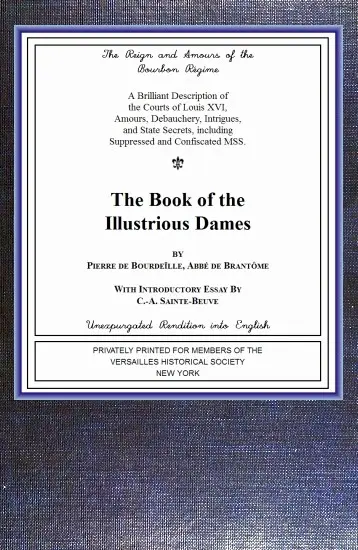
Pierre de Bourdeille Brantôme
BEHIND THE BOOK
This eBook is for the use of anyone anywhere in the United States and most other parts of the world at no cost and with almost no restrictions whatsoever. You may copy it, give it away or re-use it under the terms of the Project Gutenberg License included with this eBook or online at www.gutenberg.org. If you are not located in the United States, you will have to check the laws of the country where you are located before using this eBook. Read the source licence.
The original source file, including credits and licence, is retained by this library. Request an original-format copy at no charge. Please include the book title and Project Gutenberg identifier #67026.
KEEP YOUR CURIOSITY GOING
Cécile Tormay

Moritz Busch
John L. Ransom
Frances Wright
Cécile Tormay

Mabel Potter Daggett