Lives of Fair and Gallant Ladies. Vol 2.
Pierre de Bourdeille Brantôme
THE CLASSIC COLLECTION · 1922
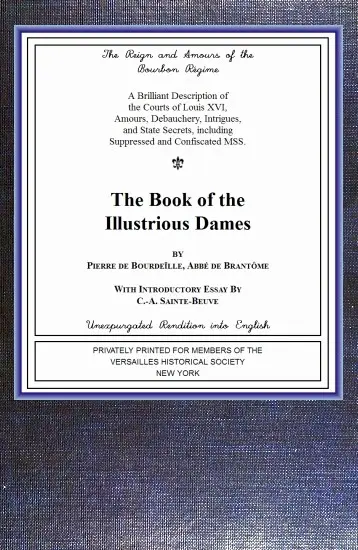
"Lives of Fair and Gallant Ladies. Vol 1" by Pierre de Bourdeille Brantôme is a historical account written in the late 16th century. This work presents a collection of anecdotes and narratives concerning women of high social standing and their experiences with love and relationships. The writing reflects a mixture of admiration for and satire of the gallant ladies of the court, delineating their romantic exploits and the social constructs surrounding them. The opening of this volume sets the stage with a foreword praising A. R. Allinson's translation, stating that it retains the charm and essence of Brantôme's original work. It introduces readers to the author's intentions as he dedicates the tales to a noble patron, expressing both jest and reverence. The initial discourse explores themes of infidelity, displaying women’s cunning and bravery in the face of possessive husbands, while also hinting at the dangers and violent outcomes that often accompany such escapades. Brantôme mentions various characters, illustrating a keen understanding of human nature through anecdotes about lovers and their perilous affairs, thus inviting readers into a world of gallantry, seduction, and the complexities of marital relationships.
Introduction adapted from the source catalogue; source summaries may be automatically generated.
Free to read · English · 126,938 words · No account needed
MAKE TIME FOR A GOOD BOOK
On by default. Untick to stop anonymous reading totals. Each page counts after 10 seconds in view. How this works.
Anonymous counting is on unless you have switched it off.
Pourtant, si je suis brunette,
Amy, n’en prenez esmoy,
Car autant aymer souhaitte
Qu’une plus blanche que moy.
◆Raymond Lulle was a native of Majorca, and lived towards the end of the thirteenth century: he was reputed to be a magician. The story that Brantôme tells was taken from the Opuscula by Charles Bovelles, fol. XXXIV. of the in-4^o edition of 1521. The famous Raimond Lulle (generally known in England as Raimond Lully), philosopher and schoolman, was celebrated throughout the Middle Ages for his logic and his commentary on Aristotle, and above all for his art of Memory, or Ars Lulliana. He was born at Palma, the capital of Majorca, in 1235. He travelled in various countries, and died (1315) in Africa after suffering great hardships, having gone there as a missionary.
◆Or Charles de Bouvelles. His life of Raymond Lulle is a quarto, printed at Paris, and published by Ascencius. It is dated 3rd of the Nones of December, 1511. Several other works by the same author are extant.
◆Arnauld de Villeneuve, a famous alchemist of the end of the thirteenth century; he died in a shipwreck, in 1313.
◆Oldrade, a jurist, was born at Lodi in the thirteenth century. His Codex de falsa moneta is not known.
◆Sisteron, in the Department of the Basses-Alpes, on the Durance. Seat of a Bishopric from the 4th Century down to 1770.
◆Aimeric de Rochechouart (1545–1582) was the bishop of Sisteron; he succeeded his uncle Albin de Rochechouart. As to the “very great lady,” that applies to one of a dozen princesses.
◆Pliny, XXXIII., cap. iv. Brantôme is mistaken about the temple.
◆Claude Blosset, lady of Torcy, the daughter of Jean Blosset and of Anne de Cugnac. She married Louis de Montberon (in 1553), Baron de Fontaines and Chalandray, first gentleman of the king’s bed-chamber. The beautiful Torcy, as she was called, had been presented to Queen Eleonor by Mme. de Canaples, the enemy of Mme. d’Etampes.
◆Hubert Thomas, Annales de vita Friderici II. Palatini (Francfort, 1624), gives no idea of this exaggeration of Queen Eleonor’s bust, who was promised to Frederick Palatine.
◆Suetonius, Octavius Augustus, cap. lxix.
◆Henri de Lorraine, Duc de Guise, nicknamed le Balafré, born 1550. Murdered by the King’s (Henri III.) orders at Blois in 1588.
◆Duc d’Anjou, afterwards Henri III.
◆The personages in question are probably Bussy d’Amboise and
Marguerite de Valois.
◆The king was Henri II., and the grand widow lady the Duchess de Valentinois. They thought it was due to a charm.
◆Pico della Mirandola, Opera omnia, t. II., liv. III., chap.
xxii., in the 1517 edition.
Your reading position is saved on this browser. Take it to another device with a library code. Reading pages adapt to text, rather than matching a printed edition.
Pierre de Bourdeille Brantôme
Pierre de Bourdeille Brantôme
BEHIND THE BOOK
This eBook is for the use of anyone anywhere in the United States and most other parts of the world at no cost and with almost no restrictions whatsoever. You may copy it, give it away or re-use it under the terms of the Project Gutenberg License included with this eBook or online at www.gutenberg.org. If you are not located in the United States, you will have to check the laws of the country where you are located before using this eBook. Read the source licence.
The original source file, including credits and licence, is retained by this library. Request an original-format copy at no charge. Please include the book title and Project Gutenberg identifier #67025.
KEEP YOUR CURIOSITY GOING
Cécile Tormay

Moritz Busch
John L. Ransom
Frances Wright
Cécile Tormay

Mabel Potter Daggett