Lives of Fair and Gallant Ladies. Vol 2.
Pierre de Bourdeille Brantôme
THE CLASSIC COLLECTION · 1922
"Lives of Fair and Gallant Ladies. Vol 1" by Pierre de Bourdeille Brantôme is a historical account written in the late 16th century. This work presents a collection of anecdotes and narratives concerning women of high social standing and their experiences with love and relationships. The writing reflects a mixture of admiration for and satire of the gallant ladies of the court, delineating their romantic exploits and the social constructs surrounding them. The opening of this volume sets the stage with a foreword praising A. R. Allinson's translation, stating that it retains the charm and essence of Brantôme's original work. It introduces readers to the author's intentions as he dedicates the tales to a noble patron, expressing both jest and reverence. The initial discourse explores themes of infidelity, displaying women’s cunning and bravery in the face of possessive husbands, while also hinting at the dangers and violent outcomes that often accompany such escapades. Brantôme mentions various characters, illustrating a keen understanding of human nature through anecdotes about lovers and their perilous affairs, thus inviting readers into a world of gallantry, seduction, and the complexities of marital relationships.
Introduction adapted from the source catalogue; source summaries may be automatically generated.
Free to read · English · 126,938 words · No account needed
MAKE TIME FOR A GOOD BOOK
On by default. Untick to stop anonymous reading totals. Each page counts after 10 seconds in view. How this works.
Anonymous counting is on unless you have switched it off.
◆Isabeau, or Isabelle, de Bavière, wife of the half imbecile Charles VI. of France, and daughter of Stephen II., Duke of Bavaria, was born 1371; died 1435. Among countless other intrigues was one with the Duc d’Orléans, her husband’s brother. One of her lovers, Louis de Boisbourdon, was thrown into the Seine in a leather sack inscribed Laissez passer la justice du roi. The famous story of the Tour de Nesles seems mythical.
◆See under Buridan, in Bayle’s Dict. Critique. Compare also Villon, in his Ballade of the Dames des Temps Jadis (Fair Dames of Yore):
Semblablement où est la reine,
Qui commanda que Buridan
Fust jeté en un sac en Seine?
(Likewise where is the Queen, who commanded Buridan to be cast in a
sack into the Seine?)
◆Plutarch, Anthony, Chap. xxxii.
◆Livy, lib. XXX., cap. xv. Appien, De Rebus punicis, XXVII.
◆Joachim du Bellay, Œuvres poétiques, 1597.
◆La Vieille Courtisane (“The Old Courtesan”), fol. 449. B. of the Œuvres poét. of Joachim du Bellay, edition of 1597.
◆This pun is difficult to explain.
◆Lucian, Amours, XV.
◆Marguerite, wife of Henri IV., whose elegance drew from the old Queen Catherine this remark: “No matter where you may go, the court will take the fashion from you, and not you from the court.”
(Brantôme, Elogé de la reine Marguerite.)
◆Brantôme alludes to the Duke d’Anjou.
◆Jeanne de Navarre, wife of Philippe le Bel, King of France, daughter and sole heiress of Henri I. of Navarre, was born 1272, died 1305 at the early age of 33. She was a beautiful and accomplished Princess, and the tales told by some historians reflecting on her character are apparently quite without foundation.
◆The Divorce satyrique attributes this contrivance to Queen Marguerite, who adopted it to make her husband, the King of Navarre, more deeply enamoured and more naughty.
◆These are taken from an old French book entitled: De la louange et beauté des Dames (“Of the Praise and Beauty of Ladies”). François Corniger has put the same into 18 Latin lines. Vencentio Calmeta has rendered them also into Italian verse, commencing with the words: Dolce Flaminia.
◆Pliny speaks of this Helen of Zeuxis.
◆Ronsard, Œuvres, 1584 edition, p. 112. It is a poem addressed to the famous painter Clouet, according to Janet, in which the poet sings the praises of his fair lady. This poem has more than one point in common with the present chapter of the Dames.
◆Marot had arranged this Spanish proverb into a quatrain, and at the time of the Ligue it was applied to the Infanta of Spain:
Your reading position is saved on this browser. Take it to another device with a library code. Reading pages adapt to text, rather than matching a printed edition.
Pierre de Bourdeille Brantôme
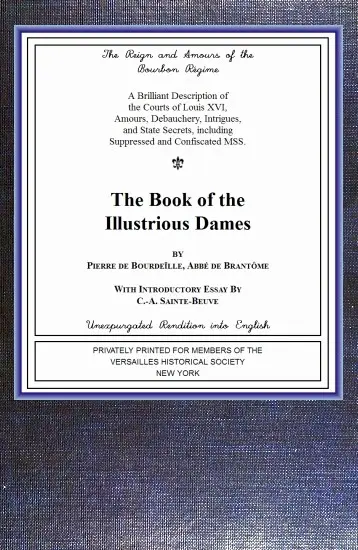
Pierre de Bourdeille Brantôme
BEHIND THE BOOK
This eBook is for the use of anyone anywhere in the United States and most other parts of the world at no cost and with almost no restrictions whatsoever. You may copy it, give it away or re-use it under the terms of the Project Gutenberg License included with this eBook or online at www.gutenberg.org. If you are not located in the United States, you will have to check the laws of the country where you are located before using this eBook. Read the source licence.
The original source file, including credits and licence, is retained by this library. Request an original-format copy at no charge. Please include the book title and Project Gutenberg identifier #67025.
KEEP YOUR CURIOSITY GOING
Cécile Tormay

Moritz Busch
John L. Ransom
Frances Wright
Cécile Tormay

Mabel Potter Daggett