Lives of Fair and Gallant Ladies. Vol 2.
Pierre de Bourdeille Brantôme
THE CLASSIC COLLECTION · 1922
"Lives of Fair and Gallant Ladies. Vol 1" by Pierre de Bourdeille Brantôme is a historical account written in the late 16th century. This work presents a collection of anecdotes and narratives concerning women of high social standing and their experiences with love and relationships. The writing reflects a mixture of admiration for and satire of the gallant ladies of the court, delineating their romantic exploits and the social constructs surrounding them. The opening of this volume sets the stage with a foreword praising A. R. Allinson's translation, stating that it retains the charm and essence of Brantôme's original work. It introduces readers to the author's intentions as he dedicates the tales to a noble patron, expressing both jest and reverence. The initial discourse explores themes of infidelity, displaying women’s cunning and bravery in the face of possessive husbands, while also hinting at the dangers and violent outcomes that often accompany such escapades. Brantôme mentions various characters, illustrating a keen understanding of human nature through anecdotes about lovers and their perilous affairs, thus inviting readers into a world of gallantry, seduction, and the complexities of marital relationships.
Introduction adapted from the source catalogue; source summaries may be automatically generated.
Free to read · English · 126,938 words · No account needed
MAKE TIME FOR A GOOD BOOK
On by default. Untick to stop anonymous reading totals. Each page counts after 10 seconds in view. How this works.
Anonymous counting is on unless you have switched it off.
◆Pico della Mirandola, one of the greatest of all the brilliant scholars of the Renaissance, and so famous for the precocity and versatility of his talents, was born 1463. After completing his studies at Bologna and elsewhere, he visited Rome, where he publicly exhibited a hundred propositions De omni re scribili, which he undertook to defend against all comers. The maturity of his powers he devoted to the study of religion and the Platonic philosophy. He died 1494, on the day of Charles VIII.’s entry into Florence.
◆Ferdinando Francesco Avalos, Marquis de Pescaire, of a well-known Neapolitan family, began his career as a soldier in 1512 at the battle of Ravenna. Distinguished himself by the capture of Milan (1521) and numerous other brilliant feats of arms. Took an important part in the battle of Pavia, where François I. of France was taken prisoner. Wounded in that battle, and died in the same year, 1525. His wife was the celebrated Vittoria Colonna.
◆Josephus, The Antiquities of the Jews, Bk. XV., Chap. vii. Herod the Great; died B. C. 4. He put to death his wife Mariamné, as well as her grandfather and his own sons by her.
◆Shiraz, a town of Persia, capital of the Province of Fars, famous for its roses, wine and nightingales, sung by the Persian poets Hafiz and Saadi.
◆Plutarch, Alexander, Chap. XXXIX.
◆It is in his Observations de plusieurs singularités (Paris, 1554) that Belon reports this fact. (Liv. III., chap. x., p. 179.)
◆The usual form is Ortiagon. The woman is the beautiful Queen Chiomara. (Cf. Livy, XXXVIII., cap. xxiv., and Boccaccio, De claris mulieribus, LXXIV.) Chiomara, wife of Ortiagon, King of Galatia, was taken prisoner by the Romans when Cn. Manlius Vulso invaded Galatia, B. C. 189. The story is told by Polybius (XXII., 21).
◆Suetonius, Cæsar, LII.
◆Livy, XXX., cap. xv.
◆Plutarch, Cato the Elder. Brantôme attributes the anecdote to
Scipion.
◆Charles de Lorraine, Cardinal de Guise, known as Cardinal de Lorraine, died in 1574. He played an important rôle at the Council of Trente. Brantôme refers to the truce of Vaucelles between Henri II. and the Emperor, which Cardinal Caraffa had succeeded in breaking in 1556. This passage had evidently been written before 1588, the year of the death of another Cardinal de Guise, the brother of Balafré.
◆The beautiful Venitians are described by Vecellio as wearing
exquisite gowns on holidays. (See Vecellio, Habiti antichi,
Venice, 1590.)
◆This passage is not in the Dies geniales by Alessandro, but in
Herodotus, II., chap. ix.
◆What Brantôme says of Flora is not true. The woman in question was not called Flora, but Acca Taruntia.
Your reading position is saved on this browser. Take it to another device with a library code. Reading pages adapt to text, rather than matching a printed edition.
Pierre de Bourdeille Brantôme
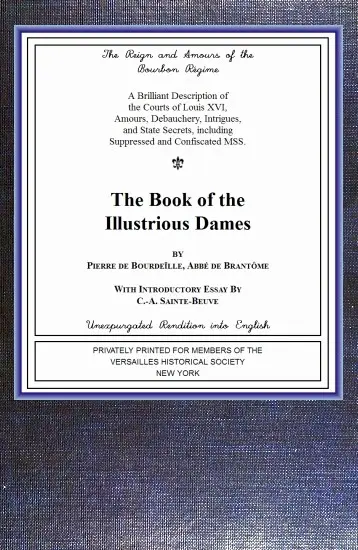
Pierre de Bourdeille Brantôme
BEHIND THE BOOK
This eBook is for the use of anyone anywhere in the United States and most other parts of the world at no cost and with almost no restrictions whatsoever. You may copy it, give it away or re-use it under the terms of the Project Gutenberg License included with this eBook or online at www.gutenberg.org. If you are not located in the United States, you will have to check the laws of the country where you are located before using this eBook. Read the source licence.
The original source file, including credits and licence, is retained by this library. Request an original-format copy at no charge. Please include the book title and Project Gutenberg identifier #67025.
KEEP YOUR CURIOSITY GOING
Cécile Tormay

Moritz Busch
John L. Ransom
Frances Wright
Cécile Tormay

Mabel Potter Daggett