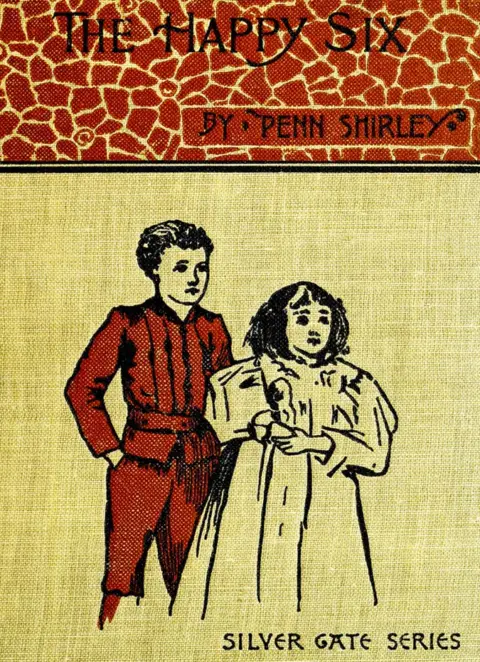
The happy six
Penn Shirley
THE CLASSIC COLLECTION · 1886
"Little Miss Weezy" by Penn Shirley is a children's novel written in the late 19th century. It follows the high-spirited toddler Louise “Weezy” Rowe through a string of domestic adventures with her family and neighbors, blending humor with gentle moral lessons. The vignettes spotlight Weezy’s mischief and charm alongside the foibles and growth of her siblings, parents, and kindly Uncle Doctor, with affectionate attention to everyday life and the virtues of honesty, obedience, and kindness. Readers who enjoy warm family stories and lively child viewpoints will find it playful and tender. The opening of the story introduces Weezy’s nickname and home circle, then sweeps through a series of comic scrapes: she locks the maid out while the wash boils over, disrupts church by serenading the hymn with “Little Sally Walker,” and later follows a beggar child and gets lost before a policeman and the girl help her home. She and a helper, Ellen, trigger a memorable moment when a pickle turns up in the teapot at a minister’s dinner; she climbs a clock to steal the desk key and cuts paper dolls from a deed; she suffers the mumps while braiding her uncle’s beard; and she inadvertently sends her father down the street with her yarn doll “Sambo” tied to his coat. Weezy “goes calling” with visiting-cards, returns in a delivery wagon with figs, and is wrongly suspected of taking a dime until it’s found. A parallel thread shows brother Kirke’s lapse and honest confession at school, while Weezy’s own judgment shines when she refuses a birthday drive until a “stealing apples” joke is cleared up. A winter visit to grandparents adds a schoolroom mix-up—promising “one slide” but “heeling and toeing” the snowy bank instead—before her father arrives to bring her home for Christmas, with a mysterious moving, musical present teased as the scene breaks.
Introduction adapted from the source catalogue; source summaries may be automatically generated.
Free to read · English · 18,512 words · No account needed
MAKE TIME FOR A GOOD BOOK
On by default. Untick to stop anonymous reading totals. Each page counts after 10 seconds in view. How this works.
Anonymous counting is on unless you have switched it off.
"I'll find something for your mother," said Mrs. Rowe, taking the child's basket into the pantry. Next moment Weezy frisked after her.
"Her hasn't no playsings, mamma. Can't her have Weezy's wabbit?"
"If my little daughter gives away her rabbit, I'm afraid she will cry for it by and by," said Mrs. Rowe, opening the cake-chest.
"No, no. Weezy won't ky."
"Well, well; run and get the rabbit, dear," said her mamma; and Weezy brought the neglected animal, that had been lying under the piano on its cotton-flannel back.
"Now you's got a playsing," said she benevolently, crowding it into Ellen Nolan's basket, between a biscuit and a doughnut.
Then, attracted by some musicians in the street, she scampered back to the sitting-room to join in the tunes.
"O mamma!" cried she, hopping up and down in ecstasy, "hear the banders blowin' moosic, and Weezy singin' what they blows."
Having watched the players out of sight, she ran into the kitchen to entertain her guest; but the funny little beggar-maid had disappeared,--basket, "playsing," and all.
"Her's tooken away Weezy's wabbit," sobbed the resentful baby, slipping through the door left ajar by Ellen. "Her's a nugly, naughty sing."
In three seconds more she was out of the yard.
"Him was Weezy's wabbit. 'Ittle dirl mustn't keep Weezy's wabbit allus," grumbled she, stubbing her indignant toes over the pavement.
Meanwhile Mrs. Rowe had been hastening to wind the spools in her work-basket before her little daughter should return to tangle the threads. Presently she was struck by the unusual stillness of the house, and went to see what the child was doing.
"I took it for granted she was with you," said Lovisa, appearing from the basement, where she had been at work ever since Ellen Nolan left. "Isn't she up-stairs?"
"No: I've looked everywhere; and the porch-door is open. I'm afraid she
has run away."
"I'll cut across to Cedar Street," said Lovisa, running out bareheaded.
Seizing her bonnet, Mrs. Rowe hurried over to Mrs. Nye's, in the hope that Weezy might be with Kisty; but none of the family had seen her that day. More and more alarmed, Mrs. Rowe hastened on down the street. Passing a group of laborers digging by the roadside, she remembered with a shudder that new water-pipes were being laid throughout the city. What if her baby had fallen into one of the deep trenches opened for these? Entering the nearest drug-store, she telephoned to her husband that Weezy was missing; and then, at a loss what further to do, ran home again to learn the result of Lovisa's search.
Your reading position is saved on this browser. Take it to another device with a library code. Reading pages adapt to text, rather than matching a printed edition.
Penn Shirley
BEHIND THE BOOK
This eBook is for the use of anyone anywhere in the United States and most other parts of the world at no cost and with almost no restrictions whatsoever. You may copy it, give it away or re-use it under the terms of the Project Gutenberg License included with this eBook or online at www.gutenberg.org. If you are not located in the United States, you will have to check the laws of the country where you are located before using this eBook. Read the source licence.
The original source file, including credits and licence, is retained by this library. Request an original-format copy at no charge. Please include the book title and Project Gutenberg identifier #76122.
KEEP YOUR CURIOSITY GOING
Coulson Kernahan

Maurice Baring
Frances Wright
Cécile Tormay

Frederic Jesup Stimson

W. H. P. (William Henry Pope) Jarvis