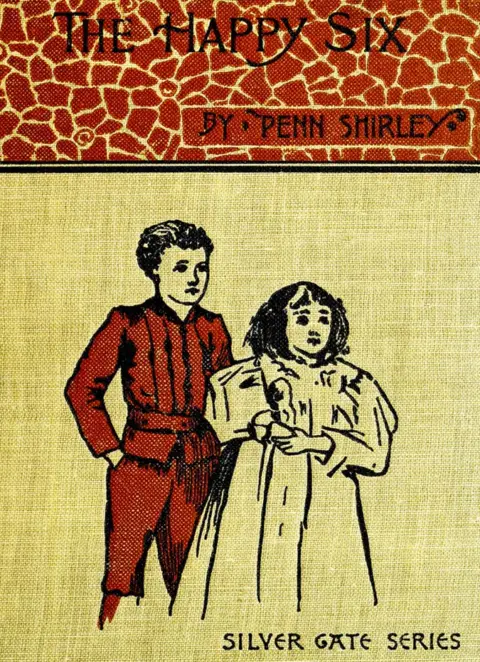
The happy six
Penn Shirley
THE CLASSIC COLLECTION · 1886
"Little Miss Weezy" by Penn Shirley is a children's novel written in the late 19th century. It follows the high-spirited toddler Louise “Weezy” Rowe through a string of domestic adventures with her family and neighbors, blending humor with gentle moral lessons. The vignettes spotlight Weezy’s mischief and charm alongside the foibles and growth of her siblings, parents, and kindly Uncle Doctor, with affectionate attention to everyday life and the virtues of honesty, obedience, and kindness. Readers who enjoy warm family stories and lively child viewpoints will find it playful and tender. The opening of the story introduces Weezy’s nickname and home circle, then sweeps through a series of comic scrapes: she locks the maid out while the wash boils over, disrupts church by serenading the hymn with “Little Sally Walker,” and later follows a beggar child and gets lost before a policeman and the girl help her home. She and a helper, Ellen, trigger a memorable moment when a pickle turns up in the teapot at a minister’s dinner; she climbs a clock to steal the desk key and cuts paper dolls from a deed; she suffers the mumps while braiding her uncle’s beard; and she inadvertently sends her father down the street with her yarn doll “Sambo” tied to his coat. Weezy “goes calling” with visiting-cards, returns in a delivery wagon with figs, and is wrongly suspected of taking a dime until it’s found. A parallel thread shows brother Kirke’s lapse and honest confession at school, while Weezy’s own judgment shines when she refuses a birthday drive until a “stealing apples” joke is cleared up. A winter visit to grandparents adds a schoolroom mix-up—promising “one slide” but “heeling and toeing” the snowy bank instead—before her father arrives to bring her home for Christmas, with a mysterious moving, musical present teased as the scene breaks.
Introduction adapted from the source catalogue; source summaries may be automatically generated.
Free to read · English · 18,512 words · No account needed
MAKE TIME FOR A GOOD BOOK
On by default. Untick to stop anonymous reading totals. Each page counts after 10 seconds in view. How this works.
Anonymous counting is on unless you have switched it off.
Lovisa hurried to the pantry as fast as she could, for a bowl of bread and milk; then she heard the man coming up the walk, and she ran back to the kitchen to hand it to him before he should have time to enter.
"Here's something for you," said she, opening the door just far enough to put the bowl through. "You can sit down outside on the doorstep and eat it."
Instead of taking the bowl, the man began to laugh; and Lovisa opened the door wider, and saw he was Mr. Blake, the baker.
"Beg your pardon, sir," stammered she, very much confused. "The little girl said you were a beggar-man." And upon that she began to laugh, too, and laughed so hard that Mrs. Rowe herself had to give the order for "two graham loaves and a loaf of sponge-cake."
"Run, dear, and get mamma's purse off the bureau," said she to Weezy. "I want to pay Mr. Blake some money."
The child brought the purse, and looked on while the bread and cake
were being paid for.
"Here, dear," said her mother, shaking some soiled visiting-cards out of the portmonnaie, "you may have these to play with. Now put mamma's purse back where you found it."
Weezy was gone some time, but presently she ran down again to her garden. Mrs. Rowe would not have felt so easy stoning raisins in the pantry if she had known the baker had left the gate unfastened.
Weezy was not long in discovering the fact. Unfortunately, she still held the cards in her hand. They gave her an idea.
"Weezy'll go a-calling," said she, whisking through the gateway, with a backward glance to see if anybody was looking. She felt quite equal to the undertaking; for hadn't she been visiting once with her mother, and carried the card-case all the way?
"'Come in, you pretty little pet;' that's what the lady'll say," she prattled on to herself, climbing the steps of the first house around the corner, dragging armless Sambo after her by the stocking-yarn hair.
"Oh, what a high-up bell!"
Even on tiptoe she could not reach it. She laid Sambo down and stood on top of him, but even then could only touch the bell-knob with the tips of her fingers.
"Oh, my suz! guess I'll have to knock."
And she did knock, so very gently that nobody in the world could have
heard her.
"People's gone away off," said she, slipping a card under the door, as she had seen her mamma do when nobody answered her ring.
Your reading position is saved on this browser. Take it to another device with a library code. Reading pages adapt to text, rather than matching a printed edition.
Penn Shirley
BEHIND THE BOOK
This eBook is for the use of anyone anywhere in the United States and most other parts of the world at no cost and with almost no restrictions whatsoever. You may copy it, give it away or re-use it under the terms of the Project Gutenberg License included with this eBook or online at www.gutenberg.org. If you are not located in the United States, you will have to check the laws of the country where you are located before using this eBook. Read the source licence.
The original source file, including credits and licence, is retained by this library. Request an original-format copy at no charge. Please include the book title and Project Gutenberg identifier #76122.
KEEP YOUR CURIOSITY GOING
Coulson Kernahan

Maurice Baring
Frances Wright
Cécile Tormay

Frederic Jesup Stimson

W. H. P. (William Henry Pope) Jarvis