THE CLASSIC COLLECTION✦A dead man’s diaryCLASSIC FREE BOOKS
A dead man’s diary
Coulson Kernahan
THE CLASSIC COLLECTION · 1888
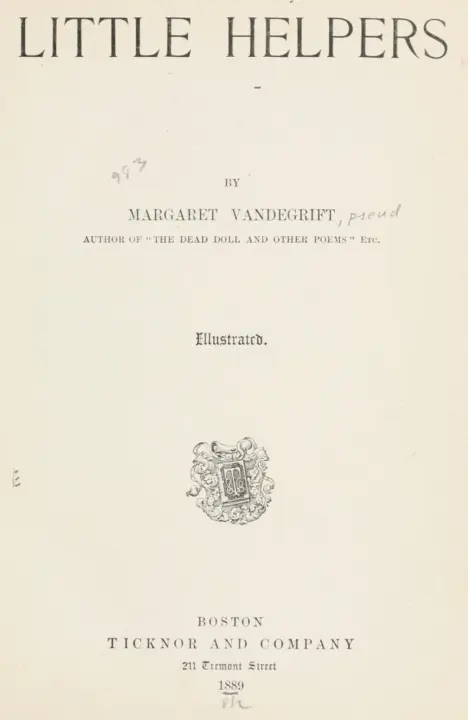
"Little Helpers" by Margaret Vandegrift is a children’s novel written in the late 19th century. The story centers around a young boy named Johnny Leslie, who navigates the complexities of childhood independence, responsibility, and morality as he prepares to deliver a Fourth of July oration. Through his various adventures, including encounters with friends and lessons from his mother, the themes of inalienable rights and the importance of personal character begin to unfold. At the start of the tale, Johnny enthusiastically stands on a flour barrel, reciting his understanding of rights and freedom to a small audience that includes Tiny, a young girl, and his stuffed companion, Veronica. His mother's nurturing guidance leads him through discussions about rights, responsibilities, and the sometimes confusing nature of independence. The opening scenes set the stage for a humorous yet insightful exploration of Johnny's experiences, leading to mishaps such as a failed attempt at smoking and a bout of illness. This serves as the foundation for Johnny's growth, not just as a child, but as a thoughtful individual beginning to comprehend the nuances of moral choices and interpersonal relationships.
Introduction adapted from the source catalogue; source summaries may be automatically generated.
Free to read · English · 60,481 words · No account needed
MAKE TIME FOR A GOOD BOOK
On by default. Untick to stop anonymous reading totals. Each page counts after 10 seconds in view. How this works.
Anonymous counting is on unless you have switched it off.
Johnny was like the Irishman’s gun in one respect—he could “shoot round a corner;” but he did not always succeed in hitting anything, as he did to-day. The anything, this time, happened to be Jim Brady, and as Jim was going very nearly as fast as Johnny was, neither had breath enough left, after the collision, to say anything for at least a minute. Then Jim managed to inquire, between his gasps,—
“Any lives lost on your side, Johnny?”
“No, I b’lieve not,” said Johnny, rather feebly, and then they both leaned against the fence, and laughed.
“I was coming after you, Johnny,” began Jim, and then he stopped to
breathe again.
“Well, you found me!” said Johnny, who, being smaller and lighter than Jim, was first to recover from the shock, “but tell me what it is, please, quick, for I’m in a hurry!”
And almost without knowing that he did so, he squared his elbows to run on again. Jim saw the motion, and his face clouded over.
“I can’t tell you everything I had to say in half a second, so I’ll not bother you; maybe, I can find somebody else,” and Jim began to walk off.
Johnny sprang after him, caught his arm, and gave him a little shake,
saying as he did so,—
“See here, Jim Brady, if you don’t stop putting on airs at me like this, I’ll—I’ll—” and he stopped for want of a threat dire enough for the occasion.
“I would,” said Jim, dryly, “but if I were you, I’d find out first what airs was—were—and who was putting ’em on. I see you’re in a hurry, and I’m sorry I stopped you. Let go of my arm, will you?”
“No, I won’t!” said Johnny, “so there now! And if you won’t be decent, and turn ’round, and walk towards home with me, why, I’ll walk along with you till you tell me what you were going to say. I never did see such a—” and again Johnny stopped for want of a word that suited him.
Jim made no answer, and his face remained sullen, but he turned at once, and the two walked on arm in arm, toward Johnny’s home.
“Well,” said Johnny, presently, “we’re ’most there. Are you going to say
anything?”
“I wouldn’t, if it was for myself—not if you hung on to me for a week!” and Jim’s face worked; Johnny even thought his voice trembled a little.
Your reading position is saved on this browser. Take it to another device with a library code. Reading pages adapt to text, rather than matching a printed edition.
BEHIND THE BOOK
This eBook is for the use of anyone anywhere in the United States and most other parts of the world at no cost and with almost no restrictions whatsoever. You may copy it, give it away or re-use it under the terms of the Project Gutenberg License included with this eBook or online at www.gutenberg.org. If you are not located in the United States, you will have to check the laws of the country where you are located before using this eBook. Read the source licence.
The original source file, including credits and licence, is retained by this library. Request an original-format copy at no charge. Please include the book title and Project Gutenberg identifier #63793.
KEEP YOUR CURIOSITY GOING
Coulson Kernahan

Maurice Baring
Frances Wright
Cécile Tormay

Frederic Jesup Stimson

W. H. P. (William Henry Pope) Jarvis