THE CLASSIC COLLECTION✦A dead man’s diaryCLASSIC FREE BOOKS
A dead man’s diary
Coulson Kernahan
THE CLASSIC COLLECTION · 1888
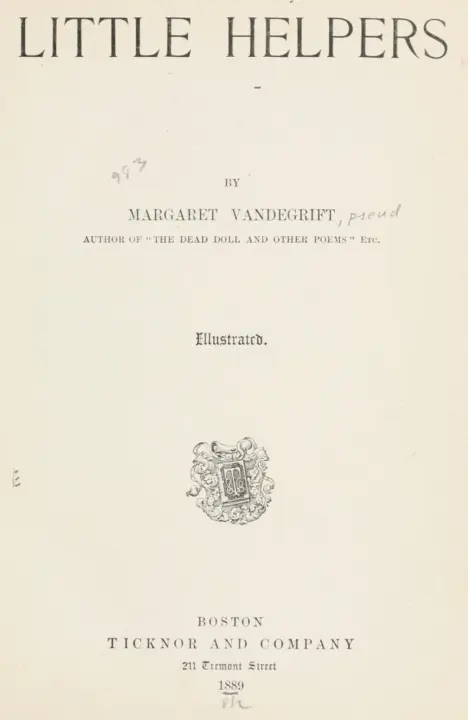
"Little Helpers" by Margaret Vandegrift is a children’s novel written in the late 19th century. The story centers around a young boy named Johnny Leslie, who navigates the complexities of childhood independence, responsibility, and morality as he prepares to deliver a Fourth of July oration. Through his various adventures, including encounters with friends and lessons from his mother, the themes of inalienable rights and the importance of personal character begin to unfold. At the start of the tale, Johnny enthusiastically stands on a flour barrel, reciting his understanding of rights and freedom to a small audience that includes Tiny, a young girl, and his stuffed companion, Veronica. His mother's nurturing guidance leads him through discussions about rights, responsibilities, and the sometimes confusing nature of independence. The opening scenes set the stage for a humorous yet insightful exploration of Johnny's experiences, leading to mishaps such as a failed attempt at smoking and a bout of illness. This serves as the foundation for Johnny's growth, not just as a child, but as a thoughtful individual beginning to comprehend the nuances of moral choices and interpersonal relationships.
Introduction adapted from the source catalogue; source summaries may be automatically generated.
Free to read · English · 60,481 words · No account needed
MAKE TIME FOR A GOOD BOOK
On by default. Untick to stop anonymous reading totals. Each page counts after 10 seconds in view. How this works.
Anonymous counting is on unless you have switched it off.
Johnny had been talking to his mother, as he often talked, about a Bible verse which he did not fully understand—
“But thou, when thou fastest, anoint thine head and wash thy face, that thou appear not unto men to fast, but unto thy Father which seeth in secret,”—and she had told him that a sacrifice, to be real and whole-hearted, must be made not only willingly, but cheerfully; “not grudgingly, or of necessity, for God loveth a cheerful giver.”
“I don’t wonder at all at that, mamma,” Johnny had replied, “when you think how hateful it is to have people do things for you as if they didn’t wish to. I’d rather go without a thing, than take it when people are that way.”
“Yes,” said Mrs. Leslie, “people do sometimes say ‘oh bother’ when ‘certainly’ would be more appropriate,”—Johnny laughed, but he blushed a little, too—“and ‘directly,’ or ‘in a minute,’” continued his mother, “when it would be more graceful, to say the least of it, to go at once, without any words. We forget too often that ‘even Christ pleased not Himself,’ and we fret over the disturbing of our own little plans and arrangements, as if we were all Great Moguls.”
“You don’t, mammy,” and Johnny kissed his mother in the particular spot, just under her chin, where he always kissed her when he felt unusually affectionate.
“Oh, yes I do, dear, oftener than you know,” said Mrs. Leslie, “but I am trying all the time, and when I am nearly sure that I am going to be cross, I go away by myself, if I can, for a few minutes, where I can fight it out without punishing any one else, and when I can’t do that, I ask for strength just to keep perfectly still until pleasant words will come.”
“You’ve been practising so long, mamma,” said Johnny, wistfully, “that you’re just about perfect, I think; but I don’t believe I will be, if I live to be as old as Methusaleh! I wish I had some sort of an arrangement to clap on the outside of my mouth, that would hold it shut for five minutes!”
“But don’t you see, dear,”—and Mrs. Leslie laughed a little at Johnny’s idea—“that if you had time to remember to clap on your ‘arrangement,’ you would have time to stop yourself in another and better way?”
“Yes, mamma, I suppose I should,” admitted Johnny, “but it somehow seems as if the other way would be easier, especially if I had the ‘arrangement’ somewhere where I could always see it.”
Your reading position is saved on this browser. Take it to another device with a library code. Reading pages adapt to text, rather than matching a printed edition.
BEHIND THE BOOK
This eBook is for the use of anyone anywhere in the United States and most other parts of the world at no cost and with almost no restrictions whatsoever. You may copy it, give it away or re-use it under the terms of the Project Gutenberg License included with this eBook or online at www.gutenberg.org. If you are not located in the United States, you will have to check the laws of the country where you are located before using this eBook. Read the source licence.
The original source file, including credits and licence, is retained by this library. Request an original-format copy at no charge. Please include the book title and Project Gutenberg identifier #63793.
KEEP YOUR CURIOSITY GOING
Coulson Kernahan

Maurice Baring
Frances Wright
Cécile Tormay

Frederic Jesup Stimson

W. H. P. (William Henry Pope) Jarvis