THE CLASSIC COLLECTION✦A dead man’s diaryCLASSIC FREE BOOKS
A dead man’s diary
Coulson Kernahan
THE CLASSIC COLLECTION · 1888
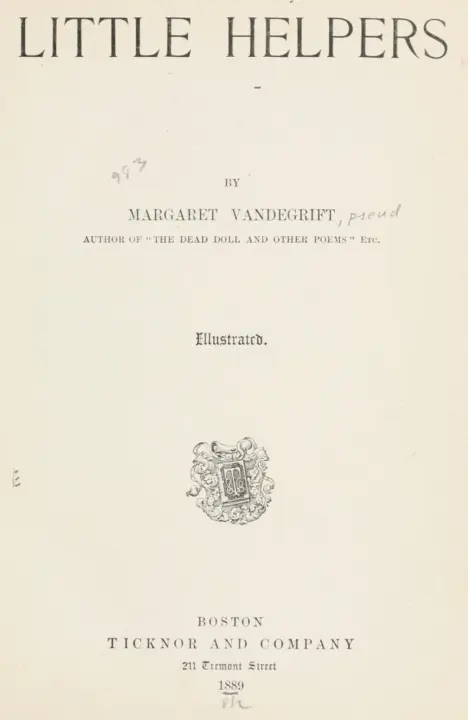
"Little Helpers" by Margaret Vandegrift is a children’s novel written in the late 19th century. The story centers around a young boy named Johnny Leslie, who navigates the complexities of childhood independence, responsibility, and morality as he prepares to deliver a Fourth of July oration. Through his various adventures, including encounters with friends and lessons from his mother, the themes of inalienable rights and the importance of personal character begin to unfold. At the start of the tale, Johnny enthusiastically stands on a flour barrel, reciting his understanding of rights and freedom to a small audience that includes Tiny, a young girl, and his stuffed companion, Veronica. His mother's nurturing guidance leads him through discussions about rights, responsibilities, and the sometimes confusing nature of independence. The opening scenes set the stage for a humorous yet insightful exploration of Johnny's experiences, leading to mishaps such as a failed attempt at smoking and a bout of illness. This serves as the foundation for Johnny's growth, not just as a child, but as a thoughtful individual beginning to comprehend the nuances of moral choices and interpersonal relationships.
Introduction adapted from the source catalogue; source summaries may be automatically generated.
Free to read · English · 60,481 words · No account needed
MAKE TIME FOR A GOOD BOOK
On by default. Untick to stop anonymous reading totals. Each page counts after 10 seconds in view. How this works.
Anonymous counting is on unless you have switched it off.
“Now, Miss Ann,” said Johnny, taking charge of the meeting, and quite forgetting to ask “if she would mind telling,” “we want you to please tell us how you manage always to seem to like what you are doing, and to want to do what everybody wants you to do and not to—not have any yourself at all!”
Miss Ann’s pleasant round face turned even redder than it had been as she bent over the blackberries, and she seemed too astonished to speak, for a moment; then she put an arm about each of the children, and gave each a hearty kiss, and somehow, although Johnny had begun to think he was too old to be kissed, he did not mind it at all.
“You dear little souls!” said Miss Ann, and Tiny thought there was a sort of quaver in her voice, “it’s only your own good-nature that makes you feel that way. Why, I’ve never been able to hold a candle to mother for work, nor to father and Julia and the boys for smartness, and there was a time, five or six years ago, when I felt sort of all discouraged. They couldn’t help laughing at me when I said silly things, and made stupid blunders, and my ugly face worried me every time I looked in the glass.”
“But you’re not ugly at all!” burst in both the children, indignantly.
Again the color swept over Miss Ann’s face, but she laughed in a pleased, childlike way, as she said,—
“There you go, again! What sweet little souls you are. I’m real glad you feel that way, dears, but I know too well it’s only your kind hearts that make you think so. And it seemed to me that I might about as well give up, I couldn’t make myself pretty, no matter how hard I tried, nor how I fixed my molasses-candy-colored hair—every way seemed to make me a little uglier than the last. And I was so slow,—I was always thinking about that poor man in the Bible, that wanted so to get into the pool, and while he was coming somebody else would step down before him. Mother would lose her patience, and Julia and the boys would laugh, a dozen times a day, and then I would get all of a tremble with nervousness, and like as not say something I’d be sorry for the minute it was said, and maybe wind up with a crying spell. They didn’t any of them know how I really felt, or they wouldn’t have laughed and joked about it, for kinder folks than mine you couldn’t find in a day’s walk, and somehow, though it sounds crooked to say so, that very thing made it hurt all the more. And when mother said she calculated to take boarders that summer, for we’d had two or three bad years, and things were getting behindhand, I came near running away, and taking a service place where nobody knew me. But I couldn’t quite bring myself to that, and I can’t tell you how thankful I’ve been ever since, that I couldn’t, for I’d have missed the best thing that ever happened to me, besides shirking a plain duty, like a coward. The first boarders that came that season were a dear old lady and her husband. He was real nice, and not a bit of trouble, but she! I lost my heart to her the first time I saw her, and I kept losing it more and more all the time she stayed. She hadn’t very good health, but most well people will give twice the trouble she did, and never stop to think of it. She was going to stay all summer, and the way I came to begin waiting on her was a sort of an accident. Julia made me take up the pail of fresh water to fill her pitcher, just to plague me, and I found her with her trunk and the top bureau drawer open, and she sitting down between them, looking very white and weak.
Your reading position is saved on this browser. Take it to another device with a library code. Reading pages adapt to text, rather than matching a printed edition.
BEHIND THE BOOK
This eBook is for the use of anyone anywhere in the United States and most other parts of the world at no cost and with almost no restrictions whatsoever. You may copy it, give it away or re-use it under the terms of the Project Gutenberg License included with this eBook or online at www.gutenberg.org. If you are not located in the United States, you will have to check the laws of the country where you are located before using this eBook. Read the source licence.
The original source file, including credits and licence, is retained by this library. Request an original-format copy at no charge. Please include the book title and Project Gutenberg identifier #63793.
KEEP YOUR CURIOSITY GOING
Coulson Kernahan

Maurice Baring
Frances Wright
Cécile Tormay

Frederic Jesup Stimson

W. H. P. (William Henry Pope) Jarvis