THE CLASSIC COLLECTION✦A dead man’s diaryCLASSIC FREE BOOKS
A dead man’s diary
Coulson Kernahan
THE CLASSIC COLLECTION · 1888
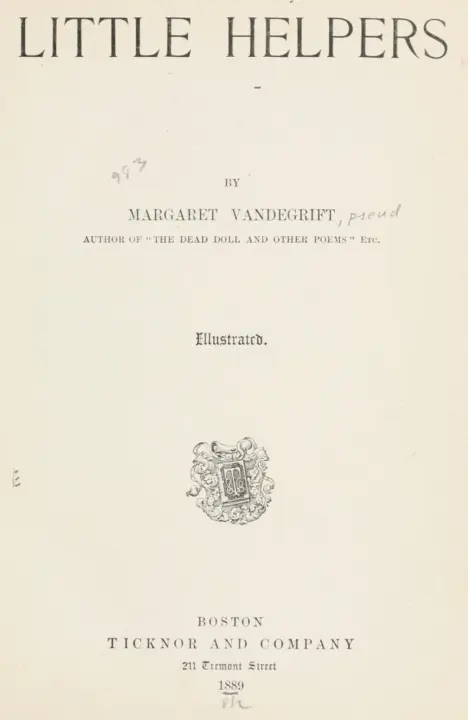
"Little Helpers" by Margaret Vandegrift is a children’s novel written in the late 19th century. The story centers around a young boy named Johnny Leslie, who navigates the complexities of childhood independence, responsibility, and morality as he prepares to deliver a Fourth of July oration. Through his various adventures, including encounters with friends and lessons from his mother, the themes of inalienable rights and the importance of personal character begin to unfold. At the start of the tale, Johnny enthusiastically stands on a flour barrel, reciting his understanding of rights and freedom to a small audience that includes Tiny, a young girl, and his stuffed companion, Veronica. His mother's nurturing guidance leads him through discussions about rights, responsibilities, and the sometimes confusing nature of independence. The opening scenes set the stage for a humorous yet insightful exploration of Johnny's experiences, leading to mishaps such as a failed attempt at smoking and a bout of illness. This serves as the foundation for Johnny's growth, not just as a child, but as a thoughtful individual beginning to comprehend the nuances of moral choices and interpersonal relationships.
Introduction adapted from the source catalogue; source summaries may be automatically generated.
Free to read · English · 60,481 words · No account needed
MAKE TIME FOR A GOOD BOOK
On by default. Untick to stop anonymous reading totals. Each page counts after 10 seconds in view. How this works.
Anonymous counting is on unless you have switched it off.
“Why mammy! of course I was!” he answered, opening his eyes very wide, and for a moment forgetting his woes. No opportunity which he considered large enough had yet occurred, for him to try to win back his mother’s “silken sleeve,” which he had worn twisted around his hat to show that he meant to render her knightly service, and which he had given back to her the day after the circus, because he felt that he was unworthy to wear it, and he often looked at it sorrowfully as it hung, where he had placed it, above his mother’s picture, in his little room.
“Very well,” she said, gently pulling him down upon her lap, and turning his face away from the distracting window. “Imagine that you are really a knight, and that you are storm bound in my castle, as the foreign knight was in Sintram’s. You’d be too polite, in that case, I hope, to be grumbling and howling because you were compelled to pass a whole day in the charming society of the lady of the castle—now, wouldn’t you?”
“Well, yes, mamma, I suppose I should,” admitted Johnny, reluctantly, “but somehow it doesn’t seem exactly the same thing. You see, the snow may all be melted before you let me out again, and when the real old knights were storm bound, or anything, they always knew that their enemies and battles and things would keep!”
“Very well then,” replied his mother, promptly, “that gives you a chance to be just so much more knightly than the ‘real old knights’ were! And if you don’t give another howl, or scowl, or grumble, all day, but are my very best Johnny, instead of my second best or third best, I’ll twist my sleeve around your new school cap this very night!”
“Oh, mammy! will I really and truly be winning it, that way?” asked
Johnny, eagerly.
“Indeed you will,” said his mother, kissing him, “for you’ll never, even if you should some day be a soldier, and fight for your country, find a worse enemy, or one that will take more conquering, than my third-best Johnny Leslie!”
Johnny returned the kiss with interest, and then, resolutely turning his back to the window, he said,—
“Tiny, if you’ll bring your old black Dinah here, I’ll get out all the blocks, and my pea-shooter, and my little brass cannon, and we’ll make a huge fort, and put Dinah in the tower, and storm it! You don’t mind our making a muss here, mammy, if we clear it up again, do you?”
Your reading position is saved on this browser. Take it to another device with a library code. Reading pages adapt to text, rather than matching a printed edition.
BEHIND THE BOOK
This eBook is for the use of anyone anywhere in the United States and most other parts of the world at no cost and with almost no restrictions whatsoever. You may copy it, give it away or re-use it under the terms of the Project Gutenberg License included with this eBook or online at www.gutenberg.org. If you are not located in the United States, you will have to check the laws of the country where you are located before using this eBook. Read the source licence.
The original source file, including credits and licence, is retained by this library. Request an original-format copy at no charge. Please include the book title and Project Gutenberg identifier #63793.
KEEP YOUR CURIOSITY GOING
Coulson Kernahan

Maurice Baring
Frances Wright
Cécile Tormay

Frederic Jesup Stimson

W. H. P. (William Henry Pope) Jarvis