THE CLASSIC COLLECTION✦A dead man’s diaryCLASSIC FREE BOOKS
A dead man’s diary
Coulson Kernahan
THE CLASSIC COLLECTION · 1888
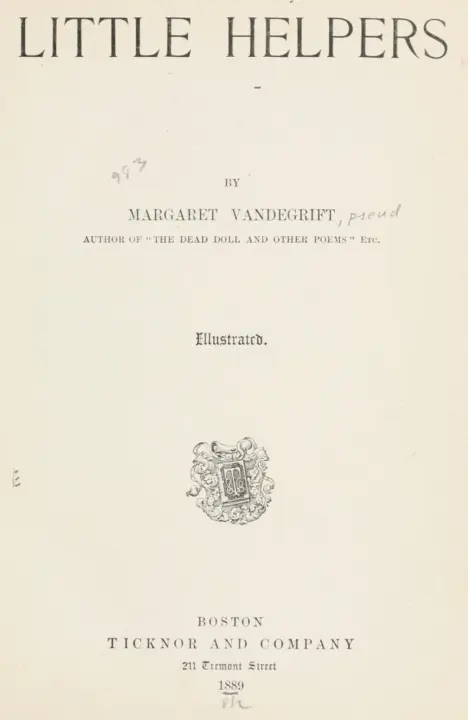
"Little Helpers" by Margaret Vandegrift is a children’s novel written in the late 19th century. The story centers around a young boy named Johnny Leslie, who navigates the complexities of childhood independence, responsibility, and morality as he prepares to deliver a Fourth of July oration. Through his various adventures, including encounters with friends and lessons from his mother, the themes of inalienable rights and the importance of personal character begin to unfold. At the start of the tale, Johnny enthusiastically stands on a flour barrel, reciting his understanding of rights and freedom to a small audience that includes Tiny, a young girl, and his stuffed companion, Veronica. His mother's nurturing guidance leads him through discussions about rights, responsibilities, and the sometimes confusing nature of independence. The opening scenes set the stage for a humorous yet insightful exploration of Johnny's experiences, leading to mishaps such as a failed attempt at smoking and a bout of illness. This serves as the foundation for Johnny's growth, not just as a child, but as a thoughtful individual beginning to comprehend the nuances of moral choices and interpersonal relationships.
Introduction adapted from the source catalogue; source summaries may be automatically generated.
Free to read · English · 60,481 words · No account needed
MAKE TIME FOR A GOOD BOOK
On by default. Untick to stop anonymous reading totals. Each page counts after 10 seconds in view. How this works.
Anonymous counting is on unless you have switched it off.
“No; what makes you think I have?” and Johnny “bristled”; he was not a little afraid of Jim’s sharp tongue.
“Oh, I thought I saw a sort of a swelled-out look around your mouth,” said Jim, very gravely, “and you don’t look happy; and those two things are what I heard a big doctor call symptom-atic!”
Johnny’s face cleared a little.
“Look out you don’t choke, Jim,” he said, briskly, and, with a nod by way of good morning, began to run, to make up for lost time.
He barely did it, and he felt that he was looking red and breathless, while everybody else had a particularly cool and comfortable expression—“as if they’d been here a week!” he grumbled to himself.
Things went on in this style all day. He nearly quarrelled with one of his best friends, at recess, about such a mere trifle that he was ashamed to remember it, afterward. His sums “came wrong”; he lost a place in one of his classes; he tripped and tumbled, scattering his books again, just as he was starting for home; the stationery store was entirely out of book straps, and although the polite stationer promised to have a very superior one, direct from the saddle-and-harness-maker’s, by the next afternoon, at latest, Johnny was not consoled.
So, altogether, he came home in a rather worse humor than that in which he had gone away, and although, fortunately, nothing happened to cause an explosion, he certainly did not add to the general happiness at the tea table. He studied his lessons in silence, for the half hour after tea which was all the evening time he was allowed for study, and then took up a book in which he had been very much interested, but it seemed suddenly to have turned dull, and he rose with unusual promptness, when the clock struck nine, and bade his father good night. His good night to his mother came later, when he was snugly in bed.
“Don’t you feel well to-night, my boy?” asked Mr. Leslie, laying a kind hand on Johnny’s head, as he spoke.
“Oh, yes, papa, I’m all right, I suppose,” replied Johnny, soberly, “but it just seems as if everything had gone sort of upside down, to-day, somehow!”
“Will you allow me to try a simple and comparatively painless experiment
upon you, John?”
Mr. Leslie spoke very seriously, but there was a twinkle in his eye which Johnny well knew meant mischief. It meant fun, too, though, and Johnny replied with equal gravity,—
“Certainly, papa, unless it is very painful.”
Your reading position is saved on this browser. Take it to another device with a library code. Reading pages adapt to text, rather than matching a printed edition.
BEHIND THE BOOK
This eBook is for the use of anyone anywhere in the United States and most other parts of the world at no cost and with almost no restrictions whatsoever. You may copy it, give it away or re-use it under the terms of the Project Gutenberg License included with this eBook or online at www.gutenberg.org. If you are not located in the United States, you will have to check the laws of the country where you are located before using this eBook. Read the source licence.
The original source file, including credits and licence, is retained by this library. Request an original-format copy at no charge. Please include the book title and Project Gutenberg identifier #63793.
KEEP YOUR CURIOSITY GOING
Coulson Kernahan

Maurice Baring
Frances Wright
Cécile Tormay

Frederic Jesup Stimson

W. H. P. (William Henry Pope) Jarvis