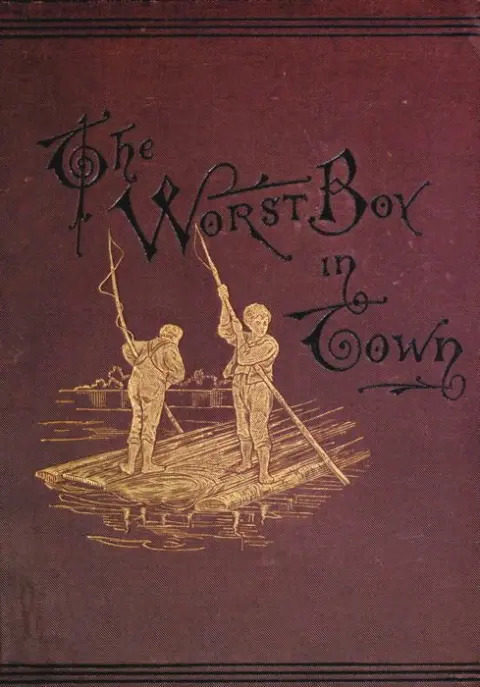
The Worst Boy in Town
John Habberton
THE CLASSIC COLLECTION · 1878
"Little Guzzy" by John Habberton is a collection of short stories written in the late 19th century. The stories range across various themes, capturing humorous, grave, and poignant moments in life. The book likely appeals to readers who enjoy light-hearted narratives with engaging characters, as suggested by its connection to Habberton's previous work, "Helen’s Babies." The opening of "Little Guzzy" introduces the setting of a mining camp called Bottle Flat, where the arrival of a new schoolteacher stirs discontent among local miners who are vehemently opposed to formal education. The miners plot to confront the teacher, but their plans shift when they discover that the incoming educator is a charming young woman named Miss Brown. Her pleasant demeanor leads to unexpectedly warm interactions, challenging the men’s initial resistance and igniting a change in their attitudes towards education and women in their community. The narrative captures the dynamics of small-town life, infusing humor and character depth throughout its opening chapter.
Introduction adapted from the source catalogue; source summaries may be automatically generated.
Free to read · English · 114,349 words · No account needed
MAKE TIME FOR A GOOD BOOK
On by default. Untick to stop anonymous reading totals. Each page counts after 10 seconds in view. How this works.
Anonymous counting is on unless you have switched it off.
“Well,” said one of the officers, “put him in the lock-up’ and investigate in the morning; we won’t want to start until then, after the tramp he’s given us. Oh, Bay Billy, you’re a smart one—no mistake about that. Why in thunder don’t you use your smartness in the right way?—there’s more money in business than in cracking cribs.”
“Besides the moral advantage,” added the squire, who was deacon as well, and who, now that he had concluded his official duties, was not adverse to laying down the higher law.
“Just so,” exclaimed the officer; “and for his family’s sake, too. Why, would you believe it, judge? they say Billy has one of the finest wives in the commonwealth—handsome, well-educated, religious, rich, and of good family. Of course she didn’t know what his profession was when she married him.”
Again the prisoner seemed convulsed with that strange rage which the officer did not understand. But the officers were tired, and they were too familiar with the disapprobation of prisoners to be seriously affected by it; so, after an appointment by the squire, and a final glare of indignation from little Guzzy, they started, under the constable’s guidance, to the lock-up.
Suddenly the door was thrown open, and there appeared, with uncovered head, streaming hair, weeping yet eager eyes, and mud-splashed garments, Helen Wyett.
Every one started, the officers stared, the squire looked a degree or two less stupid, and hastened to button his dressing-gown; the restless eyes of the convict fell on Helen’s beautiful face, and were restless no longer; while little Guzzy assumed a dignified pose, which did not seem at all consistent with his confused and shamefaced countenance.
“We may as well finish this case to-night, if Miss Wyett is prepared to testify,” said the squire, at length. “Have you lost anything, Miss Wyett?”
“No,” said Helen; “but I have found my dearest treasure—my own husband!”
And putting her arms around the convict’s neck, she kissed him, and then, dropping her head upon his shoulder, she sobbed violently.
The squire was startled into complete wakefulness, and as the moral aspect of the scene presented itself to him, he groaned:
“Onequally yoked with an onbeliever.”
The officers looked as if they were depraved yet remorseful convicts themselves, while little Guzzy’s diminutive dimensions seemed to contract perceptibly.
At length the convict quieted his wife, and persuaded her to return to her home, with a promise from the officers that she should see him in the morning.
Your reading position is saved on this browser. Take it to another device with a library code. Reading pages adapt to text, rather than matching a printed edition.
John Habberton
John Habberton
John Habberton
John Habberton
BEHIND THE BOOK
This eBook is for the use of anyone anywhere in the United States and most other parts of the world at no cost and with almost no restrictions whatsoever. You may copy it, give it away or re-use it under the terms of the Project Gutenberg License included with this eBook or online at www.gutenberg.org. If you are not located in the United States, you will have to check the laws of the country where you are located before using this eBook. Read the source licence.
The original source file, including credits and licence, is retained by this library. Request an original-format copy at no charge. Please include the book title and Project Gutenberg identifier #67985.
KEEP YOUR CURIOSITY GOING
Coulson Kernahan

Maurice Baring
Frances Wright
Cécile Tormay

Frederic Jesup Stimson

W. H. P. (William Henry Pope) Jarvis