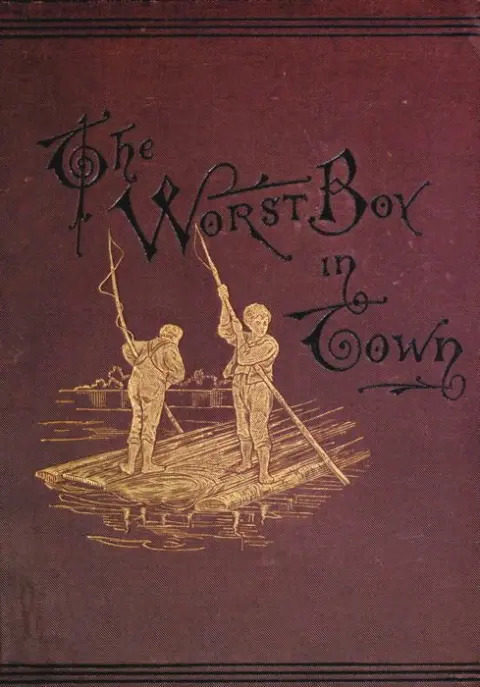
The Worst Boy in Town
John Habberton
THE CLASSIC COLLECTION · 1878
"Little Guzzy" by John Habberton is a collection of short stories written in the late 19th century. The stories range across various themes, capturing humorous, grave, and poignant moments in life. The book likely appeals to readers who enjoy light-hearted narratives with engaging characters, as suggested by its connection to Habberton's previous work, "Helen’s Babies." The opening of "Little Guzzy" introduces the setting of a mining camp called Bottle Flat, where the arrival of a new schoolteacher stirs discontent among local miners who are vehemently opposed to formal education. The miners plot to confront the teacher, but their plans shift when they discover that the incoming educator is a charming young woman named Miss Brown. Her pleasant demeanor leads to unexpectedly warm interactions, challenging the men’s initial resistance and igniting a change in their attitudes towards education and women in their community. The narrative captures the dynamics of small-town life, infusing humor and character depth throughout its opening chapter.
Introduction adapted from the source catalogue; source summaries may be automatically generated.
Free to read · English · 114,349 words · No account needed
MAKE TIME FOR A GOOD BOOK
On by default. Untick to stop anonymous reading totals. Each page counts after 10 seconds in view. How this works.
Anonymous counting is on unless you have switched it off.
Then the officers escorted the prisoner to the jail, and Guzzy sneaked quietly out, while the squire retired to his slumbers, with the firm conviction that if Solomon had been a justice of the peace at Bowerton, his denial of the newness of anything under the sun would never have been made.
Now, the jail at Bowerton, like everything else in the town, was decidedly antiquated, and consisted simply of a thickly-walled room in a building which contained several offices and living apartments.
It was as extensive a jail as Bowerton needed, and was fully strong enough to hold the few drunken and quarrelsome people who were occasionally lodged in it.
But Beigh, alias Bay Billy, alias Handsome, was no ordinary and vulgar jail-bird, the officers told him, and, that he and they might sleep securely, they considered it advisable to carefully iron his hands.
A couple of hours rolled away, and left Beigh still sitting moody and silent on the single bedstead in the Bowerton jail.
Suddenly the train of his thoughts was interrupted by a low “stt—stt” from the one little, high, grated window of the jail.
The prisoner looked up quickly, and saw the shadow of a man’s head
outside the grating.
“Hello!” whispered Beigh, hurrying under the window.
“Are you alone?” inquired the shadow.
“Yes,” replied the prisoner.
“All right, then,” whispered the voice. “There are secrets which no vulgar ears should hear. My name is Guzzy. I have been in love with your wife. I hadn’t any idea she was married; but I’ve brought you my apology.”
“I’ll forgive you,” whispered the criminal; “but——”
“’Tain’t that kind of apology,” whispered Guzzy. “It’s a steel one—a tool—one of those things that gunsmiths shorten gun-barrels with. If they can saw a rifle-barrel in two in five minutes, you ought to get out of here inside of an hour.”
“Not quite,” whispered Beigh. “My hands and feet are ironed.”
“Then I’ll do the job myself,” whispered Guzzy, as he applied the tool to one of the bars; “for it will be daylight within two hours.”
The unaccustomed labor—for Guzzy was a bookkeeper—made his arms ache severely, but still he sawed away.
He wondered what his employer would say should he be found out, but
still he sawed.
Visions of the uplifted hands and horror-struck countenances of his brother Church-members came before his eyes, and the effect of his example upon his Sunday-school class, should he be discovered, tormented his soul; but neither of those influences affected his saw.
Your reading position is saved on this browser. Take it to another device with a library code. Reading pages adapt to text, rather than matching a printed edition.
John Habberton
John Habberton
John Habberton
John Habberton
BEHIND THE BOOK
This eBook is for the use of anyone anywhere in the United States and most other parts of the world at no cost and with almost no restrictions whatsoever. You may copy it, give it away or re-use it under the terms of the Project Gutenberg License included with this eBook or online at www.gutenberg.org. If you are not located in the United States, you will have to check the laws of the country where you are located before using this eBook. Read the source licence.
The original source file, including credits and licence, is retained by this library. Request an original-format copy at no charge. Please include the book title and Project Gutenberg identifier #67985.
KEEP YOUR CURIOSITY GOING
Coulson Kernahan

Maurice Baring
Frances Wright
Cécile Tormay

Frederic Jesup Stimson

W. H. P. (William Henry Pope) Jarvis