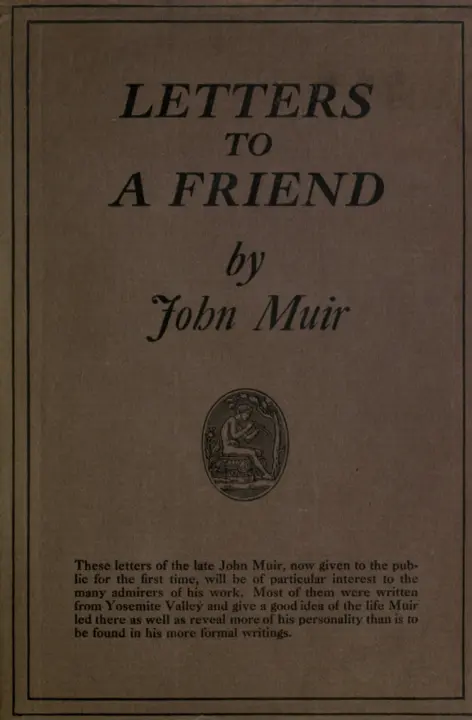
Letters to a Friend, Written to Mrs. Ezra S. Carr, 1866-1879
John Muir
THE CLASSIC COLLECTION · 1921
"Lichens" by Annie Lorrain Smith is a scientific publication written in the early 20th century. This book serves as a comprehensive study of lichens, covering their historical classification, morphology, physiology, and ecological significance. The work is likely targeted towards botanists, lichenologists, and students interested in the intricacies of these unique symbiotic organisms. The opening of the text provides context for its publication, emphasizing the challenges faced during the First World War that delayed its release. The preface explains the book's structure, indicating that it will include historical accounts of lichenology, practical information such as a glossary and bibliography, and detailed analysis of the constituents of lichens. It also acknowledges contributions from various experts in the field who assisted with research and observations, thereby establishing a foundation for the detailed exploration of lichens that follows in the subsequent chapters.
Introduction adapted from the source catalogue; source summaries may be automatically generated.
Free to read · English · 184,755 words · No account needed
MAKE TIME FOR A GOOD BOOK
On by default. Untick to stop anonymous reading totals. Each page counts after 10 seconds in view. How this works.
Anonymous counting is on unless you have switched it off.
Arnold[1138] carried to its furthest limit the method of arranging lichens ecologically, in his account of those plants from the neighbourhood of Munich. He gives “formation” lists, not only for particular substrata and in special situations, but he recapitulates the species that he found on the several different trees. It is not possible to reproduce such a detailed survey, which indeed only emphasizes the fact that the physical characters of the bark are the most important factors in lichen ecology: that on smooth bark, whether of young trees, or on bark that never becomes really rugged, there is a preponderance of species with a semi-immersed thallus, and very generally of those that are associated with Trentepohlia gonidia, such as Graphidaceae or Pyrenulaceae, though certain species of Lecidea, Lecanora and others also prefer the smooth substratum.
Bruce Fink[1139] has published a series of important papers on lichen communities in America, some of them similar to what we should find in the British Isles.
On trees with smooth bark he records in the Minnesota district:
Xanthoria polycarpa.
Candelaria concolor.
Parmelia olivacea, P. adglutinata.
Placodium cerinum.
Lecanora subfusca.
Bacidia fusca-rubella.
Lecidea enteroleuca.
Graphis scripta.
Arthonia lecideella, A. dispersa.
Arthopyrenia punctiformis, A. fallax.
Pyrenula nitida, P. thelena, P. cinerella, P. leucoplaca.
On rough bark he records:
Ramalina calicaris, R. fraxinea, R. fastigiata.
Teloschistes chrysophthalmus.
Xanthoria polycarpa, X. lychnea.
Candelaria concolor.
Parmelia perforata, P. crinita, P. Borreri, P. tiliacea,
P. saxatilis, P. caperata.
Physcia granulifera, Ph. pulverulenta, Ph. stellaris, Ph.
tribacia, Ph. obscura.
Collema pycnocarpum, C. flaccidum.
Leptogium mycochroum.
Placodium aurantiacum, Pl. cerinum.
Lecanora subfusca.
Pertusaria leioplaca, P. velata.
Bacidia rubella, B. fuscorubella.
Lecidea enteroleuca.
Rhizocarpon alboatrum, Buellia parasema.
Opegrapha varia.
Graphis scripta.
Arthonia lecideella, A. radiata.
Arthopyrenia quinqueseptata, A. macrospora.
Pyrenula nitida, P. leucoplaca.
Finally, as generally representative of the commonest lichens in our woods of deciduous trees, including both smooth- and rough-barked, the community of oak-hazel woods as observed by Watson[1140] in Somerset may be quoted:
Collema flaccidum.
Calicium hyperellum.
Ramalina calicaris, R. fraxinea with var. ampliata, R.
fastigiata, R. farinacea and R. pollinaria.
Parmelia saxatilis and f. furfuracea, P. caperata, P. physodes.
Physcia pulverulenta, Ph. tenella (hispida).
Lecanora subfusca, L. rugosa.
Pertusaria amara, P. globulifera, P. communis, P. Wulfenii.
Lecidea (Buellia) canescens.
Graphis scripta.
And on the soil of these woods:
Cladonia pyxidata, Cl. pungens, Cl. macilenta, Cl. pityrea, Cl. squamosa and Cl. sylvatica.
Your reading position is saved on this browser. Take it to another device with a library code. Reading pages adapt to text, rather than matching a printed edition.
BEHIND THE BOOK
This eBook is for the use of anyone anywhere in the United States and most other parts of the world at no cost and with almost no restrictions whatsoever. You may copy it, give it away or re-use it under the terms of the Project Gutenberg License included with this eBook or online at www.gutenberg.org. If you are not located in the United States, you will have to check the laws of the country where you are located before using this eBook. Read the source licence.
The original source file, including credits and licence, is retained by this library. Request an original-format copy at no charge. Please include the book title and Project Gutenberg identifier #61616.
KEEP YOUR CURIOSITY GOING
John Muir
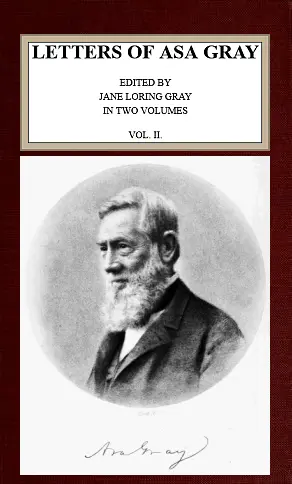
Asa Gray
Asa Gray

Florence Nightingale
Elizabeth Robins Pennell
Denison Olmsted