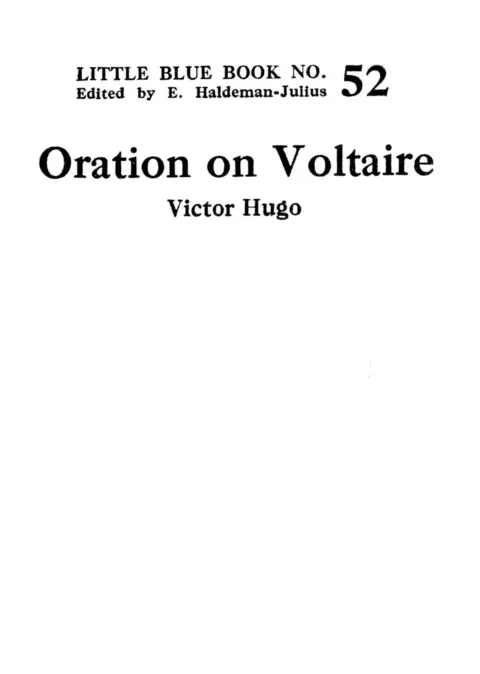
Oration on Voltaire
Victor Hugo & Julius Moritzen
THE CLASSIC COLLECTION · 1862
"Les Misérables" by Victor Hugo is a French epic historical novel published in 1862. Beginning in 1815 and culminating in the 1832 June Rebellion in Paris, it follows ex-convict Jean Valjean's struggle for redemption. The novel explores the nature of law and grace, examining themes of justice, poverty, and love through the lives of interconnected characters in nineteenth-century France. Considered one of the greatest novels of its century, it depicts society's most downtrodden members and their fight for dignity.
Introduction adapted from the source catalogue; source summaries may be automatically generated.
Free to read · English · 571,075 words · No account needed
MAKE TIME FOR A GOOD BOOK
On by default. Untick to stop anonymous reading totals. Each page counts after 10 seconds in view. How this works.
Anonymous counting is on unless you have switched it off.
In the garden, near the railing on the street, there was a stone bench, screened from the eyes of the curious by a plantation of yoke-elms, but which could, in case of necessity, be reached by an arm from the outside, past the trees and the gate.
One evening during that same month of April, Jean Valjean had gone out; Cosette had seated herself on this bench after sundown. The breeze was blowing briskly in the trees, Cosette was meditating; an objectless sadness was taking possession of her little by little, that invincible sadness evoked by the evening, and which arises, perhaps, who knows, from the mystery of the tomb which is ajar at that hour.
Perhaps Fantine was within that shadow.
Cosette rose, slowly made the tour of the garden, walking on the grass drenched in dew, and saying to herself, through the species of melancholy somnambulism in which she was plunged: “Really, one needs wooden shoes for the garden at this hour. One takes cold.”
She returned to the bench.
As she was about to resume her seat there, she observed on the spot which she had quitted, a tolerably large stone which had, evidently, not been there a moment before.
Cosette gazed at the stone, asking herself what it meant. All at once the idea occurred to her that the stone had not reached the bench all by itself, that some one had placed it there, that an arm had been thrust through the railing, and this idea appeared to alarm her. This time, the fear was genuine; the stone was there. No doubt was possible; she did not touch it, fled without glancing behind her, took refuge in the house, and immediately closed with shutter, bolt, and bar the door-like window opening on the flight of steps. She inquired of Toussaint:—
“Has my father returned yet?”
“Not yet, Mademoiselle.”
[We have already noted once for all the fact that Toussaint stuttered. May we be permitted to dispense with it for the future. The musical notation of an infirmity is repugnant to us.]
Jean Valjean, a thoughtful man, and given to nocturnal strolls, often returned quite late at night.
“Toussaint,” went on Cosette, “are you careful to thoroughly barricade the shutters opening on the garden, at least with bars, in the evening, and to put the little iron things in the little rings that close them?”
“Oh! be easy on that score, Miss.”
Toussaint did not fail in her duty, and Cosette was well aware of the fact, but she could not refrain from adding:—
“It is so solitary here.”
Your reading position is saved on this browser. Take it to another device with a library code. Reading pages adapt to text, rather than matching a printed edition.
Victor Hugo & Julius Moritzen
Victor Hugo
Victor Hugo
Victor Hugo
BEHIND THE BOOK
This eBook is for the use of anyone anywhere in the United States and most other parts of the world at no cost and with almost no restrictions whatsoever. You may copy it, give it away or re-use it under the terms of the Project Gutenberg License included with this eBook or online at www.gutenberg.org. If you are not located in the United States, you will have to check the laws of the country where you are located before using this eBook. Read the source licence.
The original source file, including credits and licence, is retained by this library. Request an original-format copy at no charge. Please include the book title and Project Gutenberg identifier #135.
KEEP YOUR CURIOSITY GOING
Cécile Tormay

Moritz Busch
Coulson Kernahan
John L. Ransom

Maurice Baring
Frances Wright