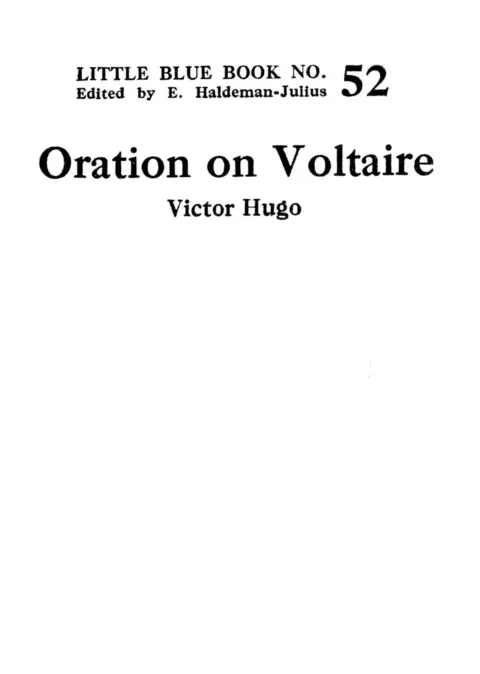
Oration on Voltaire
Victor Hugo & Julius Moritzen
THE CLASSIC COLLECTION · 1862
"Les Misérables" by Victor Hugo is a French epic historical novel published in 1862. Beginning in 1815 and culminating in the 1832 June Rebellion in Paris, it follows ex-convict Jean Valjean's struggle for redemption. The novel explores the nature of law and grace, examining themes of justice, poverty, and love through the lives of interconnected characters in nineteenth-century France. Considered one of the greatest novels of its century, it depicts society's most downtrodden members and their fight for dignity.
Introduction adapted from the source catalogue; source summaries may be automatically generated.
Free to read · English · 571,075 words · No account needed
MAKE TIME FOR A GOOD BOOK
On by default. Untick to stop anonymous reading totals. Each page counts after 10 seconds in view. How this works.
Anonymous counting is on unless you have switched it off.
By the side of Enjolras, who represented the logic of the Revolution, Combeferre represented its philosophy. Between the logic of the Revolution and its philosophy there exists this difference—that its logic may end in war, whereas its philosophy can end only in peace. Combeferre complemented and rectified Enjolras. He was less lofty, but broader. He desired to pour into all minds the extensive principles of general ideas: he said: “Revolution, but civilization”; and around the mountain peak he opened out a vast view of the blue sky. The Revolution was more adapted for breathing with Combeferre than with Enjolras. Enjolras expressed its divine right, and Combeferre its natural right. The first attached himself to Robespierre; the second confined himself to Condorcet. Combeferre lived the life of all the rest of the world more than did Enjolras. If it had been granted to these two young men to attain to history, the one would have been the just, the other the wise man. Enjolras was the more virile, Combeferre the more humane. Homo and vir, that was the exact effect of their different shades. Combeferre was as gentle as Enjolras was severe, through natural whiteness. He loved the word citizen, but he preferred the word man. He would gladly have said: Hombre, like the Spanish. He read everything, went to the theatres, attended the courses of public lecturers, learned the polarization of light from Arago, grew enthusiastic over a lesson in which Geoffroy Sainte-Hilaire explained the double function of the external carotid artery, and the internal, the one which makes the face, and the one which makes the brain; he kept up with what was going on, followed science step by step, compared Saint-Simon with Fourier, deciphered hieroglyphics, broke the pebble which he found and reasoned on geology, drew from memory a silkworm moth, pointed out the faulty French in the Dictionary of the Academy, studied Puységur and Deleuze, affirmed nothing, not even miracles; denied nothing, not even ghosts; turned over the files of the Moniteur, reflected. He declared that the future lies in the hand of the schoolmaster, and busied himself with educational questions. He desired that society should labor without relaxation at the elevation of the moral and intellectual level, at coining science, at putting ideas into circulation, at increasing the mind in youthful persons, and he feared lest the present poverty of method, the paltriness from a literary point of view confined to two or three centuries called classic, the tyrannical dogmatism of official pedants, scholastic prejudices and routines should end by converting our colleges into artificial oyster beds. He was learned, a purist, exact, a graduate of the Polytechnic, a close student, and at the same time, thoughtful “even to chimæras,” so his friends said. He believed in all dreams, railroads, the suppression of suffering in chirurgical operations, the fixing of images in the dark chamber, the electric telegraph, the steering of balloons. Moreover, he was not much alarmed by the citadels erected against the human mind in every direction, by superstition, despotism, and prejudice. He was one of those who think that science will eventually turn the position. Enjolras was a chief, Combeferre was a guide. One would have liked to fight under the one and to march behind the other. It is not that Combeferre was not capable of fighting, he did not refuse a hand-to-hand combat with the obstacle, and to attack it by main force and explosively; but it suited him better to bring the human race into accord with its destiny gradually, by means of education, the inculcation of axioms, the promulgation of positive laws; and, between two lights, his preference was rather for illumination than for conflagration. A conflagration can create an aurora, no doubt, but why not await the dawn? A volcano illuminates, but daybreak furnishes a still better illumination. Possibly, Combeferre preferred the whiteness of the beautiful to the blaze of the sublime. A light troubled by smoke, progress purchased at the expense of violence, only half satisfied this tender and serious spirit. The headlong precipitation of a people into the truth, a ‘93, terrified him; nevertheless, stagnation was still more repulsive to him, in it he detected putrefaction and death; on the whole, he preferred scum to miasma, and he preferred the torrent to the cesspool, and the falls of Niagara to the lake of Montfaucon. In short, he desired neither halt nor haste. While his tumultuous friends, captivated by the absolute, adored and invoked splendid revolutionary adventures, Combeferre was inclined to let progress, good progress, take its own course; he may have been cold, but he was pure; methodical, but irreproachable; phlegmatic, but imperturbable. Combeferre would have knelt and clasped his hands to enable the future to arrive in all its candor, and that nothing might disturb the immense and virtuous evolution of the races. The good must be innocent, he repeated incessantly. And in fact, if the grandeur of the Revolution consists in keeping the dazzling ideal fixedly in view, and of soaring thither athwart the lightnings, with fire and blood in its talons, the beauty of progress lies in being spotless; and there exists between Washington, who represents the one, and Danton, who incarnates the other, that difference which separates the swan from the angel with the wings of an eagle.
Your reading position is saved on this browser. Take it to another device with a library code. Reading pages adapt to text, rather than matching a printed edition.
Victor Hugo & Julius Moritzen
Victor Hugo
Victor Hugo
Victor Hugo
BEHIND THE BOOK
This eBook is for the use of anyone anywhere in the United States and most other parts of the world at no cost and with almost no restrictions whatsoever. You may copy it, give it away or re-use it under the terms of the Project Gutenberg License included with this eBook or online at www.gutenberg.org. If you are not located in the United States, you will have to check the laws of the country where you are located before using this eBook. Read the source licence.
The original source file, including credits and licence, is retained by this library. Request an original-format copy at no charge. Please include the book title and Project Gutenberg identifier #135.
KEEP YOUR CURIOSITY GOING
Cécile Tormay

Moritz Busch
Coulson Kernahan
John L. Ransom

Maurice Baring
Frances Wright