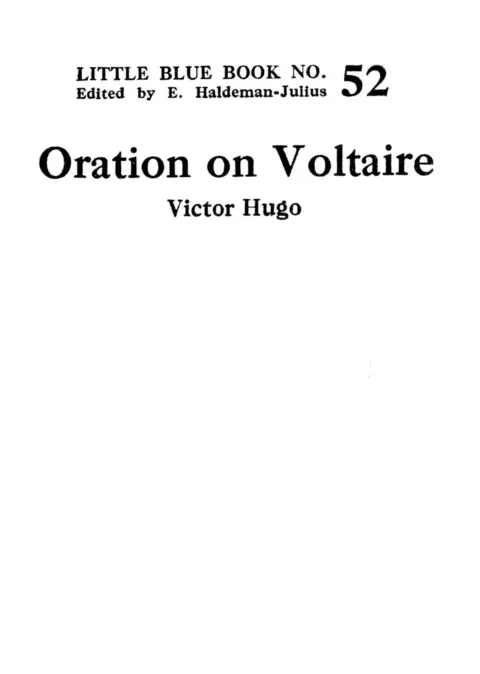
Oration on Voltaire
Victor Hugo & Julius Moritzen
THE CLASSIC COLLECTION · 1862
"Les Misérables" by Victor Hugo is a French epic historical novel published in 1862. Beginning in 1815 and culminating in the 1832 June Rebellion in Paris, it follows ex-convict Jean Valjean's struggle for redemption. The novel explores the nature of law and grace, examining themes of justice, poverty, and love through the lives of interconnected characters in nineteenth-century France. Considered one of the greatest novels of its century, it depicts society's most downtrodden members and their fight for dignity.
Introduction adapted from the source catalogue; source summaries may be automatically generated.
Free to read · English · 571,075 words · No account needed
MAKE TIME FOR A GOOD BOOK
On by default. Untick to stop anonymous reading totals. Each page counts after 10 seconds in view. How this works.
Anonymous counting is on unless you have switched it off.
His face paled and smiled. Life was no longer there, it was something
else.
His breath sank, his glance grew grander. He was a corpse on which the
wings could be felt.
He made a sign to Cosette to draw near, then to Marius; the last minute of the last hour had, evidently, arrived.
He began to speak to them in a voice so feeble that it seemed to come from a distance, and one would have said that a wall now rose between them and him.
“Draw near, draw near, both of you. I love you dearly. Oh! how good it is to die like this! And thou lovest me also, my Cosette. I knew well that thou still felt friendly towards thy poor old man. How kind it was of thee to place that pillow under my loins! Thou wilt weep for me a little, wilt thou not? Not too much. I do not wish thee to have any real griefs. You must enjoy yourselves a great deal, my children. I forgot to tell you that the profit was greater still on the buckles without tongues than on all the rest. A gross of a dozen dozens cost ten francs and sold for sixty. It really was a good business. So there is no occasion for surprise at the six hundred thousand francs, Monsieur Pontmercy. It is honest money. You may be rich with a tranquil mind. Thou must have a carriage, a box at the theatres now and then, and handsome ball dresses, my Cosette, and then, thou must give good dinners to thy friends, and be very happy. I was writing to Cosette a while ago. She will find my letter. I bequeath to her the two candlesticks which stand on the chimney-piece. They are of silver, but to me they are gold, they are diamonds; they change candles which are placed in them into wax-tapers. I do not know whether the person who gave them to me is pleased with me yonder on high. I have done what I could. My children, you will not forget that I am a poor man, you will have me buried in the first plot of earth that you find, under a stone to mark the spot. This is my wish. No name on the stone. If Cosette cares to come for a little while now and then, it will give me pleasure. And you too, Monsieur Pontmercy. I must admit that I have not always loved you. I ask your pardon for that. Now she and you form but one for me. I feel very grateful to you. I am sure that you make Cosette happy. If you only knew, Monsieur Pontmercy, her pretty rosy cheeks were my delight; when I saw her in the least pale, I was sad. In the chest of drawers, there is a bank-bill for five hundred francs. I have not touched it. It is for the poor. Cosette, dost thou see thy little gown yonder on the bed? dost thou recognize it? That was ten years ago, however. How time flies! We have been very happy. All is over. Do not weep, my children, I am not going very far, I shall see you from there, you will only have to look at night, and you will see me smile. Cosette, dost thou remember Montfermeil? Thou wert in the forest, thou wert greatly terrified; dost thou remember how I took hold of the handle of the water-bucket? That was the first time that I touched thy poor, little hand. It was so cold! Ah! your hands were red then, mademoiselle, they are very white now. And the big doll! dost thou remember? Thou didst call her Catherine. Thou regrettedest not having taken her to the convent! How thou didst make me laugh sometimes, my sweet angel! When it had been raining, thou didst float bits of straw on the gutters, and watch them pass away. One day I gave thee a willow battledore and a shuttlecock with yellow, blue and green feathers. Thou hast forgotten it. Thou wert roguish so young! Thou didst play. Thou didst put cherries in thy ears. Those are things of the past. The forests through which one has passed with one’s child, the trees under which one has strolled, the convents where one has concealed oneself, the games, the hearty laughs of childhood, are shadows. I imagined that all that belonged to me. In that lay my stupidity. Those Thénardiers were wicked. Thou must forgive them. Cosette, the moment has come to tell thee the name of thy mother. She was called Fantine. Remember that name—Fantine. Kneel whenever thou utterest it. She suffered much. She loved thee dearly. She had as much unhappiness as thou hast had happiness. That is the way God apportions things. He is there on high, he sees us all, and he knows what he does in the midst of his great stars. I am on the verge of departure, my children. Love each other well and always. There is nothing else but that in the world: love for each other. You will think sometimes of the poor old man who died here. Oh my Cosette, it is not my fault, indeed, that I have not seen thee all this time, it cut me to the heart; I went as far as the corner of the street, I must have produced a queer effect on the people who saw me pass, I was like a madman, I once went out without my hat. I no longer see clearly, my children, I had still other things to say, but never mind. Think a little of me. Come still nearer. I die happy. Give me your dear and well-beloved heads, so that I may lay my hands upon them.”
Your reading position is saved on this browser. Take it to another device with a library code. Reading pages adapt to text, rather than matching a printed edition.
Victor Hugo & Julius Moritzen
Victor Hugo
Victor Hugo
Victor Hugo
BEHIND THE BOOK
This eBook is for the use of anyone anywhere in the United States and most other parts of the world at no cost and with almost no restrictions whatsoever. You may copy it, give it away or re-use it under the terms of the Project Gutenberg License included with this eBook or online at www.gutenberg.org. If you are not located in the United States, you will have to check the laws of the country where you are located before using this eBook. Read the source licence.
The original source file, including credits and licence, is retained by this library. Request an original-format copy at no charge. Please include the book title and Project Gutenberg identifier #135.
KEEP YOUR CURIOSITY GOING
Cécile Tormay

Moritz Busch
Coulson Kernahan
John L. Ransom

Maurice Baring
Frances Wright