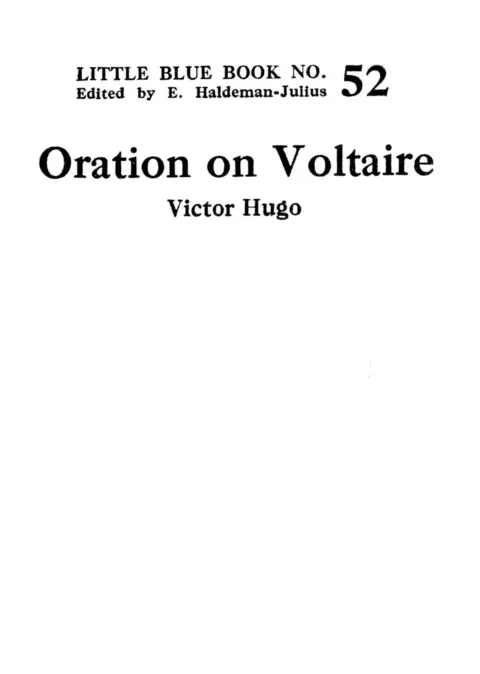
Oration on Voltaire
Victor Hugo & Julius Moritzen
THE CLASSIC COLLECTION · 1862
"Les Misérables" by Victor Hugo is a French epic historical novel published in 1862. Beginning in 1815 and culminating in the 1832 June Rebellion in Paris, it follows ex-convict Jean Valjean's struggle for redemption. The novel explores the nature of law and grace, examining themes of justice, poverty, and love through the lives of interconnected characters in nineteenth-century France. Considered one of the greatest novels of its century, it depicts society's most downtrodden members and their fight for dignity.
Introduction adapted from the source catalogue; source summaries may be automatically generated.
Free to read · English · 571,075 words · No account needed
MAKE TIME FOR A GOOD BOOK
On by default. Untick to stop anonymous reading totals. Each page counts after 10 seconds in view. How this works.
Anonymous counting is on unless you have switched it off.
Strange to say, at that epoch, people still imagined that a wedding was a private and social festival, that a patriarchal banquet does not spoil a domestic solemnity, that gayety, even in excess, provided it be honest, and decent, does happiness no harm, and that, in short, it is a good and a venerable thing that the fusion of these two destinies whence a family is destined to spring, should begin at home, and that the household should thenceforth have its nuptial chamber as its witness.
And people were so immodest as to marry in their own homes.
The marriage took place, therefore, in accordance with this now superannuated fashion, at M. Gillenormand’s house.
Natural and commonplace as this matter of marrying is, the banns to publish, the papers to be drawn up, the mayoralty, and the church produce some complication. They could not get ready before the 16th of February.
Now, we note this detail, for the pure satisfaction of being exact, it chanced that the 16th fell on Shrove Tuesday. Hesitations, scruples, particularly on the part of Aunt Gillenormand.
“Shrove Tuesday!” exclaimed the grandfather, “so much the better. There
is a proverb:
“‘Mariage un Mardi gras
N’aura point enfants ingrats.’66
Let us proceed. Here goes for the 16th! Do you want to delay, Marius?”
“No, certainly not!” replied the lover.
“Let us marry, then,” cried the grandfather.
Accordingly, the marriage took place on the 16th, notwithstanding the public merrymaking. It rained that day, but there is always in the sky a tiny scrap of blue at the service of happiness, which lovers see, even when the rest of creation is under an umbrella.
On the preceding evening, Jean Valjean handed to Marius, in the
presence of M. Gillenormand, the five hundred and eighty-four thousand
francs.
As the marriage was taking place under the régime of community of property, the papers had been simple.
Henceforth, Toussaint was of no use to Jean Valjean; Cosette inherited her and promoted her to the rank of lady’s maid.
As for Jean Valjean, a beautiful chamber in the Gillenormand house had been furnished expressly for him, and Cosette had said to him in such an irresistible manner: “Father, I entreat you,” that she had almost persuaded him to promise that he would come and occupy it.
Your reading position is saved on this browser. Take it to another device with a library code. Reading pages adapt to text, rather than matching a printed edition.
Victor Hugo & Julius Moritzen
Victor Hugo
Victor Hugo
Victor Hugo
BEHIND THE BOOK
This eBook is for the use of anyone anywhere in the United States and most other parts of the world at no cost and with almost no restrictions whatsoever. You may copy it, give it away or re-use it under the terms of the Project Gutenberg License included with this eBook or online at www.gutenberg.org. If you are not located in the United States, you will have to check the laws of the country where you are located before using this eBook. Read the source licence.
The original source file, including credits and licence, is retained by this library. Request an original-format copy at no charge. Please include the book title and Project Gutenberg identifier #135.
KEEP YOUR CURIOSITY GOING
Cécile Tormay

Moritz Busch
Coulson Kernahan
John L. Ransom

Maurice Baring
Frances Wright