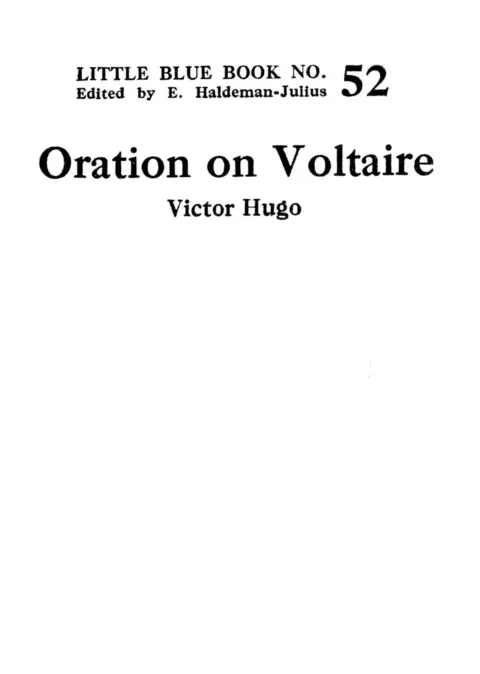
Oration on Voltaire
Victor Hugo & Julius Moritzen
THE CLASSIC COLLECTION · 1862
"Les Misérables" by Victor Hugo is a French epic historical novel published in 1862. Beginning in 1815 and culminating in the 1832 June Rebellion in Paris, it follows ex-convict Jean Valjean's struggle for redemption. The novel explores the nature of law and grace, examining themes of justice, poverty, and love through the lives of interconnected characters in nineteenth-century France. Considered one of the greatest novels of its century, it depicts society's most downtrodden members and their fight for dignity.
Introduction adapted from the source catalogue; source summaries may be automatically generated.
Free to read · English · 571,075 words · No account needed
MAKE TIME FOR A GOOD BOOK
On by default. Untick to stop anonymous reading totals. Each page counts after 10 seconds in view. How this works.
Anonymous counting is on unless you have switched it off.
“Would you believe it? Marius comes home nowadays at one o’clock in the
morning.”
Bahorel replied:—
“What do you expect? There’s always a petard in a seminary fellow.”
At times, Courfeyrac folded his arms, assumed a serious air, and said
to Marius:—
“You are getting irregular in your habits, young man.”
Courfeyrac, being a practical man, did not take in good part this reflection of an invisible paradise upon Marius; he was not much in the habit of concealed passions; it made him impatient, and now and then he called upon Marius to come back to reality.
One morning, he threw him this admonition:—
“My dear fellow, you produce upon me the effect of being located in the moon, the realm of dreams, the province of illusions, capital, soap-bubble. Come, be a good boy, what’s her name?”
But nothing could induce Marius “to talk.” They might have torn out his nails before one of the two sacred syllables of which that ineffable name, Cosette, was composed. True love is as luminous as the dawn and as silent as the tomb. Only, Courfeyrac saw this change in Marius, that his taciturnity was of the beaming order.
During this sweet month of May, Marius and Cosette learned to know these immense delights. To dispute and to say you for thou, simply that they might say thou the better afterwards. To talk at great length with very minute details, of persons in whom they took not the slightest interest in the world; another proof that in that ravishing opera called love, the libretto counts for almost nothing;
For Marius, to listen to Cosette discussing finery;
For Cosette, to listen to Marius talk in politics;
To listen, knee pressed to knee, to the carriages rolling along the Rue
de Babylone;
To gaze upon the same planet in space, or at the same glowworm gleaming
in the grass;
To hold their peace together; a still greater delight than
conversation;
Etc., etc.
In the meantime, divers complications were approaching.
One evening, Marius was on his way to the rendezvous, by way of the Boulevard des Invalides. He habitually walked with drooping head. As he was on the point of turning the corner of the Rue Plumet, he heard some one quite close to him say:—
“Good evening, Monsieur Marius.”
He raised his head and recognized Éponine.
Your reading position is saved on this browser. Take it to another device with a library code. Reading pages adapt to text, rather than matching a printed edition.
Victor Hugo & Julius Moritzen
Victor Hugo
Victor Hugo
Victor Hugo
BEHIND THE BOOK
This eBook is for the use of anyone anywhere in the United States and most other parts of the world at no cost and with almost no restrictions whatsoever. You may copy it, give it away or re-use it under the terms of the Project Gutenberg License included with this eBook or online at www.gutenberg.org. If you are not located in the United States, you will have to check the laws of the country where you are located before using this eBook. Read the source licence.
The original source file, including credits and licence, is retained by this library. Request an original-format copy at no charge. Please include the book title and Project Gutenberg identifier #135.
KEEP YOUR CURIOSITY GOING
Cécile Tormay

Moritz Busch
Coulson Kernahan
John L. Ransom

Maurice Baring
Frances Wright