THE CLASSIC COLLECTION✦Frank Merriwell’s dangerCLASSIC FREE BOOKS
Frank Merriwell’s danger
Burt L. Standish
THE CLASSIC COLLECTION · 1914
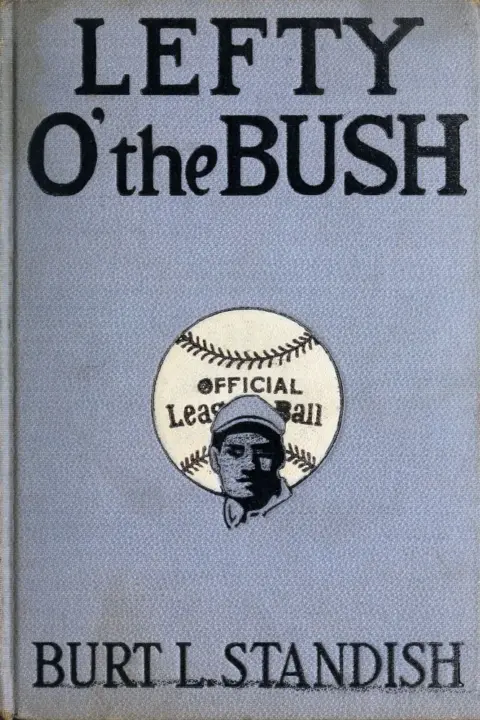
"Lefty o' the Bush" by Burt L. Standish is a sports novel written in the early 20th century. It centers around the intense rivalry in minor league baseball, particularly between the teams of Bancroft and Kingsbridge. The story highlights the fast-paced emotions and stakes that accompany a small-town baseball season, focusing on the character of Tom Locke, a rookie pitcher whose performance has a significant impact on the local fans and rivalries. At the start of the book, we are introduced to the eager anticipation surrounding the opening game of the Northern League season in Kingsbridge, a mill town filled with passionate baseball fans. The opening chapter sets the stage with the Bancroft "Bullies" manager Mike Riley observing the tensions between the two teams, particularly toward Locke, the unknown pitcher for Kingsbridge. The community’s hopes are pinned on Locke, who initially struggles under the pressure and jeering from the crowd, leading to doubts about his abilities. However, as the narrative unfolds, Locke gradually finds his footing on the mound, causing a shift in the crowd's perception and foreshadowing his potential to become a local hero amid the fierce rivalry.
Introduction adapted from the source catalogue; source summaries may be automatically generated.
Free to read · English · 57,469 words · No account needed
MAKE TIME FOR A GOOD BOOK
On by default. Untick to stop anonymous reading totals. Each page counts after 10 seconds in view. How this works.
Anonymous counting is on unless you have switched it off.
That first wide one brought a mocking shout from the Bancroft bunch on the bleachers, and apparently Locke grew still more nervous, for his second pitch forced Harney to do a lively dodge to avoid being bored in the ribs.
“Ball tuh!”
“Wow-wow!” barked one coacher. “He’s wild as mountain scenery.”
“Take a ramble, Cap; he’ll walk ye,” cried the other coacher.
The Bancroft rooters scoffed again; the Kingsbridge crowd was anxiously
silent.
“Never mind that, kid,” soothed Oulds. “Take your time; don’t hurry.
Make him hit.”
The backstop returning the ball, Locke attempted to catch it with his gloved hand, dropped it, turned hastily, struck it with his toe, and sent it rolling toward second.
Larry Stark, covering that sack, sprang after the sphere, scooped it up, and held it in both hands against his chest while stepping swiftly toward the pitcher to speak a few low, reassuring words. Then he tossed the ball, and danced back to his position.
There was no doubt about it now; plainly Locke was nervous. Seeing this, the coachers and the visiting spectators did what they could to rattle him. Even though he tried to steady himself, the next ball from his fingers whiffed up a pop of dust two feet in front of the plate.
“Ball three!”
“The ascension begins early to-day,” laughed the coacher near third; and the Bancrofters behind him began to sing: “Up in a Balloon, Boys.”
On the home bench, Manager Hutchinson leaned forward, his elbow on his knee, his hand propping his chin, eyes narrowed and fixed on the disturbed pitcher.
Standing behind the bench, Henry Cope removed his old straw hat to mop his bald head and flushed face, trying all the while to preserve a calm and confident smile.
The crowd in the stand and along the right side of the field stirred restlessly. Murmurs were heard: “What’s the matter with him?” “Punk!” “Rotten!” “He can’t find the plate!” “He’s no good!”
“Take your time, Locke,” begged Captain Stark. “Don’t hurry. Put it straight over, and let him hit. We’re behind you.”
Harney, sneering, twiddled his bat and made a bluff of turning his back to the plate. Although he did not turn, his indifferent pose spoke his disdain and belief that he would receive a pass.
The assurance was justified. Seeking to get a grip on himself, Tom Locke strove to whip over a straight one. Then――
“Take y’ur base!” croaked the umpire as the horsehide plunked into
Oulds’ reaching mitt.
Your reading position is saved on this browser. Take it to another device with a library code. Reading pages adapt to text, rather than matching a printed edition.
Burt L. Standish
Burt L. Standish

Burt L. Standish

Burt L. Standish
BEHIND THE BOOK
This eBook is for the use of anyone anywhere in the United States and most other parts of the world at no cost and with almost no restrictions whatsoever. You may copy it, give it away or re-use it under the terms of the Project Gutenberg License included with this eBook or online at www.gutenberg.org. If you are not located in the United States, you will have to check the laws of the country where you are located before using this eBook. Read the source licence.
The original source file, including credits and licence, is retained by this library. Request an original-format copy at no charge. Please include the book title and Project Gutenberg identifier #72013.
KEEP YOUR CURIOSITY GOING
Coulson Kernahan

Maurice Baring
Frances Wright
Cécile Tormay

Frederic Jesup Stimson

W. H. P. (William Henry Pope) Jarvis