
Last letters from the living dead man
David Patterson (Spirit) Hatch
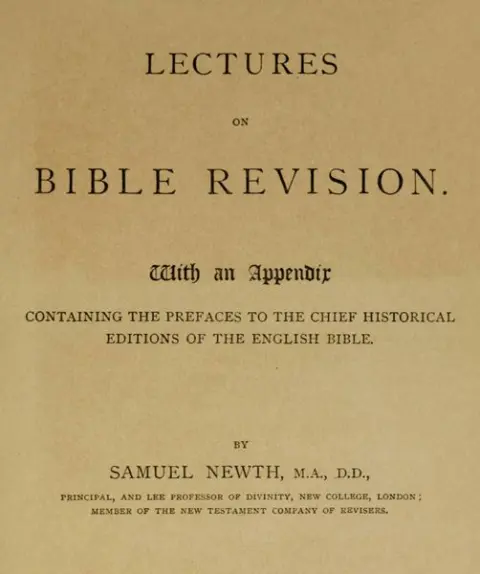
THE CLASSIC COLLECTION · 1881
"Lectures on Bible Revision" by Samuel Newth is a scholarly examination written in the late 19th century. The text focuses on the significance of biblical revisions, particularly the need for an updated understanding of the English Bible in light of historical and linguistic changes. It serves as a resource for Sunday-school and Bible-class teachers to navigate the complexities of these revisions and engage thoughtfully with their communities. The opening of the work introduces the author's aim to clarify the distinctions between the substance and form of Scripture, urging readers to acknowledge that while the truths contained in the Bible are eternal, the language and translations are subject to change. Newth emphasizes that reverence for the Scriptures should focus on the underlying truths rather than the specific wording, which has evolved over time. He reflects on historical translations and revisions, illustrating how the English Bible has transformed through various interpreters and linguistic shifts, underscoring the necessity of ongoing revision to maintain its relevance and accuracy for contemporary readers.
Introduction adapted from the source catalogue; source summaries may be automatically generated.
Free to read · English · 79,829 words · No account needed
MAKE TIME FOR A GOOD BOOK
On by default. Untick to stop anonymous reading totals. Each page counts after 10 seconds in view. How this works.
Anonymous counting is on unless you have switched it off.
[142] Whittingham had previously done the same in his New Testament of 1557. In his address “To the Reader” he says: “And because the Hebrewe and Greke phrases, which are strange to rendre in other tongues, and also short, shulde not be to hard, I haue sometyme interpreted them without any whit diminishing the grace of the sense, as our lāgage doth vse them, and sometyme have put to that worde which lacking made the sentence obscure, but haue set it in such letters as may easily be discerned from the cōmun text.”
In some later editions of the Genevan Bible, printed in black letter, this clause is altered into “wee have put in the text between these two markes [ ] such worde or verbe as doth more properlie explane or manifest the text in our tongue.”
[143] To the end that.
[144] ἔξο βέλους
[145] σεισάχθειαν
[146] Circa annum 900. B. Rhenan. rerum German lib. 2.
[147] STRYPE, Life of Parker, b. iv. c. 20; JOHNSON, Historical Account, p. 87; BURNET, History of the Reformation, part ii. book iii. p. 406, ed. 1681.
[148] The Psalms were in the first instance assigned to Guest, Bishop of Rochester. It is probable that the Archbishop was dissatisfied with Guest’s work, and on good grounds, for he despatched it very quickly, and forwarded it to the Archbishop with a letter, in which he thus sets forth his estimate of his duty as a translator: “I have not altered the Translation but where it giveth occasion of an error. As in the first Psalm, at the beginning I turn the preterperfect tense into the present tense; because the tense is too hard in the preterperfect tense. Where in the New Testament one piece of a Psalm is reported, I translate it in the Psalm according to the translation thereof in the New Testament, for the avoiding of the offence that may rise to the people upon diverse translations.” (STRYPE, Life of Parker, b. iii. c. 6; Parker Correspondence, PARKER, sec. ed. p. 250.)
[149] Parker Correspondence, PARKER, sec. ed. p. 335.
[150] Hist. of Ref., part ii. book iii. p. 406, ed. 1681.
[151] Collection of Records, part ii. book iii. number 10.
[152] Probably a misprint for Harmer.
[153] CARDWELL, Documentary Annals, vol. ii. p. 110.
[154] Barlow was present at the Hampton Court Conference in January, 1601, and all accounts describe him as then Dean of Chester; and his narrative of the Conference, published in 1604, is described as “contracted by William Barlow, Doctor of Divinity, and Dean of Chester.” Sir Peter Leycester, Hist. Antiq. of Cheshire, p. 169, states that Barlow was appointed Dean in 1603.
[155] Bishop of Chichester, November 3rd, 1605; Bishop of Ely, 1609;
Bishop of Winchester, 1619.
[156] Bishop of Lichfield, April, 1614; Bishop of Norwich, 1618.
[157] Subsequently Regius Professor of Hebrew, Cambridge.
Your reading position is saved on this browser. Take it to another device with a library code. Reading pages adapt to text, rather than matching a printed edition.
BEHIND THE BOOK
This eBook is for the use of anyone anywhere in the United States and most other parts of the world at no cost and with almost no restrictions whatsoever. You may copy it, give it away or re-use it under the terms of the Project Gutenberg License included with this eBook or online at www.gutenberg.org. If you are not located in the United States, you will have to check the laws of the country where you are located before using this eBook. Read the source licence.
The original source file, including credits and licence, is retained by this library. Request an original-format copy at no charge. Please include the book title and Project Gutenberg identifier #42514.
KEEP YOUR CURIOSITY GOING
David Patterson (Spirit) Hatch

David Patterson (Spirit) Hatch

David Patterson (Spirit) Hatch
Cécile Tormay

Moritz Busch
John L. Ransom