
Last letters from the living dead man
David Patterson (Spirit) Hatch
THE CLASSIC COLLECTION · 1881
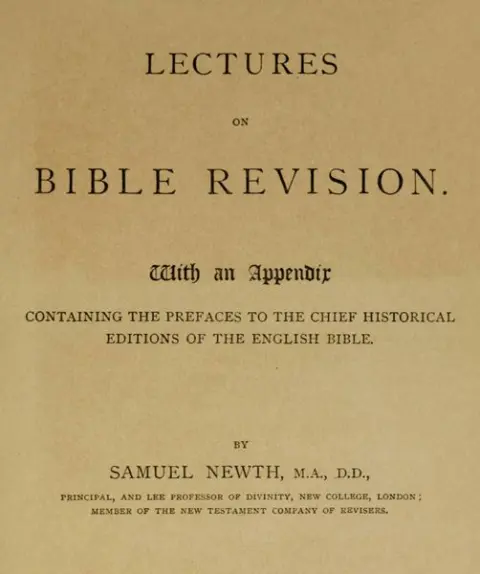
"Lectures on Bible Revision" by Samuel Newth is a scholarly examination written in the late 19th century. The text focuses on the significance of biblical revisions, particularly the need for an updated understanding of the English Bible in light of historical and linguistic changes. It serves as a resource for Sunday-school and Bible-class teachers to navigate the complexities of these revisions and engage thoughtfully with their communities. The opening of the work introduces the author's aim to clarify the distinctions between the substance and form of Scripture, urging readers to acknowledge that while the truths contained in the Bible are eternal, the language and translations are subject to change. Newth emphasizes that reverence for the Scriptures should focus on the underlying truths rather than the specific wording, which has evolved over time. He reflects on historical translations and revisions, illustrating how the English Bible has transformed through various interpreters and linguistic shifts, underscoring the necessity of ongoing revision to maintain its relevance and accuracy for contemporary readers.
Introduction adapted from the source catalogue; source summaries may be automatically generated.
Free to read · English · 79,829 words · No account needed
MAKE TIME FOR A GOOD BOOK
On by default. Untick to stop anonymous reading totals. Each page counts after 10 seconds in view. How this works.
Anonymous counting is on unless you have switched it off.
[106] Canon Selwyn had persistently advocated the claims of revision, and had brought it before the Notice of the Lower House of Convocation so early as March 1st, 1856. Notice of a renewed motion on the question had been given by him for the meeting of Convocation on February, 1870, and was only withdrawal when superseded by the proposal sent down on February 11th from the Upper House.
[107] Canon Cook, Dr. J. H. Newman, Canon Pusey, and Dr. W. Wright. Dr. Wright, however, subsequently joined the Old Testament Company.
[108] Dr. S. P. Tregelles.
[109] Now Bishop of Winchester.
[110] Now Dean of Canterbury.
[111] Now Dean of Peterborough.
[112] Now D.D.
[113] Now Bursar.
[114] Now Dean of Lichfield.
[115] Now Dean of Lincoln.
[116] Now D.D. and Hulsean Professor of Divinity, Cambridge.
[117] Now Bishop of Durham.
[118] Now D.D., and Master of the Leys School, Cambridge.
[119] Now D.D., Principal of New College, London, and Lee Professor of
Divinity.
[120] Now Professor of Humanity, St. Andrews.
[121] Now Dean of Rochester.
[122] Now LL.D.
[123] Now Principal of the Presbyterian College, Carmarthen.
[124] Now also Dean of Llandaff.
[125] Now also Regius Professor of Divinity, Cambridge.
[126] Now Lady Margaret Preacher, Cambridge.
[127] Now Archdeacon of Oxford.
[128] Corresponding Member.
[129] These have been thus distributed:
Bishop of Gloucester 405
Dr. Scrivener 399
Mr. Humphry 385
Dr. Newth 373
Dr. Hort 362
Dean of Lichfield 352
Dean of Rochester 337
Canon Westcott 304
Dean of Llandaff 302
Dean of Lincoln 297
Bishop of Durham 290
Archdeacon Lee 283
Dr. Moulton 271
Archdeacon Palmer 255
Dean of Westminster 253
Dr. Vance Smith 245
Dr. Brown 209
Dr. Angus 199
Dr. Milligan 182
Canon Kennedy 165
Dr. Eadie 135
Bishop of Salisbury 121
Bishop of St. Andrews 109
Dr. Roberts 94
Archbishop of Dublin 63
Dean Merivale 19
Dean Alford 16
Bishop Wilberforce 1
[130] As the original would be very obscure to many of my readers, I have somewhat reluctantly decided to give the modern spelling and the modern equivalent for obsolete words.
[131] Psalm lxxxvii. 6 is thus rendered in the Wycliffite versions, after the Vulgate and LXX. The LXX. here differs from the Hebrew.
[132] The word Judah, from which “Jew” is derived, is from a Hebrew verb, meaning “to praise.” (See Gen. xxix. 35; xlix. 8.)
[133] By “sentence” Purvey commonly means “sense,” or “meaning.”
[134] That is, if he examine many copies, and especially those of recent
date.
[135] AUGUSTINE, Christian Doctrine, book ii., c. xi.
[136] Bohemians.
[137] AUGUSTINE, Christian Doctrine, b. ii. c. xii.
[138] Wisdom, iv. 3.
[139] This Prologue contains but little in the way of historical information. It has this especial interest, that it is the preface of the first printed portion of the English Bible.
[140] Imitate.
[141] Changed in later editions, first into “To the diligent and Christian Reader. Grace, mercie, and peace, through Christ Jesus,” and then “To the Christian Reader” simply.
Your reading position is saved on this browser. Take it to another device with a library code. Reading pages adapt to text, rather than matching a printed edition.
BEHIND THE BOOK
This eBook is for the use of anyone anywhere in the United States and most other parts of the world at no cost and with almost no restrictions whatsoever. You may copy it, give it away or re-use it under the terms of the Project Gutenberg License included with this eBook or online at www.gutenberg.org. If you are not located in the United States, you will have to check the laws of the country where you are located before using this eBook. Read the source licence.
The original source file, including credits and licence, is retained by this library. Request an original-format copy at no charge. Please include the book title and Project Gutenberg identifier #42514.
KEEP YOUR CURIOSITY GOING
David Patterson (Spirit) Hatch

David Patterson (Spirit) Hatch

David Patterson (Spirit) Hatch
Cécile Tormay

Moritz Busch
John L. Ransom