
Last letters from the living dead man
David Patterson (Spirit) Hatch
THE CLASSIC COLLECTION · 1881
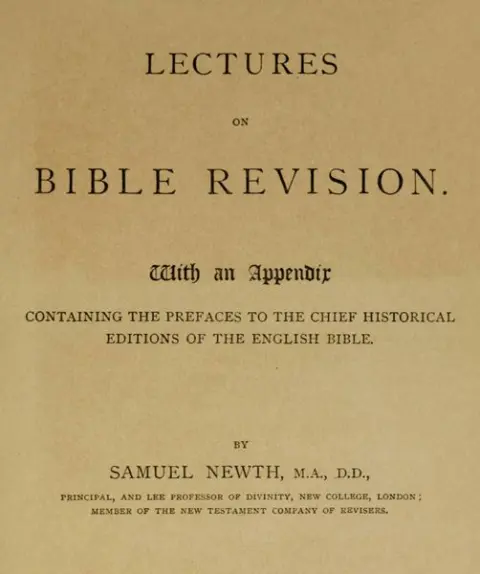
"Lectures on Bible Revision" by Samuel Newth is a scholarly examination written in the late 19th century. The text focuses on the significance of biblical revisions, particularly the need for an updated understanding of the English Bible in light of historical and linguistic changes. It serves as a resource for Sunday-school and Bible-class teachers to navigate the complexities of these revisions and engage thoughtfully with their communities. The opening of the work introduces the author's aim to clarify the distinctions between the substance and form of Scripture, urging readers to acknowledge that while the truths contained in the Bible are eternal, the language and translations are subject to change. Newth emphasizes that reverence for the Scriptures should focus on the underlying truths rather than the specific wording, which has evolved over time. He reflects on historical translations and revisions, illustrating how the English Bible has transformed through various interpreters and linguistic shifts, underscoring the necessity of ongoing revision to maintain its relevance and accuracy for contemporary readers.
Introduction adapted from the source catalogue; source summaries may be automatically generated.
Free to read · English · 79,829 words · No account needed
MAKE TIME FOR A GOOD BOOK
On by default. Untick to stop anonymous reading totals. Each page counts after 10 seconds in view. How this works.
Anonymous counting is on unless you have switched it off.
[Sidenote: The purpose of the Translators, with their number, furniture, care, &c.] But it is high time to leave them, and to shew in brief what we proposed to ourselves, and what course we held, in this our perusal and survey of the Bible. Truly, good Christian Reader, we never thought from the beginning that we should need to make a new translation, nor yet to make of a bad one a good one: (for then the imputation of Sixtus had been true in some sort, that our people had been fed with gall of dragons instead of wine, with wheal instead of milk;) but to make a good one better, or out of many good ones one principal good one, not justly to be excepted against; that hath been our endeavour, that our mark. To that purpose there were many chosen, that were greater in other men’s eyes than in their own, and that sought the truth rather than their own praise. Again, they came, or were thought to come, to the work, not exercendi causa, (as one saith,) but exercitati, that is, learned not to learn; for the chief overseer and ἐργοδιώκτης under his Majesty, to whom not only we, but also our whole Church was much bound, knew by his wisdom, which thing only Nazianzen taught so long ago, [Sidenote: Nazianz. εἰς ρν’, ἐπισκ παρουσ. Idem in Apologet.] that it is a preposterous order to teach first and to learn after; that τὸ ἐν πίθῳ κεραμίαν μανθάνειν to learn and practise together, is neither commendable for the workman, nor safe for the work. Therefore such were thought upon, as could say modestly with St. Hierome, Et Hebræum sermonem ex parte didicimus, et in Latino pene ab ipsis incunabulis, &c., detriti sumus; Both we have learned the Hebrew tongue in part, and in the Latin we have been exercised almost from our very cradle. St. Hierome maketh no mention of the Greek tongue, wherein yet he did excel; because he translated not the Old Testament out of Greek, but out of Hebrew. And in what sort did these assemble? In the trust of their own knowledge, or of their sharpness of wit, or deepness of judgment, as it were in an arm of flesh? At no hand. They trusted in him that hath the key of David, opening, and no man shutting; they prayed to the Lord, the Father of our Lord, to the effect that St. Augustine did: [Sidenote: St. August. lib. 11. Confess. cap. 2.] O let thy Scriptures be my pure delight; let me not be deceived in them, neither let me deceive by them. In this confidence, and with this devotion, did they assemble together; not too many, lest one should trouble another; and yet many, lest many things haply might escape them. If you ask what they had before them; truly it was the Hebrew text of the Old Testament, the Greek of the New. These are the two golden pipes, or rather conduits, wherethrough the olivebranches empty themselves into the gold. [Sidenote: St. Aug. 3. De doctr. cap. 3., &c. St. Hieron. ad Suniam et Fretel. St. Hieron. ad Lucinium, Dist 9. Ut veterum.] St. Augustine calleth them precedent, or original, tongues; St. Hierome, fountains. The same St. Hierome affirmeth, and Gratian hath not spared to put it into his decree, That as the credit of the old books (he meaneth of the Old Testament) is to be tried by the Hebrew volumes; so of the new by the Greek tongue, he meaneth by the original Greek. If truth be to be tried by these tongues, then whence should a translation be made, but out of them? These tongues therefore (the Scriptures, we say, in those tongues) we set before us to translate, being the tongues wherein God was pleased to speak to his Church by his Prophets and Apostles. [Sidenote: Joseph. Antiq. lib. 12.] Neither did we run over the work with that posting haste that the Septuagint did, if that be true which is reported of them, that they finished it in seventy-two days; neither were we barred or hindered from going over it again, having once done it, like St. Hierome, [Sidenote: St. Hieron. ad Pammach. pro lib. advers. Jovinian. πρωτόπειροι.] if that be true which himself reporteth, that he could no sooner write anything, but presently it was caught from him, and published, and he could not have leave to mend it; neither, to be short, were we the first that fell in hand with translating the Scripture into English, and consequently destitute of former helps, as it is written of Origen, that he was the first in a manner, that put his hand to write commentaries upon the Scriptures, and therefore no marvel if he overshot himself many times. None of these things: The work hath not been huddled up in seventy-two days, but hath cost the workmen, as light as it seemeth, the pains of twice seven times seventy-two days, and more. Matters of such weight and consequence are to be speeded with maturity: for in a business of moment a man feareth not the blame of convenient slackness. Neither did we think much to consult the translators or commentators, [Sidenote: Φιλεῖ γὰρ ὀκνεῖν πραγμ’ ἀνὴρ πράσσων μέγα, Sophocl. in Elect.] Chaldee, Hebrew, Syrian, Greek, or Latin; no, nor the Spanish, French, Italian, or Dutch; neither did we disdain to revise that which we had done, and to bring back to the anvil that which we had hammered: but having and using as great helps as were needful, and fearing no reproach for slowness, nor coveting praise for expedition, we have at length, through the good hand of the Lord upon us, brought the work to that pass that you see.
Your reading position is saved on this browser. Take it to another device with a library code. Reading pages adapt to text, rather than matching a printed edition.
BEHIND THE BOOK
This eBook is for the use of anyone anywhere in the United States and most other parts of the world at no cost and with almost no restrictions whatsoever. You may copy it, give it away or re-use it under the terms of the Project Gutenberg License included with this eBook or online at www.gutenberg.org. If you are not located in the United States, you will have to check the laws of the country where you are located before using this eBook. Read the source licence.
The original source file, including credits and licence, is retained by this library. Request an original-format copy at no charge. Please include the book title and Project Gutenberg identifier #42514.
KEEP YOUR CURIOSITY GOING
David Patterson (Spirit) Hatch

David Patterson (Spirit) Hatch

David Patterson (Spirit) Hatch
Cécile Tormay

Moritz Busch
John L. Ransom