
Last letters from the living dead man
David Patterson (Spirit) Hatch
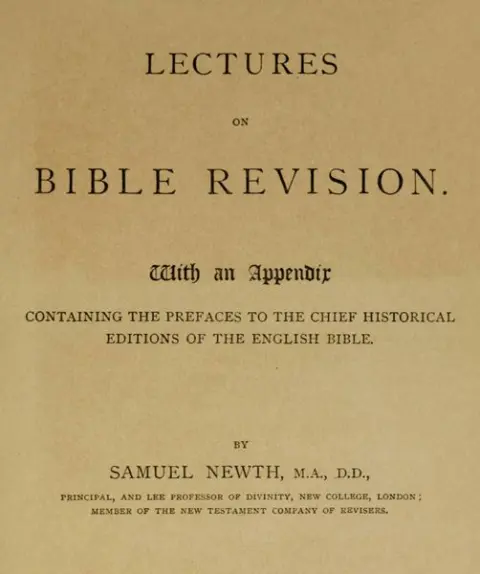
THE CLASSIC COLLECTION · 1881
"Lectures on Bible Revision" by Samuel Newth is a scholarly examination written in the late 19th century. The text focuses on the significance of biblical revisions, particularly the need for an updated understanding of the English Bible in light of historical and linguistic changes. It serves as a resource for Sunday-school and Bible-class teachers to navigate the complexities of these revisions and engage thoughtfully with their communities. The opening of the work introduces the author's aim to clarify the distinctions between the substance and form of Scripture, urging readers to acknowledge that while the truths contained in the Bible are eternal, the language and translations are subject to change. Newth emphasizes that reverence for the Scriptures should focus on the underlying truths rather than the specific wording, which has evolved over time. He reflects on historical translations and revisions, illustrating how the English Bible has transformed through various interpreters and linguistic shifts, underscoring the necessity of ongoing revision to maintain its relevance and accuracy for contemporary readers.
Introduction adapted from the source catalogue; source summaries may be automatically generated.
Free to read · English · 79,829 words · No account needed
MAKE TIME FOR A GOOD BOOK
On by default. Untick to stop anonymous reading totals. Each page counts after 10 seconds in view. How this works.
Anonymous counting is on unless you have switched it off.
Yet before we end, we must answer a third cavil and objection of their’s against us, for altering and amending our translations so oft; wherein truly they deal hardly and strangely with us. For to whom ever was it imputed for a fault, (by such as were wise,) to go over that which he had done, and to amend it where he saw cause? [Sidenote: St. August. Epist. 9. St. August. lib. Retract Video interdum vitia mea. St. August. Epist. 8.] St. Augustine was not afraid to exhort St. Hierome to a Palinodia or recantation. The same St. Augustine was not ashamed to retractate, we might say, revoke, many things that had passed him, and doth even glory that he seeth his infirmities. If we will be sons of the truth, we must consider what it speaketh, and trample upon our own credit, yea, and upon other men’s too, if either be any way an hindrance to it. This to the cause. Then to the persons we say, that of all men they ought to be most silent in this case. For what varieties have they, and what alterations have they made, not only of their service books, portesses, and breviaries, but also of their Latin translation? The service book supposed to be made by St. Ambrose, (Officium Ambrosianum,) was a great while in special use and request: but Pope Adrian, [Sidenote: Durand. lib. 5. cap. 2.] calling a council with the aid of Charles the Emperor, abolished it, yea, burnt it, and commanded the service book of St. Gregory universally to be used. Well, Officium Gregorianum gets by this means to be in credit; but doth it continue without change or altering? No, the very Roman service was of two fashions; the new fashion, and the old, the one used in one Church, and the other in another; as is to be seen in Pamelius a Romanist, his preface before Micrologus. The same Pamelius reporteth out of Radulphus de Rivo, that about the year of our Lord 1277 Pope Nicolas the Third removed out of the churches of Rome the more ancient books (of service,) and brought into use the missals of the Friers Minorites, and commanded them to be observed there: insomuch that about an hundred years after, when the aboved named Radulphus happened to be at Rome, he found all the books to be new, of the new stamp. Neither was there this chopping and changing in the more ancient times only, but also of late. Pius Quintus himself confesseth, that every bishoprick almost had a peculiar kind of service, most unlike to that which others had; which moved him to abolish all other breviaries, though never so ancient, and privileged and published by Bishops in their Dioceses, and to establish and ratify that only which was of his own setting forth in the year 1568. Now when the Father of their Church, who gladly would heal the sore of the daughter of his people softly and slightly, and make the best of it, findeth so great fault with them for their odds and jarring; we hope the children have no great cause to vaunt of their uniformity. But the difference that appeareth between our translations, and our often correcting of them, is the thing that we are specially charged with; let us see therefore whether they themselves be without fault this way, (if it be to be counted a fault to correct,) and whether they be fit men to throw stones at us: O tandem major parcas insane minori: They that are less sound themselves ought not to object infirmities to others. If we should tell them, that Valla, Stapulensis, Erasmus, and Vives, found fault with their vulgar translation, and consequently wished the same to be mended, or a new one to be made; they would answer peradventure, that we produced their enemies for witnesses against them; albeit they were in no other sort enemies, than as St. Paul was to the Galatians, [Sidenote: Gal. 4. 16.] for telling them the truth: and it were to be wished, that they had dared to tell it them plainlier and oftener. But what will they say to this, That Pope Leo the Tenth allowed Erasmus’ translation of the New Testament, so much different from the vulgar, by his apostolick letter and bull? [Sidenote: Sixtus Senens.] That the same Leo exhorted Pagnine to translate the whole Bible, and bare whatsoever charges was necessary for the work? Surely, as the apostle reasoneth to the Hebrews, [Sidenote: Heb. 7. 11. & 8. 7.] that if the former Law and Testament had been sufficient, there had been no need of the latter: so we may say, that if the old vulgar had been at all points allowable, to small purpose had labour and charges been undergone about framing of a new. If they say, it was one Pope’s private opinion, and that he consulted only himself; then we are able to go further with them, and to aver, that more of their chief men of all sorts, even their own Trent champions, Paiva and Vega, and their own inquisitor Hieronymus ab Oleastro, and their own Bishop Isidorus Clarius, and their own Cardinal Thomas a vio Cajetan, do either make new translations themselves, or follow new ones of other men’s making, or note the vulgar interpreter for halting, none of them fear to dissent from him, nor yet to except against him. And call they this an uniform tenor of text and judgment about the text, so many of their worthies disclaiming the now received conceit? Nay, we will yet come nearer the quick. [Sidenote: Sixtus 5. Præf. fixa bibliis.] Doth not their Paris edition differ from the Lovain, and Hentenius’s from them both, and yet all of them allowed by authority? Nay, doth not Sixtus Quintus confess, that certain Catholicks (he meaneth certain of his own side) were in such an humour of translating the Scriptures into Latin, that Satan taking occasion by them, though they thought of no such matter, did strive what he could, out of so uncertain and manifold a variety of translations, so to mingle all things, that nothing might seem to be left certain and firm in them, &c.? Nay further, did not the same Sixtus ordain by an inviolable decree, and that with the counsel and consent of his Cardinals, that the Latin edition of the Old and New Testament, which the council of Trent would have to be authentick, is the same without controversy which he then set forth, being diligently corrected and printed in the printinghouse of Vatican? Thus Sixtus in his preface before his Bible. And yet Clement the Eighth, his immediate successor to account of, publisheth another edition of the Bible, containing in it infinite differences from that of Sixtus, and many of them weighty and material; and yet this must be authentick by all means. What is to have the faith of our glorious Lord Jesus Christ with yea and nay, if this be not? Again, what is sweet harmony and consent, if this be? Therefore, as Demaratus of Corinth advised a great King, before he talked of the dissensions among the Grecians, to compose his domestick broils; (for at that time his queen and his son and heir were at deadly feud with him) so all the while that our adversaries do make so many and so various editions themselves, and do jar so much about the worth and authority of them, they can with no shew of equity challenge us for changing and correcting.
Your reading position is saved on this browser. Take it to another device with a library code. Reading pages adapt to text, rather than matching a printed edition.
BEHIND THE BOOK
This eBook is for the use of anyone anywhere in the United States and most other parts of the world at no cost and with almost no restrictions whatsoever. You may copy it, give it away or re-use it under the terms of the Project Gutenberg License included with this eBook or online at www.gutenberg.org. If you are not located in the United States, you will have to check the laws of the country where you are located before using this eBook. Read the source licence.
The original source file, including credits and licence, is retained by this library. Request an original-format copy at no charge. Please include the book title and Project Gutenberg identifier #42514.
KEEP YOUR CURIOSITY GOING
David Patterson (Spirit) Hatch

David Patterson (Spirit) Hatch

David Patterson (Spirit) Hatch
Cécile Tormay

Moritz Busch
John L. Ransom