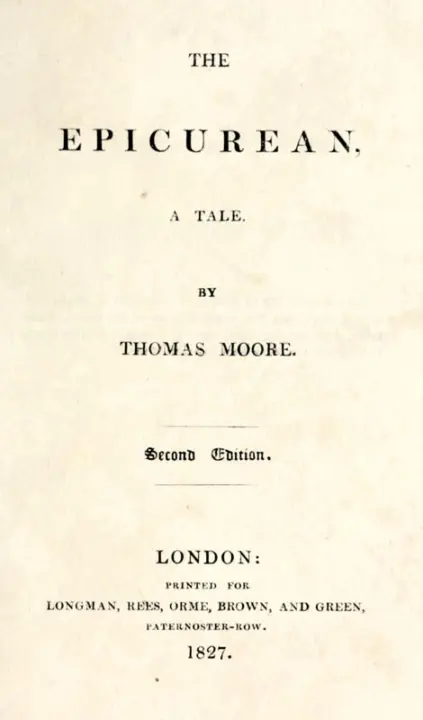
The Epicurean: A Tale
Thomas Moore
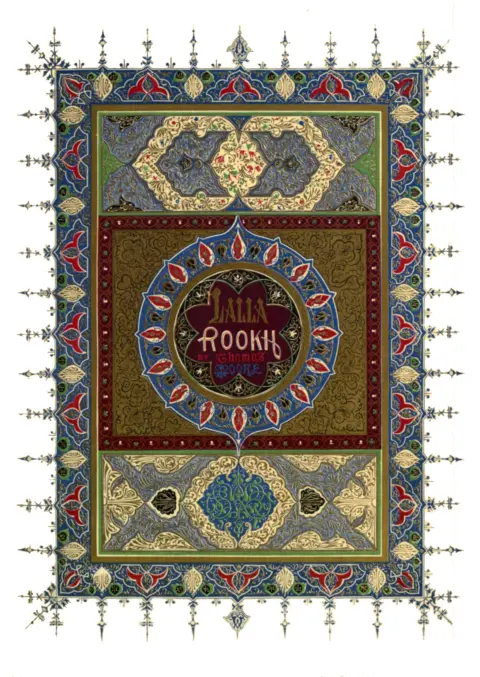
THE CLASSIC COLLECTION · 1817
"Lalla Rookh: An Oriental romance" by Thomas Moore is a romantic work first published in 1817. The poem follows Princess Lalla Rookh, daughter of Mughal emperor Aurangzeb, as she journeys to marry the King of Bukhara. Along the way, she falls in love with Feramorz, a poet in her entourage who entertains her with four enchanting tales. The work blends a frame narrative with interpolated poems set in sumptuous Eastern settings, exploring themes of love, disguise, and identity in a world of Persian splendor.
Introduction adapted from the source catalogue; source summaries may be automatically generated.
Free to read · English · 77,115 words · No account needed
MAKE TIME FOR A GOOD BOOK
On by default. Untick to stop anonymous reading totals. Each page counts after 10 seconds in view. How this works.
Anonymous counting is on unless you have switched it off.
p. 295.—He sits, with flow’rets fetter’d round.
See the representation of the Eastern Cupid, pinioned closely round with wreaths of flowers, in Picart’s Cérémonies Religieuses.
Footnote 328:
p. 295.—Lose all their glory when he flies.
“Among the birds of Tonquin is a species of goldfinch, which sings so melodiously that it is called the Celestial bird. Its wings, when it is perched, appear variegated with beautiful colours, but when it flies they lose all their splendour.”—Grosier.
Footnote 329:
p. 296.—Whose pinion knows no resting place.
“As these birds on the Bosphorus are never known to rest, they are called by the French ‘les âmes damnées.’”—Dalloway.
Footnote 330:
p. 296.—If there his darling rose is not.
“You may place a hundred handfuls of fragrant herbs and flowers before the nightingale, yet he wishes not, in his constant heart, for more than the sweet breath of his beloved rose.”—Jami.
Footnote 331:
p. 298.—From the great Mantra, which around.
“He is said to have found the great Mantra, spell or talisman, through which he ruled over the elements and spirits of all denominations.”—Wilford.
Footnote 332:
p. 298.—To the gold gems of AFRIC.
“The gold jewels of Jinnie, which are called by the Arabs El Herrez, from the supposed charm they contain.”—Jackson.
Footnote 333:
p. 298.—To keep him from the Siltim’s harm.
“A demon, supposed to haunt woods, &c. in a human
shape.”—Richardson.
Footnote 334:
p. 298.—Her Selim’s smile to NOURMAHAL.
The name of Jehanguire before his accession to the throne.
Footnote 335:
p. 300.—Anemones and Seas of Gold.
“Hemasagara, or the Sea of Gold, with flowers of the brightest gold colour.”—Sir W. Jones.
Footnote 336:
p. 300.—Their buds on CAMADEVA’S quiver.
“This tree (the Nagacesara) is one of the most delightful on earth, and the delicious odour of its blossoms justly gives them a place in the quiver of Camadeva, or the God of Love.”—Id.
Footnote 337:
p. 300.—Is call’d the Mistress of the Night.
“The Malayans style the tube-rose (Polianthes tuberosa) Sandal Malam, or the Mistress of the Night.”—Pennant.
Footnote 338:
p. 300.—That wander through ZAMARA’S shades.
The people of the Batta country in Sumatra (of which Zamara is one of the ancient names), “when not engaged in war, lead an idle, inactive life, passing the day in playing on a kind of flute, crowned with garlands of flowers, among which the globe-amaranthus, a native of the country, mostly prevails.”—Marsden.
Footnote 339:
p. 300.—From the divine Amrita tree.
“The largest and richest sort (of the Jambu, or rose-apple) is called Amrita, or immortal, and the mythologists of Tibet apply the same word to a celestial tree, bearing ambrosial fruit.”—Sir W. Jones.
Footnote 340:
Your reading position is saved on this browser. Take it to another device with a library code. Reading pages adapt to text, rather than matching a printed edition.
BEHIND THE BOOK
This eBook is for the use of anyone anywhere in the United States and most other parts of the world at no cost and with almost no restrictions whatsoever. You may copy it, give it away or re-use it under the terms of the Project Gutenberg License included with this eBook or online at www.gutenberg.org. If you are not located in the United States, you will have to check the laws of the country where you are located before using this eBook. Read the source licence.
The original source file, including credits and licence, is retained by this library. Request an original-format copy at no charge. Please include the book title and Project Gutenberg identifier #76794.
KEEP YOUR CURIOSITY GOING
Coulson Kernahan

Maurice Baring
Frances Wright
Cécile Tormay

Frederic Jesup Stimson

W. H. P. (William Henry Pope) Jarvis