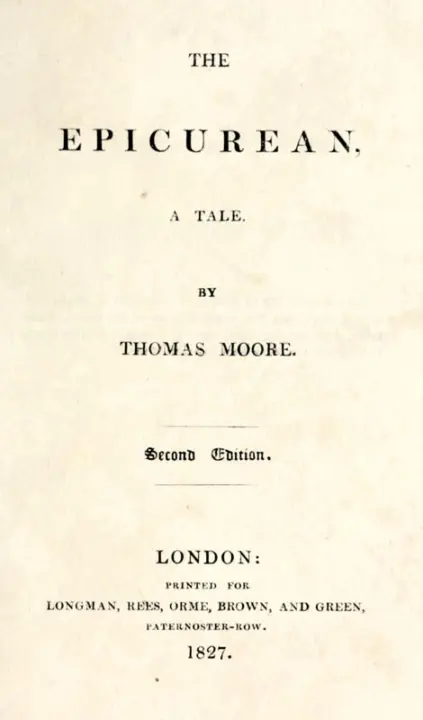
The Epicurean: A Tale
Thomas Moore
THE CLASSIC COLLECTION · 1817
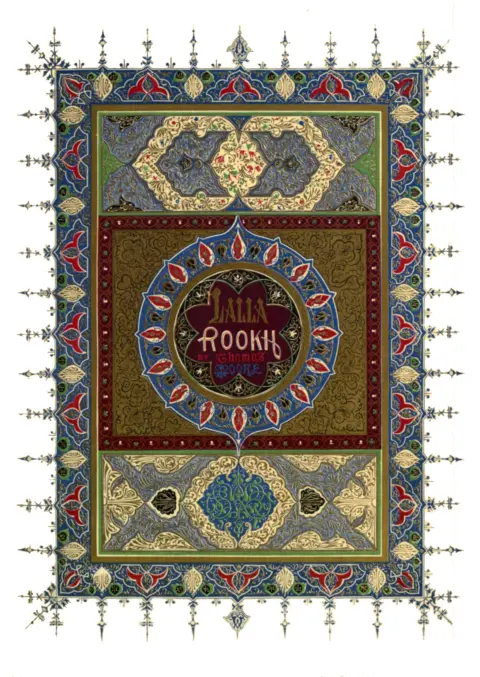
"Lalla Rookh: An Oriental romance" by Thomas Moore is a romantic work first published in 1817. The poem follows Princess Lalla Rookh, daughter of Mughal emperor Aurangzeb, as she journeys to marry the King of Bukhara. Along the way, she falls in love with Feramorz, a poet in her entourage who entertains her with four enchanting tales. The work blends a frame narrative with interpolated poems set in sumptuous Eastern settings, exploring themes of love, disguise, and identity in a world of Persian splendor.
Introduction adapted from the source catalogue; source summaries may be automatically generated.
Free to read · English · 77,115 words · No account needed
MAKE TIME FOR A GOOD BOOK
On by default. Untick to stop anonymous reading totals. Each page counts after 10 seconds in view. How this works.
Anonymous counting is on unless you have switched it off.
“The Feast of Roses continues the whole time of their remaining in bloom.”—See Pietro de la Valle.
Footnote 316:
p. 287.—The Flow’ret of a hundred leaves.
“Gud sad berk, the Rose of a hundred leaves. I believe a particular
species.”—Ouseley.
Footnote 317:
p. 287.—Behind the palms of BARAMOULE.—Bernier.
Footnote 318:
p. 288.—On BELA’S hills is less alive.
A place mentioned in the Toozek Jehangeery, or Memoirs of Jehanguire, where there is an account of the beds of saffron-flowers about Cashmere.
Footnote 319:
p. 289.—Sung from his lighted gallery.
“It is the custom among the women to employ the Maazeen to chaunt from the gallery of the nearest minaret, which on that occasion is illuminated, and the women assembled at the house respond at intervals with a ziraleet or joyous chorus.”—Russel.
Footnote 320:
p. 289.—From gardens, where the silken swing.
“The swing is a favourite pastime in the East, as promoting a circulation of air, extremely refreshing in those sultry climates.”—Richardson.
“The swings are adorned with festoons. This pastime is accompanied with the music of voices and of instruments, hired by the masters of the swings.”—Thevenot.
Footnote 321:
p. 289.—Among the tents that line the way.
“At the keeping of the Feast of Roses we beheld an infinite number of tents pitched, with such a crowd of men, women, boys, and girls, with music, dances,” &c. &c.—Herbert.
Footnote 322:
p. 290.—An answer in song to the kiss of each wave.
“An old commentator of the Chou-King says, the ancients having remarked that a current of water made some of the stones near its banks send forth a sound, they detached some of them, and being charmed with the delightful sound they emitted, constructed King or musical instruments of them.”—Grosier.
This miraculous quality has been attributed also to the shore of Attica. “Hujus littus, ait Capella, concentum musicum illisis terræ undis reddere, quod propter tantam eruditionis vim puto dictum.”—Ludov. Vives in Augustin. de Civitat. Dei, lib. xviii. c. 8.
Footnote 323:
p. 290.—So felt the magnificent Son of Acbar.
Jehanguire was the son of the Great Acbar.
Footnote 324:
p. 292.—Yet playful as Peris just loos’d from their cages.
In the wars of the Dives with the Peris, whenever the former took the latter prisoners, “they shut them up in iron cages, and hung them on the highest trees. Here they were visited by their companions, who brought them the choicest odours.”—Richardson.
Footnote 325:
p. 293.—Of the flowers of this planet—though treasures were there.
In the Malay language the same word signifies women and flowers.
Footnote 326:
p. 293.—He saw that City of Delight.
The capital of Shadukiam. See note, p. 357.
Footnote 327:
Your reading position is saved on this browser. Take it to another device with a library code. Reading pages adapt to text, rather than matching a printed edition.
BEHIND THE BOOK
This eBook is for the use of anyone anywhere in the United States and most other parts of the world at no cost and with almost no restrictions whatsoever. You may copy it, give it away or re-use it under the terms of the Project Gutenberg License included with this eBook or online at www.gutenberg.org. If you are not located in the United States, you will have to check the laws of the country where you are located before using this eBook. Read the source licence.
The original source file, including credits and licence, is retained by this library. Request an original-format copy at no charge. Please include the book title and Project Gutenberg identifier #76794.
KEEP YOUR CURIOSITY GOING
Coulson Kernahan

Maurice Baring
Frances Wright
Cécile Tormay

Frederic Jesup Stimson

W. H. P. (William Henry Pope) Jarvis