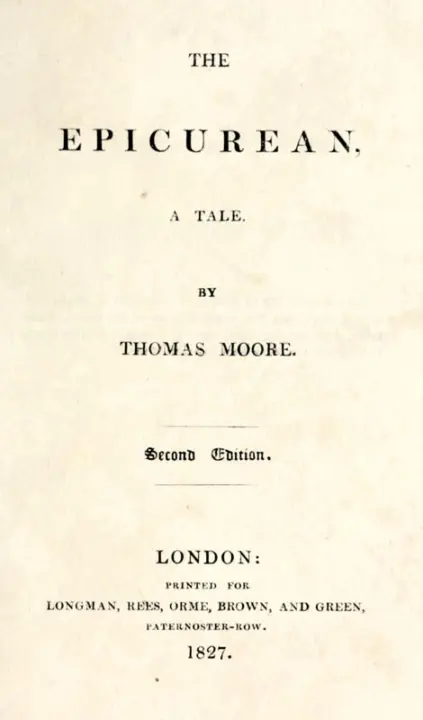
The Epicurean: A Tale
Thomas Moore
THE CLASSIC COLLECTION · 1817
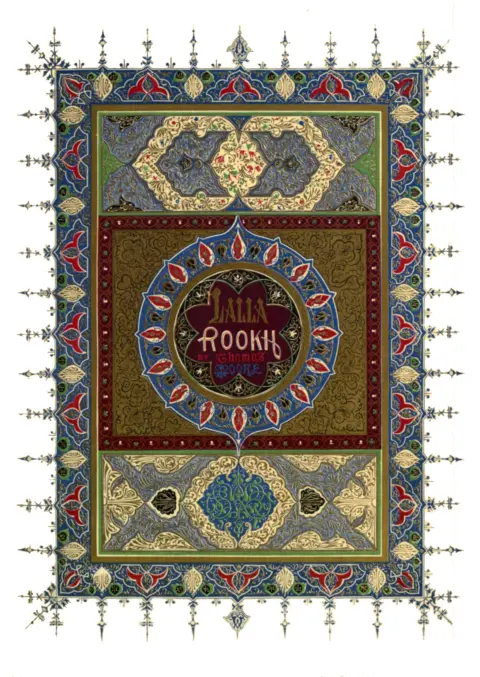
"Lalla Rookh: An Oriental romance" by Thomas Moore is a romantic work first published in 1817. The poem follows Princess Lalla Rookh, daughter of Mughal emperor Aurangzeb, as she journeys to marry the King of Bukhara. Along the way, she falls in love with Feramorz, a poet in her entourage who entertains her with four enchanting tales. The work blends a frame narrative with interpolated poems set in sumptuous Eastern settings, exploring themes of love, disguise, and identity in a world of Persian splendor.
Introduction adapted from the source catalogue; source summaries may be automatically generated.
Free to read · English · 77,115 words · No account needed
MAKE TIME FOR A GOOD BOOK
On by default. Untick to stop anonymous reading totals. Each page counts after 10 seconds in view. How this works.
Anonymous counting is on unless you have switched it off.
p. 301.—Down to the basil tuft, that waves.
Sweet basil, called Rayhan in Persia, and generally found in
church-yards.
“The women in Egypt go, at least two days in the week, to pray and weep at the sepulchres of the dead; and the custom then is to throw upon the tombs a sort of herb, which the Arabs call rihan, and which is our sweet basil.”—Maillet, Lett. 10.
Footnote 341:
p. 301.—To scent the desert and the dead.
“In the Great Desert are found many stalks of lavender and
rosemary.”—Asiat. Res.
Footnote 342:
p. 303.—That blooms on a leafless bough.
“The almond-tree, with white flowers, blossoms on the bare
branches.”—Hasselquist.
Footnote 343:
p. 303.—Inhabit the mountain-herb, that dyes.
An herb on Mount Libanus, which is said to communicate a yellow golden hue to the teeth of the goats and other animals that graze upon it.
Niebuhr thinks this may be the herb which the Eastern alchymists look to as a means of making gold. “Most of those alchymical enthusiasts think themselves sure of success, if they could but find out the herb, which gilds the teeth and gives a yellow colour to the flesh of the sheep that eat it. Even the oil of this plant must be of a golden colour. It is called Haschischat ed dab.”
Father Jerom Dandini, however, asserts that the teeth of the goats at Mount Libanus are of a silver colour; and adds, “This confirms to me that which I observed in Candia: to wit, that the animals that live on Mount Ida eat a certain herb, which renders their teeth of a golden colour; which, according to my judgment, cannot otherwise proceed than from the mines which are under ground.”—Dandini, Voyage to Mount Libanus.
Footnote 344:
p. 304.—Of AZAB blew, was full of scents.—The myrrh country.
Footnote 345:
p. 304.—Where Love himself, of old, lay sleeping.
“This idea (of deities living in shells) was not unknown to the Greeks, who represent the young Nerites, one of the Cupids, as living in shells on the shores of the Red Sea.”—Wilford.
Footnote 346:
p. 305.—From CHINDARA’S warbling fount I come.
“A fabulous mountain, where instruments are said to be constantly playing.”—Richardson.
Footnote 347:
p. 307.—The cinnamon-seed from grove to grove.
“The Pompadour pigeon is the species, which, by carrying the fruit of the cinnamon to different places, is a great disseminator of this valuable tree.”—See Brown’s Illustr. Tab. 19.
Footnote 348:
p. 307.—The past, the present, and future of pleasure.
Your reading position is saved on this browser. Take it to another device with a library code. Reading pages adapt to text, rather than matching a printed edition.
BEHIND THE BOOK
This eBook is for the use of anyone anywhere in the United States and most other parts of the world at no cost and with almost no restrictions whatsoever. You may copy it, give it away or re-use it under the terms of the Project Gutenberg License included with this eBook or online at www.gutenberg.org. If you are not located in the United States, you will have to check the laws of the country where you are located before using this eBook. Read the source licence.
The original source file, including credits and licence, is retained by this library. Request an original-format copy at no charge. Please include the book title and Project Gutenberg identifier #76794.
KEEP YOUR CURIOSITY GOING
Coulson Kernahan

Maurice Baring
Frances Wright
Cécile Tormay

Frederic Jesup Stimson

W. H. P. (William Henry Pope) Jarvis