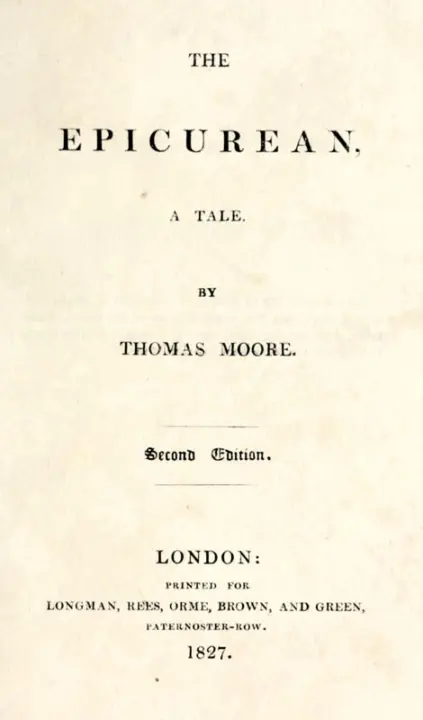
The Epicurean: A Tale
Thomas Moore
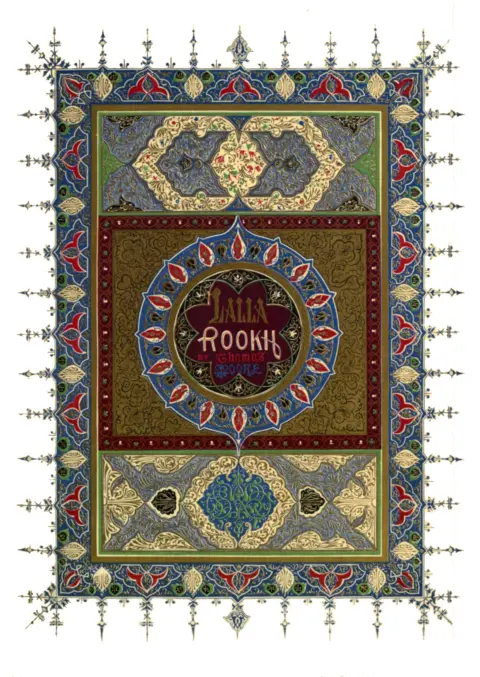
THE CLASSIC COLLECTION · 1817
"Lalla Rookh: An Oriental romance" by Thomas Moore is a romantic work first published in 1817. The poem follows Princess Lalla Rookh, daughter of Mughal emperor Aurangzeb, as she journeys to marry the King of Bukhara. Along the way, she falls in love with Feramorz, a poet in her entourage who entertains her with four enchanting tales. The work blends a frame narrative with interpolated poems set in sumptuous Eastern settings, exploring themes of love, disguise, and identity in a world of Persian splendor.
Introduction adapted from the source catalogue; source summaries may be automatically generated.
Free to read · English · 77,115 words · No account needed
MAKE TIME FOR A GOOD BOOK
On by default. Untick to stop anonymous reading totals. Each page counts after 10 seconds in view. How this works.
Anonymous counting is on unless you have switched it off.
For a particular description and plate of the Banyan-tree, see
Cordiner’s Ceylon.
Footnote 168:
p. 133.—Thy Monarchs and their thousand Thrones.
“With this immense treasure Mamood returned to Ghizni, and in the year 400 prepared a magnificent festival, where he displayed to the people his wealth in golden thrones and in other ornaments, in a great plain without the city of Ghizni.”—Ferishta.
Footnote 169:
p. 133.—’Tis He of Gazna—fierce in wrath.
“Mahmood of Gazna, or Ghizni, who conquered India in the beginning of the 11th century.”—See his History in Dow and Sir J. Malcolm.
Footnote 170:
p. 133.—Of many a young and lov’d Sultana.
“It is reported that the hunting equipage of the Sultan Mahmood was so magnificent, that he kept 400 greyhounds and bloodhounds, each of which wore a collar set with jewels, and a covering edged with gold and pearls.”—Universal History, vol. iii.
Footnote 171:
p. 134.—For Liberty shed, so holy is.
Objections may be made to my use of the word Liberty in this, and more especially in the story that follows it, as totally inapplicable to any state of things that has ever existed in the East; but though I cannot, of course, mean to employ it in that enlarged and noble sense which is so well understood at the present day, and, I grieve to say, so little acted upon, yet it is no disparagement to the word to apply it to that national independence, that freedom from the interference and dictation of foreigners, without which, indeed, no liberty of any kind can exist; and for which both Hindoos and Persians fought against their Mussulman invaders with, in many cases, a bravery that deserved much better success.
Footnote 172:
p. 136.—Now among AFRIC’S lunar Mountains.
“The Mountains of the Moon, or the Montes Lunæ of antiquity, at the foot of which the Nile is supposed to rise.”—Bruce.
“Sometimes called,” says Jackson, “Jibbel Kumrie, or the white or lunar-coloured mountains; so a white horse is called by the Arabians a moon-coloured horse.”
Footnote 173:
p. 136.—And hail the new-born Giant’s smile.
“The Nile, which the Abyssinians know by the names of Abey and Alawy, or the Giant.”—Asiat. Research. vol. i. p. 387.
Footnote 174:
p. 136.—Her grots, and sepulchres of Kings.
See Perry’s View of the Levant for an account of the sepulchres in Upper Thebes, and the numberless grots, covered all over with hieroglyphics in the mountains of Upper Egypt.
Footnote 175:
p. 136.—In warm ROSETTA’S vale—now loves.
“The orchards of Rosetta are filled with turtle-doves.”—Sonnini.
Footnote 176:
p. 136.—The azure calm of MŒRIS’ Lake.
Savary mentions the pelicans upon Lake Mœris.
Footnote 177:
p. 137.—Warns them to their silken beds.
Your reading position is saved on this browser. Take it to another device with a library code. Reading pages adapt to text, rather than matching a printed edition.
BEHIND THE BOOK
This eBook is for the use of anyone anywhere in the United States and most other parts of the world at no cost and with almost no restrictions whatsoever. You may copy it, give it away or re-use it under the terms of the Project Gutenberg License included with this eBook or online at www.gutenberg.org. If you are not located in the United States, you will have to check the laws of the country where you are located before using this eBook. Read the source licence.
The original source file, including credits and licence, is retained by this library. Request an original-format copy at no charge. Please include the book title and Project Gutenberg identifier #76794.
KEEP YOUR CURIOSITY GOING
Coulson Kernahan

Maurice Baring
Frances Wright
Cécile Tormay

Frederic Jesup Stimson

W. H. P. (William Henry Pope) Jarvis