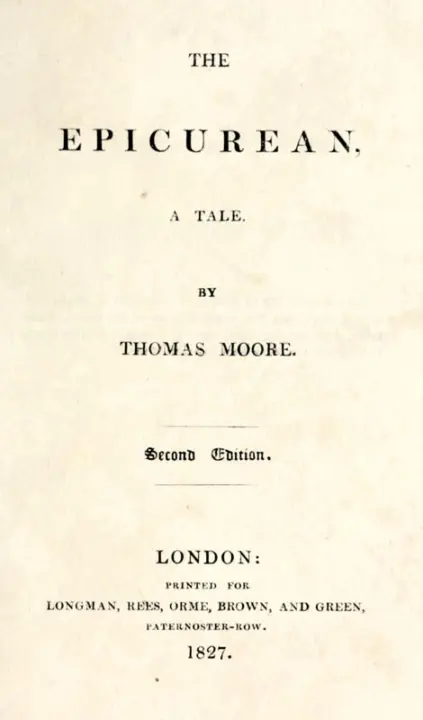
The Epicurean: A Tale
Thomas Moore
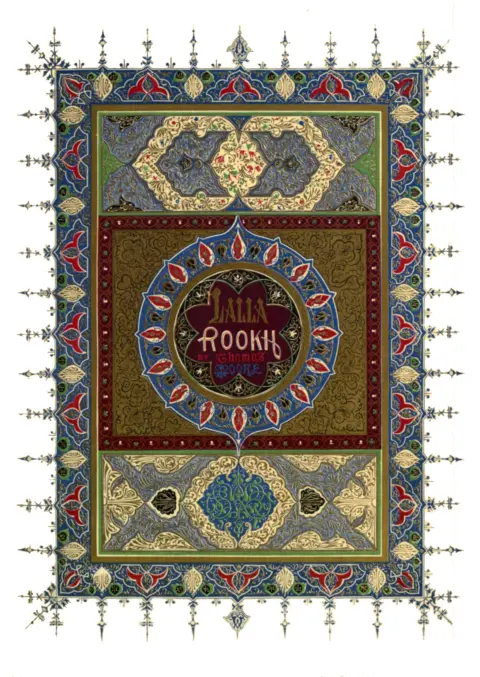
THE CLASSIC COLLECTION · 1817
"Lalla Rookh: An Oriental romance" by Thomas Moore is a romantic work first published in 1817. The poem follows Princess Lalla Rookh, daughter of Mughal emperor Aurangzeb, as she journeys to marry the King of Bukhara. Along the way, she falls in love with Feramorz, a poet in her entourage who entertains her with four enchanting tales. The work blends a frame narrative with interpolated poems set in sumptuous Eastern settings, exploring themes of love, disguise, and identity in a world of Persian splendor.
Introduction adapted from the source catalogue; source summaries may be automatically generated.
Free to read · English · 77,115 words · No account needed
MAKE TIME FOR A GOOD BOOK
On by default. Untick to stop anonymous reading totals. Each page counts after 10 seconds in view. How this works.
Anonymous counting is on unless you have switched it off.
“The superb date-tree, whose head languidly reclines, like that of a handsome woman overcome with sleep.”—Dafard el Hadad.
Footnote 178:
p. 137.—Some purple-wing’d Sultana sitting.
“That beautiful bird, with plumage of the finest shining blue, with purple beak and legs, the natural and living ornament of the temples and palaces of the Greeks and Romans, which, from the stateliness of its port, as well as the brilliancy of its colours, has obtained the title of Sultana.”—Sonnini.
Footnote 179:
p. 138.—Only the fierce hyæna stalks.
Jackson, speaking of the plague that occurred in West Barbary, when he was there, says, “The birds of the air fled away from the abodes of men. The hyænas, on the contrary, visited the cemeteries,” &c.
Footnote 180:
p. 138.—Throughout the city’s desolate walks.
“Gondar was full of hyænas from the time it turned dark till the dawn of day, seeking the different pieces of slaughtered carcasses, which this cruel and unclean people expose in the streets without burial, and who firmly believe that these animals are Falashta from the neighbouring mountains, transformed by magic, and come down to eat human flesh in the dark in safety.”—Bruce.
Footnote 181:
p. 138.—The glaring of those large blue eyes.—Bruce.
Footnote 182:
p. 140.—But see—who yonder comes by stealth.
This circumstance has been often introduced into poetry;—by Vincentius Fabricius, by Darwin, and lately, with very powerful effect, by Mr. Wilson.
Footnote 183:
p. 142.—Who sings at the last his own death-lay.
“In the East, they suppose the Phœnix to have fifty orifices in his bill, which are continued to his tail; and that, after living one thousand years, he builds himself a funeral pile, sings a melodious air of different harmonies through his fifty organ pipes, flaps his wings with a velocity which sets fire to the wood, and consumes himself.”—Richardson.
Footnote 184:
p. 144.—Their first sweet draught of glory take.
“On the shores of a quadrangular lake stand a thousand goblets, made of stars, out of which souls predestined to enjoy felicity drink the crystal wave.”—From Châteaubriand’s Description of the Mahometan Paradise, in his Beauties of Christianity.
Footnote 185:
p. 145.—Now, upon SYRIA’S land of roses.
Richardson thinks that Syria had its name from Suri, a beautiful and delicate species of rose, for which that country has been always famous;—hence, Suristan, the Land of Roses.
Footnote 186:
p. 145.—Gay lizards, glittering on the walls.
“The number of lizards I saw one day in the great court of the Temple of the Sun at Balbec amounted to many thousands; the ground, the walls, and stones of the ruined buildings, were covered with them.”—Bruce.
Footnote 187:
Your reading position is saved on this browser. Take it to another device with a library code. Reading pages adapt to text, rather than matching a printed edition.
BEHIND THE BOOK
This eBook is for the use of anyone anywhere in the United States and most other parts of the world at no cost and with almost no restrictions whatsoever. You may copy it, give it away or re-use it under the terms of the Project Gutenberg License included with this eBook or online at www.gutenberg.org. If you are not located in the United States, you will have to check the laws of the country where you are located before using this eBook. Read the source licence.
The original source file, including credits and licence, is retained by this library. Request an original-format copy at no charge. Please include the book title and Project Gutenberg identifier #76794.
KEEP YOUR CURIOSITY GOING
Coulson Kernahan

Maurice Baring
Frances Wright
Cécile Tormay

Frederic Jesup Stimson

W. H. P. (William Henry Pope) Jarvis