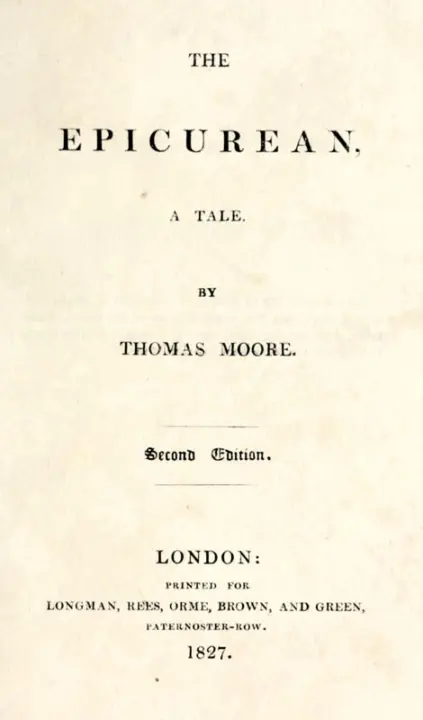
The Epicurean: A Tale
Thomas Moore
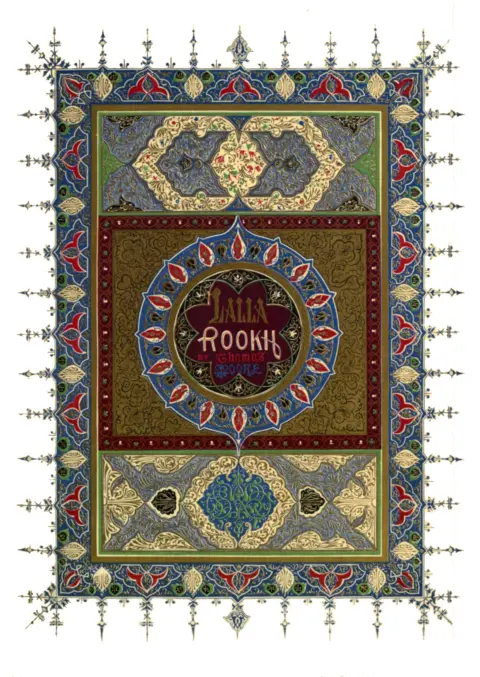
THE CLASSIC COLLECTION · 1817
"Lalla Rookh: An Oriental romance" by Thomas Moore is a romantic work first published in 1817. The poem follows Princess Lalla Rookh, daughter of Mughal emperor Aurangzeb, as she journeys to marry the King of Bukhara. Along the way, she falls in love with Feramorz, a poet in her entourage who entertains her with four enchanting tales. The work blends a frame narrative with interpolated poems set in sumptuous Eastern settings, exploring themes of love, disguise, and identity in a world of Persian splendor.
Introduction adapted from the source catalogue; source summaries may be automatically generated.
Free to read · English · 77,115 words · No account needed
MAKE TIME FOR A GOOD BOOK
On by default. Untick to stop anonymous reading totals. Each page counts after 10 seconds in view. How this works.
Anonymous counting is on unless you have switched it off.
“Numerous small islands emerge from the Lake of Cashmere. One is called Char Chenaur, from the plane-trees upon it.”—Foster.
Footnote 160:
p. 130.—And the golden floods that thitherward stray.
“The Altan Kol or Golden River of Tibet, which runs into the Lakes of Sing-su-hay, has abundance of gold in its sands, which employs the inhabitants all the summer in gathering it.”—Description of Tibet in Pinkerton.
Footnote 161:
p. 131.—Blooms nowhere but in Paradise.
“The Brahmins of this province insist that the blue campac flowers only in Paradise.”—Sir W. Jones. It appears, however, from a curious letter of the sultan of Menangcabow, given by Marsden, that one place on earth may lay claim to the possession of it. “This is the Sultan, who keeps the flower champaka that is blue, and to be found in no other country but his, being yellow elsewhere.”—Marsden’s Sumatra.
Footnote 162:
p. 131.—Flung at night from angel hands.
“The Mahometans suppose that falling stars are the firebrands wherewith the good angels drive away the bad, when they approach too near the empyrean or verge of the heavens.”—Fryer.
Footnote 163:
p. 132.—Beneath the pillars of CHILMINAR.
The Forty Pillars; so the Persians call the ruins of Persepolis. It is imagined by them that this palace and the edifices at Balbec were built by Genii, for the purpose of hiding in their subterraneous caverns immense treasures, which still remain there.—See D’Herbelot and Volney.
Footnote 164:
p. 132.—To the south of sun-bright Araby.—The Isles of Panchaia.
Diodorus mentions the Isle of Panchaia, to the south of Arabia Felix, where there was a temple of Jupiter. This island, or rather cluster of isles, has disappeared, “sunk (says Grandpré) in the abyss made by the fire beneath their foundations.”—Voyage to the Indian Ocean.
Footnote 165:
p. 132.—The jewell’d cup of their King Jamshid.
“The cup of Jamshid, discovered, they say, when digging for the foundations of Persepolis.”—Richardson.
Footnote 166:
p. 132.—O’er coral rocks, and amber beds.
“It is not like the Sea of India, whose bottom is rich with pearls and ambergris, whose mountains of the coast are stored with gold and precious stones, whose gulfs breed creatures that yield ivory, and among the plants of whose shores are ebony, red wood, and the wood of Hairzan, aloes, camphor, cloves, sandal-wood, and all other spices and aromatics: where parrots and peacocks are birds of the forest, and musk and civet are collected upon the lands.”—Travels of Two Mohammedans.
Footnote 167:
p. 133.—Thy Pagods and thy pillar’d shades.
... “in the ground The bended twigs take root, and daughters grow About the mother-tree, a pillar’d shade, High over-arch’d, and echoing walks between.”—MILTON.
Your reading position is saved on this browser. Take it to another device with a library code. Reading pages adapt to text, rather than matching a printed edition.
BEHIND THE BOOK
This eBook is for the use of anyone anywhere in the United States and most other parts of the world at no cost and with almost no restrictions whatsoever. You may copy it, give it away or re-use it under the terms of the Project Gutenberg License included with this eBook or online at www.gutenberg.org. If you are not located in the United States, you will have to check the laws of the country where you are located before using this eBook. Read the source licence.
The original source file, including credits and licence, is retained by this library. Request an original-format copy at no charge. Please include the book title and Project Gutenberg identifier #76794.
KEEP YOUR CURIOSITY GOING
Coulson Kernahan

Maurice Baring
Frances Wright
Cécile Tormay

Frederic Jesup Stimson

W. H. P. (William Henry Pope) Jarvis