THE CLASSIC COLLECTION✦All Aboard: A Story for GirlsCLASSIC FREE BOOKS
All Aboard: A Story for Girls
Fannie E. (Fannie Ellsworth) Newberry
THE CLASSIC COLLECTION · 1899
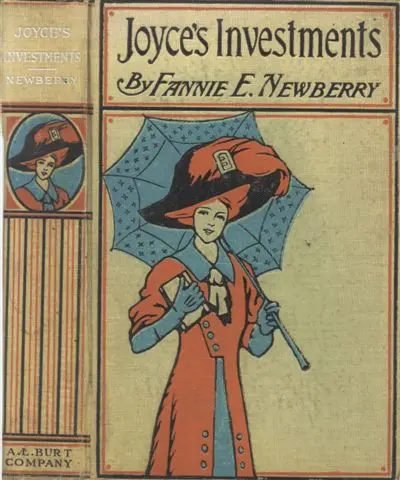
"Joyce's Investments: A Story for Girls" by Fannie E. Newberry is a novel written in the late 19th century. The story centers around Joyce Lavillotte, a young woman who inherits a significant fortune from her father and is determined to use her wealth for the betterment of a struggling community tied to her family's factory, the Early Glass Works. Against the backdrop of a patriarchal society, Joyce defies expectations, aiming not only to manage the factory but also to create a model town that addresses the needs of its inhabitants. At the start of the book, we are introduced to Joyce as she discusses her ambitious plans with her lawyer, Mr. Barrington, who is skeptical of her intentions. Joyce's passion shines through as she expresses her desire to build a better community, with schools and housing that foster comfort and cooperation among the workers. Her revolutionary ideas about co-operation and community transformation capture the reader's attention, hinting at the challenges she will face in her pursuit of social reform and her interactions with the residents of Littleton. This opening sets the stage for Joyce's journey in balancing her newfound power and responsibility as a young heiress seeking to make a meaningful impact.
Introduction adapted from the source catalogue; source summaries may be automatically generated.
Free to read · English · 75,602 words · No account needed
MAKE TIME FOR A GOOD BOOK
On by default. Untick to stop anonymous reading totals. Each page counts after 10 seconds in view. How this works.
Anonymous counting is on unless you have switched it off.
"Isn't it? According to the Bible it's a large one, almost a crime." Her laughing eyes sought his, and she continued, "Now, I haven't a particle of pride. I've eaten one peach and I want another. Moreover, I want it pared and quartered."
They were almost as isolated in their little corner as if in a nook of the woods. The crowds surged to and fro, and its units were "but as trees walking" to their oblivious eyes. Joyce was discovering new depths in George Dalton's nature. He was a thinker, and as his thinking had grown out of contact with men, rather than from grubbing in books, it was often of a unique and picturesque kind.
He saw the ludicrous in everything, and, with all his practicality, there was a strain of romance so fresh and young mingled with it, that it made a boy of him whenever he was dominated by it. He was the boy to-night, and as he leaned towards Joyce, talking in an undertone, his eye bright, his laughter frequent, his manner full of respectful friendliness, she forgot that he had ever seemed hard, cold, and given over to business alone.
At length the call of a train at some distant doorway startled Joyce,
and she glanced around.
"Isn't that our train he's calling? It can't be! But I'm afraid it is."
Each consulted a watch, and looked guiltily at the other.
"It has been very short," said Joyce involuntarily.
"And very sweet!" added George below his breath. "Well, come on, little parcels. One-two-three-four--have I got them all? Why--what is it?"
The girl's face had a piteous look as it was turned to his.
"I had forgotten it all--the Hapgoods, Lozcoski, poor Nate! We were as easy as if there were no trouble anywhere. It all rushed over me once more, and I felt, for the instant, that I could never bear it again. But you will help me? You'll understand now, and not think me foolish and crazy, as you sometimes do?"
"Do I? I did not know it. I'll stand by you in everything, never fear! Come, child, or we'll miss this train, too."
She preceded him without a word, and he was glad to keep quite behind for a little, for when he remembered how he had called her "child" his face was hot with embarrassment. He had never forgotten before. Had she noticed? Her face told him nothing.
As they hurried out through the gates and down the platform to their waiting train, the passengers were descending from another, just arrived. Hastily crossing this tide transversely two men, arm in arm, passed them close in the busy throng.
Your reading position is saved on this browser. Take it to another device with a library code. Reading pages adapt to text, rather than matching a printed edition.
Fannie E. (Fannie Ellsworth) Newberry
BEHIND THE BOOK
This eBook is for the use of anyone anywhere in the United States and most other parts of the world at no cost and with almost no restrictions whatsoever. You may copy it, give it away or re-use it under the terms of the Project Gutenberg License included with this eBook or online at www.gutenberg.org. If you are not located in the United States, you will have to check the laws of the country where you are located before using this eBook. Read the source licence.
The original source file, including credits and licence, is retained by this library. Request an original-format copy at no charge. Please include the book title and Project Gutenberg identifier #21857.
KEEP YOUR CURIOSITY GOING
Coulson Kernahan

Maurice Baring
Frances Wright
Cécile Tormay

Frederic Jesup Stimson

W. H. P. (William Henry Pope) Jarvis