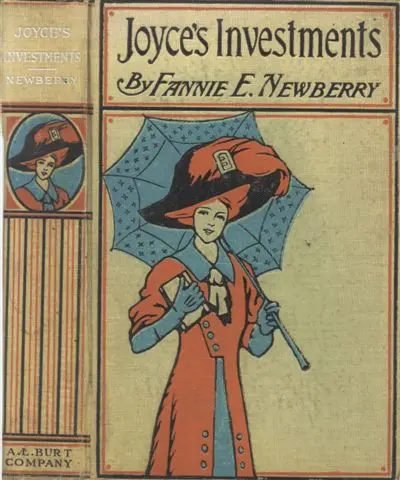
Joyce’s Investments: A Story for Girls
Fannie E. (Fannie Ellsworth) Newberry
THE CLASSIC COLLECTION · 1898
"All Aboard: A Story for Girls" by Fannie E. Newberry is a fictional novel written in the late 19th century. The story centers around twin sisters named Faith and Hope, who are embarking on a significant journey with their father, Captain Hosmer, as he takes them on a voyage aboard the steamship “International.” The book seems to discuss themes of family, adventure, and the excitement of travel, particularly through the experiences of young women in a period that may have limited their autonomy. At the start of the story, the twins are introduced through their interactions with their kind-hearted guardian, Debby, who has cared for them since infancy. As they prepare to leave their home and set sail with their father, readers witness poignant moments of goodbye, the contrasting personalities of the twins, and their eagerness for adventure. The narrative captures the twins' lively banter and excitement, alongside the subtly complex emotions surrounding leaving home and their close bond with Debby. The beginning sets a tone of youthful curiosity and an exploration of familial relationships against the backdrop of a sea voyage, promising an enchanting adventure as they encounter new lands and people.
Introduction adapted from the source catalogue; source summaries may be automatically generated.
Free to read · English · 59,795 words · No account needed
MAKE TIME FOR A GOOD BOOK
On by default. Untick to stop anonymous reading totals. Each page counts after 10 seconds in view. How this works.
Anonymous counting is on unless you have switched it off.
The second speaker was a large, corpulent woman, with a voluminous white apron tied about her voluminous waist. She stood deferentially before the prospective roomer who had asked the question, to whom she was showing the accommodations of her house, with interpolations of a private nature, on a subject too near her heart, to-day, to be ignored even with strangers. As she stood nodding her head with an emphasis that threatened to dislodge the smart cap with purple ribbons, which she had rather hastily assumed when summoned to the door, the caller mentally decided that here was a good soul, indeed, but rather loquacious to be the sole guardian of two girls "putty as twin blooms."
She, herself, was tall and slender, and wore her rich street costume with an easy elegance, as if fine clothing were too much a matter of course to excite her interest. But upon her face were lines which showed that, at some time, she had looked long and deeply into the hollow eyes of trouble, possibly despair. Even the smile now curving her well-turned lips lacked the joyousness of youth, though in years she seemed well on the sunny side of early middle age. She was evidently in no hurry this morning, and finding her possible landlady so ready to talk, bent an attentive ear that was most flattering to the good creature.
"I knew," she said, sinking into a rattan chair tied up with blue ribbons, like an over-dressed baby, "that these rooms had an air which suggested youth and beauty. I don't wonder your heart is sore to lose them."
"Ah, it's broke it is, 'm!" the voice breaking in sympathy, "for I've looked upon 'em as my own, entirely, and it's nigh to eighteen year, now. Their mother, just a slip of a girl herself, 'm, had only time for a long look at her babbies before she begun to sink, and when she see, herself, 'twas the end, she whispered, 'Debby'--I was right over her, 'm, leaving the babbies to anybody, for little they were to me then, beside the dear young mistress--so she says, says she, 'Debby!' and I says, very soft-like, 'Yes, Miss Helen,'--'cause, mind you, I'd been her maid afore she was merrit at all, and I allays forgot when I wasn't thinkin', and give her the old name--and I says, 'Yes, Miss Helen?' And then she smiles up at me just as bright as on her wellest days, 'm, and says, 'Call 'em Faith and Hope,' Debby; that's what they would be to me if--and not rightly onderstandin' of her, I breaks in, 'Faith and Hope? Call what faith and hope?' For, thinkses I, 'she may be luny with the fever.' But no, she says faint-like, but clear and sound as a bell, 'Call my babies so. Let their names be Faith and Hope, and when their poor father comes home, say it was my wish, and he must not grieve too much, for he will have Faith and Hope always with him.' And then the poor dear sinks off again and never rightly comes to, till she's clean gone."
Your reading position is saved on this browser. Take it to another device with a library code. Reading pages adapt to text, rather than matching a printed edition.
Fannie E. (Fannie Ellsworth) Newberry
BEHIND THE BOOK
This eBook is for the use of anyone anywhere in the United States and most other parts of the world at no cost and with almost no restrictions whatsoever. You may copy it, give it away or re-use it under the terms of the Project Gutenberg License included with this eBook or online at www.gutenberg.org. If you are not located in the United States, you will have to check the laws of the country where you are located before using this eBook. Read the source licence.
The original source file, including credits and licence, is retained by this library. Request an original-format copy at no charge. Please include the book title and Project Gutenberg identifier #19001.
KEEP YOUR CURIOSITY GOING
Wilfrid Scawen Blunt
Wilfrid Scawen Blunt

E. W. (Edgar Watson) Howe
Coulson Kernahan

Maurice Baring
Frances Wright