THE CLASSIC COLLECTION✦My diaries, being a personal narrative of events 1888-1914, Part 2 (1900-1914)CLASSIC FREE BOOKS
My diaries, being a personal narrative of events 1888-1914, Part 2 (1900-1914)
Wilfrid Scawen Blunt
THE CLASSIC COLLECTION · 1902
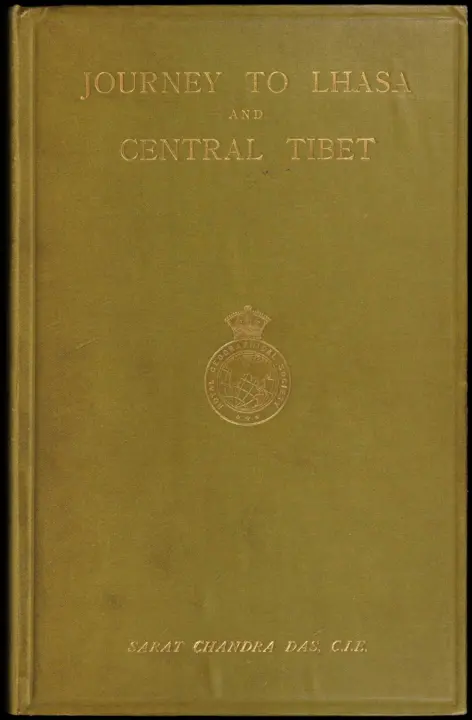
"Journey to Lhasa and Central Tibet" by Sarat Chandra Das is a travelogue published in 1902. The book chronicles Das's second expedition to Tibet in 1881, undertaken under British colonial orders. Das ventures into the forbidden Tibetan capital and central regions, documenting his observations as both explorer and covert agent. Contemporary reviews praised it as the most authentic account of Tibet available, highlighting Das's courage and keen insight into this mysterious land.
Introduction adapted from the source catalogue; source summaries may be automatically generated.
Free to read · English · 110,516 words · No account needed
MAKE TIME FOR A GOOD BOOK
On by default. Untick to stop anonymous reading totals. Each page counts after 10 seconds in view. How this works.
Anonymous counting is on unless you have switched it off.
[444] These charmed banners are the lung-ta, or “airy horses,” of which mention is frequently made in this work.
[445] This remark applies equally well to all diseases in Buddhist
estimation.
[446] Jaeschke, ‘Tib. engl. dict.,’ calls this disease pags chu, “skin water;” snying chu, “heart water;” dmu chu, “dropsy, especially in the chest and belly.” On the medical knowledge of the Tibetans, see Journ. Bengal Asiat. Soc., iv. pp. 1 et sqq.—(W. R.)
[447] In this game, which is an invention of one of the Panchen rinpoches, dice are thrown, by which the players get different positions in the various heavens or hells—(S. C. D.) Our author also mentions a game called te-pi, or rocket, but, unfortunately, does not give any idea of the game itself. See also ‘Report U.S. National Museum,’ 1893, p. 723.—(W. R.)
[448] Chinese authors say that, “during the 7th and 8th moons they (the Tibetans) put up tents along the river banks, and men and women bathe together in the river, it being symbolical of the purification ceremonies of the 13th of the 3rd month (in China),” Jour. Roy. Asiat. Soc., No. xxiii., p. 213.—(W. R.)
[449] On the 29th day of the moon.—(W. R.)
[450] Our author mentions also the following festivals:—
15th of 1st moon: Buddha’s birthday. 15th of 3rd ,, First preaching of the Kalachakra tantra. 8th of 4th ,, Buddha became a mendicant. 15th of 4th ,, Buddha’s nirvana. 5th of 5th ,, Feast of god of medicine. 4th of 6th ,, Buddha’s first sermon. 10th of 7th ,, Birth of Padma chyung-nas (Padma Sambhava). 15th of 7th ,, The snowy mountains are worshipped. 25th of 10th ,, Birth of Tsongkhapa.
Cf. Waddell, op. cit., 502 et sqq.
[451] Known in southern Buddhist countries as varsha or Barsat. Yar is dbyar (usually pronounced chyar), “summer;” and nas (gnas), “abode.” I do not believe the practice is generally observed. Cf. Waddell, op. cit., 224, and supra.—(W. R.)
[452] See p. 114. On the New Year festivities, see Waddell, op. cit.,
518.
[453] I have witnessed a number of these kurim, or guilt-offering ceremonies, but none of such magnitude as the one held at Lhasa. See, for a picture of this procession at Lhasa, Georgi, ‘Alph. Tibet,’ p. 212.—(W. R.)
[454] Toma is droma (or doma), the root of the potentilla anserina, and called chuoma in Eastern and North-eastern Tibet. It is mealy, and tastes like a bean rather than a potato. It is about 1½ inches long.—(W. R.)
[455] All these omens of good and bad luck are of equal importance at any time of the year.—(W. R.)
[456] I have seen these mummers in North-eastern Tibet. See ‘Land of the Lamas,’ p. 246.—(W. R.)
Your reading position is saved on this browser. Take it to another device with a library code. Reading pages adapt to text, rather than matching a printed edition.
BEHIND THE BOOK
This eBook is for the use of anyone anywhere in the United States and most other parts of the world at no cost and with almost no restrictions whatsoever. You may copy it, give it away or re-use it under the terms of the Project Gutenberg License included with this eBook or online at www.gutenberg.org. If you are not located in the United States, you will have to check the laws of the country where you are located before using this eBook. Read the source licence.
The original source file, including credits and licence, is retained by this library. Request an original-format copy at no charge. Please include the book title and Project Gutenberg identifier #68898.
KEEP YOUR CURIOSITY GOING
Wilfrid Scawen Blunt
Wilfrid Scawen Blunt

E. W. (Edgar Watson) Howe
Francis Greenleaf Allinson & Anne C. E. (Anne Crosby Emery) Allinson
Cyrenus Cole

John Martineau