THE CLASSIC COLLECTION✦My diaries, being a personal narrative of events 1888-1914, Part 2 (1900-1914)CLASSIC FREE BOOKS
My diaries, being a personal narrative of events 1888-1914, Part 2 (1900-1914)
Wilfrid Scawen Blunt
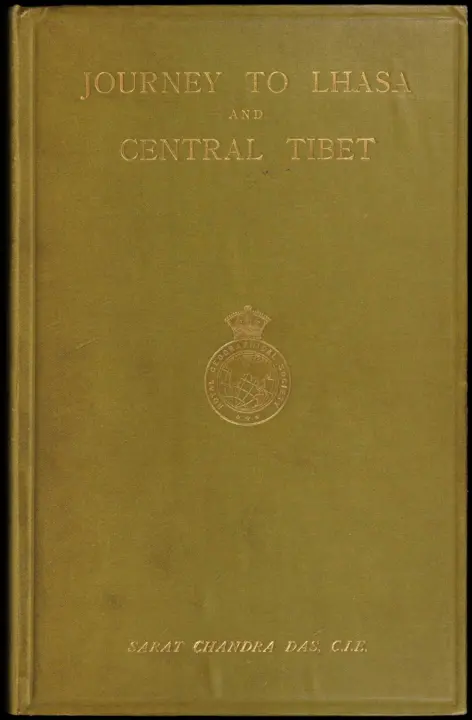
THE CLASSIC COLLECTION · 1902
"Journey to Lhasa and Central Tibet" by Sarat Chandra Das is a travelogue published in 1902. The book chronicles Das's second expedition to Tibet in 1881, undertaken under British colonial orders. Das ventures into the forbidden Tibetan capital and central regions, documenting his observations as both explorer and covert agent. Contemporary reviews praised it as the most authentic account of Tibet available, highlighting Das's courage and keen insight into this mysterious land.
Introduction adapted from the source catalogue; source summaries may be automatically generated.
Free to read · English · 110,516 words · No account needed
MAKE TIME FOR A GOOD BOOK
On by default. Untick to stop anonymous reading totals. Each page counts after 10 seconds in view. How this works.
Anonymous counting is on unless you have switched it off.
[430] So far as the Khamba are concerned, I think our author is not correct in his statement. That it may have once been as he says is highly probable, but at present it is certainly not so; intercourse with the Chinese has, I believe, caused not only the people of Eastern Tibet, but of all Tibet to adopt to a great extent their ideas concerning marriages between near relations.—(W. R.)
[431] Neither is it in Khamdo. See my ‘Land of the Lamas,’ p. 211 et
sqq.—(W. R.)
[432] I hardly imagine that our author intends to convey the idea that this is a custom of the Tibetans.—(W. R.)
[433] See Waddell, op. cit., p. 88. He says the “soul-extracting lama”
is called hpobo.
[434] Cf. ‘Land of the Lamas,’ p. 287.—(W. R.)
[435] The tuisol, or “cleansing ceremony” (bkrus, washed; gsol, to pray), is performed on numerous occasions and for various purposes. I suppose that by “relics,” remains after cremation are here meant.—(W. R.)
[436] Waddell, op. cit., 491, calls this sacrifice to the manes of the
deceased ting-shag.
[437] Our author is not quite right here, as the Tibetans have borrowed the major part of their pharmacopœia from China and India. Most of their medical works are purely Chinese or Indian, and I do not believe they have much more, if even so much, knowledge of surgery as the Chinese, who are terribly ignorant themselves in this art. Tibetan medicines are in high favour among the Chinese and Mongols.—(W. R.)
[438] This is the usual Chinese method of inoculation.—(W. R.)
[439] Our author was misinformed. Snakes are very rare along the western border of China, venomous ones especially.—(W. R.)
[440] Camel’s milk must be as great a rarity in most parts of Tibet as is elephant’s milk, another remedy much prized in that country.—(W. R.)
[441] Probably the same as the Lo Tawa, or “stripped Lhopas,” mentioned by lama Serap-gyatso, ‘Report on Explor. from 1856 to 1888,’ p. 7. This explorer distinguishes three classes of Lhopas—Lho karpo, or “white Lhopas,” who are somewhat civilized; Lho nagpo, or “black Lhopas,” who are a little less civilized; and the Lho tawa (kra-pa), or uncivilized, literally “mottled” Lhopas. Cf. also, op. cit., pp. 16, 17, and Nain Singh’s remarks in Jour. Roy. Geog. Soc., vol. xlvii. p. 120.
[442] Our author gives the name of this disease as gzah-nad. Jaeschke, ‘Tib. engl. dict.,’ translates this word by “apoplexy,” adding that, in Western Tibet it seems to be used only for “epilepsy.”—(W. R.)
[443] Klu nad, or Klin gnod-nad, meaning that the Nagas brings about the disease. Mje nad is mdje nad.—(W. R.)
Your reading position is saved on this browser. Take it to another device with a library code. Reading pages adapt to text, rather than matching a printed edition.
BEHIND THE BOOK
This eBook is for the use of anyone anywhere in the United States and most other parts of the world at no cost and with almost no restrictions whatsoever. You may copy it, give it away or re-use it under the terms of the Project Gutenberg License included with this eBook or online at www.gutenberg.org. If you are not located in the United States, you will have to check the laws of the country where you are located before using this eBook. Read the source licence.
The original source file, including credits and licence, is retained by this library. Request an original-format copy at no charge. Please include the book title and Project Gutenberg identifier #68898.
KEEP YOUR CURIOSITY GOING
Wilfrid Scawen Blunt
Wilfrid Scawen Blunt

E. W. (Edgar Watson) Howe
Francis Greenleaf Allinson & Anne C. E. (Anne Crosby Emery) Allinson
Cyrenus Cole

John Martineau