THE CLASSIC COLLECTION✦My diaries, being a personal narrative of events 1888-1914, Part 2 (1900-1914)CLASSIC FREE BOOKS
My diaries, being a personal narrative of events 1888-1914, Part 2 (1900-1914)
Wilfrid Scawen Blunt
THE CLASSIC COLLECTION · 1902
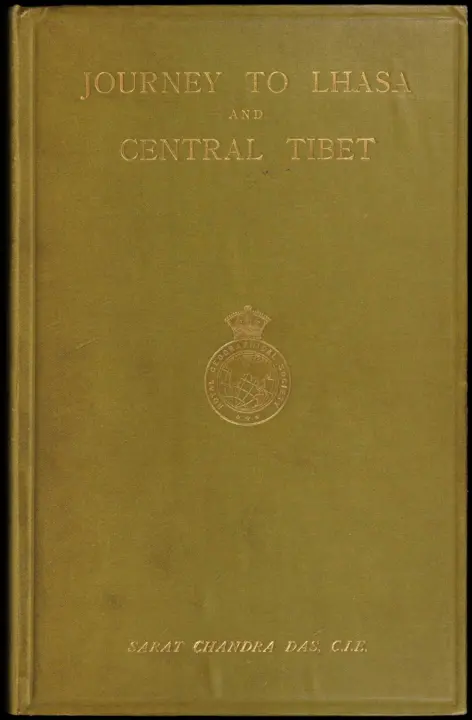
"Journey to Lhasa and Central Tibet" by Sarat Chandra Das is a travelogue published in 1902. The book chronicles Das's second expedition to Tibet in 1881, undertaken under British colonial orders. Das ventures into the forbidden Tibetan capital and central regions, documenting his observations as both explorer and covert agent. Contemporary reviews praised it as the most authentic account of Tibet available, highlighting Das's courage and keen insight into this mysterious land.
Introduction adapted from the source catalogue; source summaries may be automatically generated.
Free to read · English · 110,516 words · No account needed
MAKE TIME FOR A GOOD BOOK
On by default. Untick to stop anonymous reading totals. Each page counts after 10 seconds in view. How this works.
Anonymous counting is on unless you have switched it off.
[139] Ging-gu la, Yá-go, and Tuchung-Jong of the maps.—(W. R.)
[140] Called Shar cho ening on the maps. Shar, “east;” chyog (pyogs), “quarter.”—(W. R.)
[141] Dowa targya of the map.—(W. R.)
[142] The author is slightly mistaken here. The Gyarong is on the west border of Sze-ch’uan and identical with the Chinese Chin-chuan, while Markham is to the west of the River of Golden Sands (Chin sha chiang), in 29° N. lat., with its capital at Gartok (or Chiang-ka), and is one of the easternmost provinces ruled by Lhasa.—(W. R.)
[143] Georgi, ‘Alph. Tibet.,’ p. 450, appears to refer to Dongtse when he says, “Antequam pervenias Kiangse Feudum est Kalonii Prouse, Castellum Vallo minutum, et Aurifodina.”—(W. R.)
[144] Kon-chog sum, i.e. Buddha, the Law and the Brotherhood (Sangha). Protestant missionaries have, very wrongly, I think, used the word Kon-chog as a translation of our word God, which is as untranslatable into Tibetan as it appears to be into Chinese, unless the Mohammedan expression Chen chu, “the real Lord,” be used.—(W. R.)
[145] Or Ngi-hok, an open quadrangle on the roof of a house, enclosed on all sides by walls, in two of which are door-like openings (S. C. D.). Jaeschke explains the word nyi-yol by “any screen or shelter from the sun’s rays: awning, curtain, parasol, pent-house.”
[146] Gnas-brtan bchu-drug, the sixteen highest disciples of the Buddha
Gautama.—(W. R.)
[147] Cf. Captain Sam. Turner, op. cit., 236, and Geo. Bogle (in C. R. Markham’s ‘Narrative of the Mission, etc.,’ 97). Bogle there says, “The floor is of a chalky clay, mixed with small pebbles, and formed into a smooth and very beautiful terrace, which, by the labours of a young gylang, who every morning gets his feet upon two woollen cloths, and exercises himself for three or four hours in skating about the room, will, in the course of fifteen or twenty years, acquire a polish equal to the other floors in the palace, which are not inferior to the finest variegated marble.”—(W. R.)
[148] This image is called the Jo-vo. It is in the Lhasa Jokhang, in the centre of the city. See my ‘Land of the Lamas,’ p. 105, note 2. See also chap. vi. p. 151 of the present narrative.—(W. R.)
[149] Called in Tibetan Chos-gyong (skyong), “protectors of the doctrine,” or Ku na gyalbo, “five great kings.” See Emil Schlagintweit, ‘Buddhism in Tibet,’ p. 157.
[150] Dzabs-drung-(pa), lit., “one near the feet of.” The expression ku-drung-pa, “near the body,” is also used.—(W. R.)
[151] Mdah-dpon, “master of the arrow,” is a military officer of about the rank of a general; they are given light-blue buttons (4th class) by the Chinese authorities.—(W. R.)
Your reading position is saved on this browser. Take it to another device with a library code. Reading pages adapt to text, rather than matching a printed edition.
BEHIND THE BOOK
This eBook is for the use of anyone anywhere in the United States and most other parts of the world at no cost and with almost no restrictions whatsoever. You may copy it, give it away or re-use it under the terms of the Project Gutenberg License included with this eBook or online at www.gutenberg.org. If you are not located in the United States, you will have to check the laws of the country where you are located before using this eBook. Read the source licence.
The original source file, including credits and licence, is retained by this library. Request an original-format copy at no charge. Please include the book title and Project Gutenberg identifier #68898.
KEEP YOUR CURIOSITY GOING
Wilfrid Scawen Blunt
Wilfrid Scawen Blunt

E. W. (Edgar Watson) Howe
Francis Greenleaf Allinson & Anne C. E. (Anne Crosby Emery) Allinson
Cyrenus Cole

John Martineau