THE CLASSIC COLLECTION✦My diaries, being a personal narrative of events 1888-1914, Part 2 (1900-1914)CLASSIC FREE BOOKS
My diaries, being a personal narrative of events 1888-1914, Part 2 (1900-1914)
Wilfrid Scawen Blunt
THE CLASSIC COLLECTION · 1902
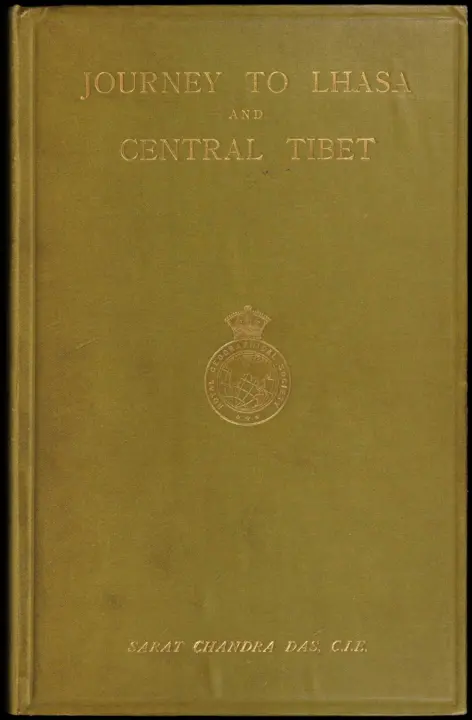
"Journey to Lhasa and Central Tibet" by Sarat Chandra Das is a travelogue published in 1902. The book chronicles Das's second expedition to Tibet in 1881, undertaken under British colonial orders. Das ventures into the forbidden Tibetan capital and central regions, documenting his observations as both explorer and covert agent. Contemporary reviews praised it as the most authentic account of Tibet available, highlighting Das's courage and keen insight into this mysterious land.
Introduction adapted from the source catalogue; source summaries may be automatically generated.
Free to read · English · 110,516 words · No account needed
MAKE TIME FOR A GOOD BOOK
On by default. Untick to stop anonymous reading totals. Each page counts after 10 seconds in view. How this works.
Anonymous counting is on unless you have switched it off.
[118] The syllable la, here and throughout this narrative, whenever it is a suffix to a name of a person, forms no part of the name, but is only an honorific expletive. It is even used after titles, as Ponbo la, Pundib la, Lhacham la, Kusho la, etc. Chandra Das hardly ever gives the names of the Tibetans he refers to in his narrative, because a person’s name is never used when he or she is addressed, nor is it but rarely mentioned. He probably never heard the names of most of the people of whom he speaks.—(W. R.)
[119] Written grog tsang, or grog-ma tsang.—(W. R.)
[120] Or Eastern (shar) gyatso.—(W. R.)
[121] Kye-na of the map.—(W. R.)
[122] Probably Shornub is shar, “east;” nub, “west.”—(W. R.)
[123] By “Grand Lama” the author means the Panchen Rinpoche or Teshu
lama of Tashilhunpo.
[124] Called on the map Gang, Jor-gya, Patshal, Pen jang. Natog does not appear on it. On p. 74 he calls Penagangdo, Penjang, and Pishi, Patal.—(W. R.)
[125] I have never heard of unam; but gonam (sgo snam?) is the name generally given to serges and foreign (Russian) broadcloth.—(W. R.)
[126] A mani lhakhang is usually a chorten around which are, under covered galleries, rows of large prayer-wheels, or rather prayer-barrels. I have never seen any temple attached to such structures; but the chortens are hollow, with an opening at the base by which clay tsa-tsa offerings can be put in the monument.—(W. R.)
[127] Doi of the maps.—(W. R.)
[128] Penam jong of the maps. Cf. Captain Turner, op. cit., 229 (he calls it Painam), and C. R. Markham, op. cit., 78, where Bogle also refers to it as Painam.—(W. R.)
[129] In Tibet a married woman is called chang-ma, or “wine companion.” One of her principal duties is to present wine to her friends and guests. It is to avoid this duty that many women enter monastic life (S. C. D.). I think S. C. D. was misinformed. A wife is called chung-ma, not chang-ma. Chung means “little,” and ma “mother.”—(W. R.)
[130] The metaphysical portion of the Tibetan Buddhist scriptures, called in Sanskrit Abhidharma.—(W. R.)
[131] Or gsol gchig, i.e. “first meal.”—(W. R.)
[132] Pe li of the maps.—(W. R.)
[133] Chog-tse of the maps.—(W. R.)
[134] See J.R.A.S., n.s., vol. xxiii. p. 220. The Dung-khors’ offices are mostly hereditary.—(W. R.)
[135] Nagpa, “enchanters or experts in incantations.” See Waddell, op. cit., 475, 483. ‘Land of the Lamas,’ p. 217.—(W. R.)
[136] Or Norbu khyung hdjin (?), “the precious garuda-holder.” The garuda (khyung) is the king of birds, according to Tibetans.—(W. R.)
[137] Pong kong of the maps.—(W. R.)
[138] Called Tho-man on the maps.—(W. R.)
Your reading position is saved on this browser. Take it to another device with a library code. Reading pages adapt to text, rather than matching a printed edition.
BEHIND THE BOOK
This eBook is for the use of anyone anywhere in the United States and most other parts of the world at no cost and with almost no restrictions whatsoever. You may copy it, give it away or re-use it under the terms of the Project Gutenberg License included with this eBook or online at www.gutenberg.org. If you are not located in the United States, you will have to check the laws of the country where you are located before using this eBook. Read the source licence.
The original source file, including credits and licence, is retained by this library. Request an original-format copy at no charge. Please include the book title and Project Gutenberg identifier #68898.
KEEP YOUR CURIOSITY GOING
Wilfrid Scawen Blunt
Wilfrid Scawen Blunt

E. W. (Edgar Watson) Howe
Francis Greenleaf Allinson & Anne C. E. (Anne Crosby Emery) Allinson
Cyrenus Cole

John Martineau